2026 UTP Cabling Guide: Why Cat6A Replaces Cat6 & Cat5e for Wi-Fi 7 & PoE++
Author: Will Publish Time: 15-01-2026 Origin: Site
2026 UTP Cable Buyer’s Guide: Why Cat6A is the New Minimum Standard
A practical 2026 playbook for engineers and buyers choosing between Cat5e, Cat6 and Cat6A in the era of Wi-Fi 7, PoE++ and AI-ready buildings.
By 2026, Cat5e/Cat6 become bottlenecks for Wi-Fi 7 and 10G backhaul.
Cat6A with pure copper and improved geometry is built for AXT and PoE++ heat.
ZION delivers testable, compliant infrastructure instead of commodity “network cable”.
■ 1) Why 2026 Matters for Copper Cabling
2026 is a tipping point for structured cabling. Multiple technology trends converge at once: Wi-Fi 7 rollouts, 2.5G/5G/10G access switches, AI-enabled edge devices and building-wide PoE++. For many existing buildings, the physical cabling has quietly become the new bottleneck.
As Wi-Fi 7 (802.11be) access points push beyond 10Gbps, and as more cameras, sensors and controllers draw power over Ethernet, legacy Cat5e – and even Cat6 in many cases – can limit the real-world throughput and reliability of the entire network.
In 2026, choosing Cat5e or Cat6 for new projects is no longer “saving money” – it is locking in a performance ceiling that your Wi-Fi 7 access layer and AI workloads will quickly hit.
■ 2) 2026 Mainstream Choices: Cat5e vs Cat6 vs Cat6A
In practice, most projects in 2026 revolve around three copper categories: Cat5e, Cat6 and Cat6A. Higher categories (Cat7/Cat8) exist but are niche and typically shielded or data-center specific.
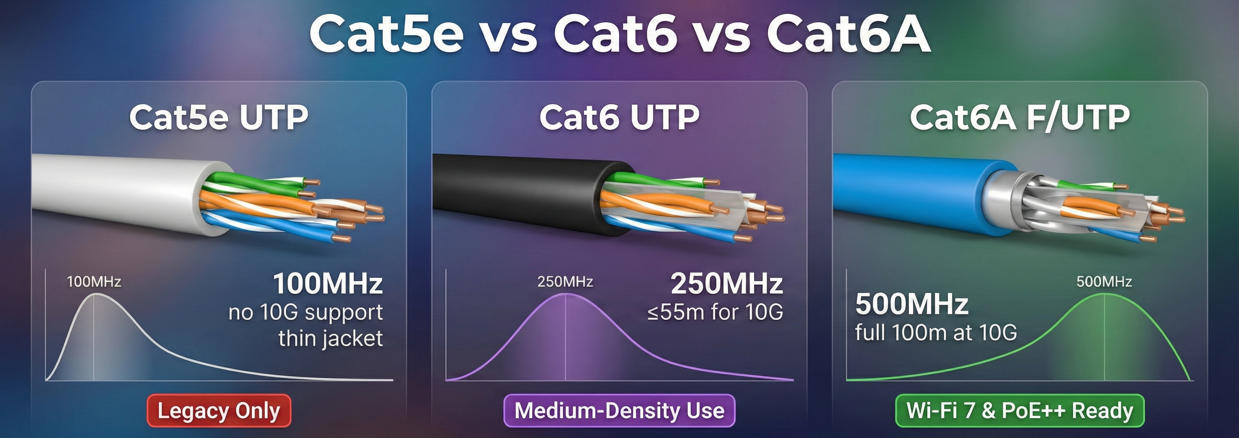
| Category | Bandwidth | 10G Support | 2026 Recommendation | Typical Physical Features |
|---|---|---|---|---|
| Cat5e UTP | 100 MHz | No 10G support | Repairs only / low-end residential | Thinnest diameter, no central spine, often imitated by CCA products |
| Cat6 UTP | 250 MHz | Up to 55 m for 10G | Small offices, low to medium density networks | 24AWG, small or partial separator, medium jacket thickness |
| Cat6A UTP | 500 MHz | Full 100 m at 10G | Wi-Fi 6/6E/7, PoE++, enterprise & smart buildings | Thicker 23AWG conductors, clear cross-separator / isolation geometry, robust outer jacket |
If your new build or renovation will live longer than five years, treating Cat6A as the baseline and Cat6 as the compromise is a safer assumption than the other way around.
■ 3) Inside Cat6A: Structure & Alien Crosstalk
Cat6A is not just “thicker Cat6”. It is a different geometry, designed specifically to survive in dense cable bundles where external noise between cables – Alien Crosstalk (AXT) – becomes the limiting factor.
How Cat6A UTP Controls Alien Crosstalk
Compared to typical Cat6, a quality Cat6A UTP cable from ZION features:
23AWG conductors for lower DC resistance and better thermal performance
More precise twist rates between pairs to minimize pair-to-pair coupling
Central cross-shaped spine or isolation elements to keep pairs physically separated
Thicker outer jacket to improve pair-to-pair isolation between adjacent cables in a bundle
This mechanical design is the reason Cat6A maintains 10G performance across full 100 m channels, even in tightly packed cable trays and filled conduits.
Cat6 usually fails in high-density bundles because of Alien Crosstalk, not just bandwidth. Cat6A is engineered from the inside out to control AXT and protect your 10G links.
■ 4) PoE++, Heat & Safety in Dense Bundles
In modern smart buildings, the same copper cables that carry data also deliver power: to Wi-Fi access points, AI cameras, access control, lighting and sensors. With PoE++ (up to 90W), heat build-up inside cable bundles becomes a real design constraint.
Why Conductor Size and Material Matter
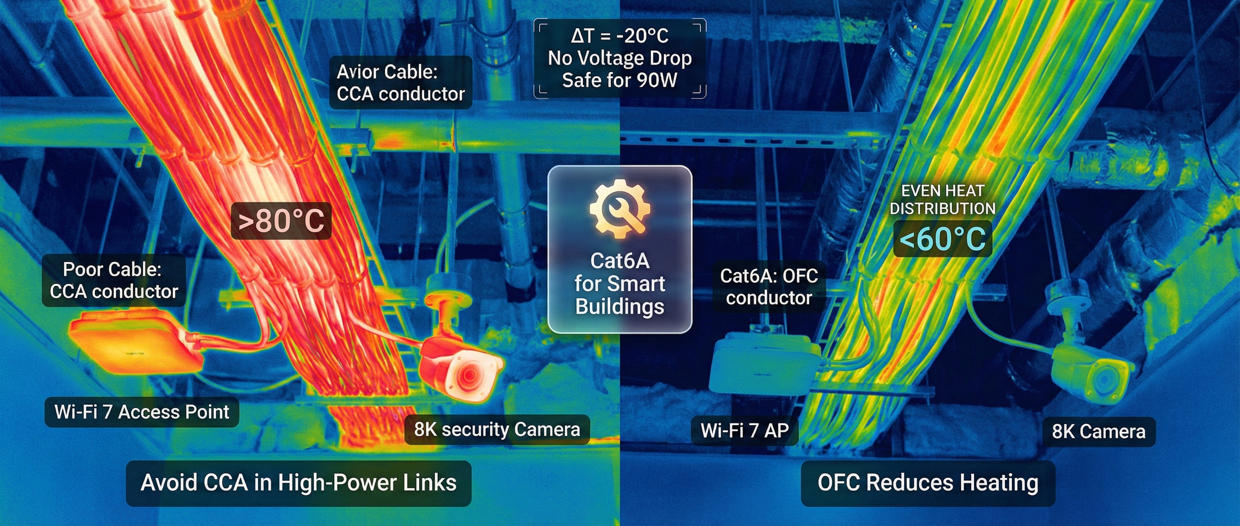
Thin-gauge conductors and CCA (copper-clad aluminium) significantly increase DC resistance, which raises temperature under load and accelerates jacket ageing. Over time, this can lead to unexpected failures and even compromised fire performance.
ZION Cat6A deploys 23AWG oxygen-free copper conductors and optimized geometry. In dense bundles, this can reduce temperature rise by 15–20% compared to undersized or CCA cables, helping maintain signal integrity and extend cable life over a ten-year horizon or more.
For PoE++ camera rings, Wi-Fi 7 ceilings or LED lighting grids, always treat conductor size and copper purity as safety parameters – not just cost parameters.
■ 5) Horizontal Cabling vs Patch Cords: Don’t Mix Line Gauges
Choosing the right conductor type for the right part of the link is essential. Solid and stranded conductors exist for different reasons, and confusing them can impact performance and durability.
| Type | Typical Gauge | Primary Use | Location |
|---|---|---|---|
| Solid conductor | 23/24AWG | Horizontal runs, backbone segments | Inside walls, conduits, trays and risers |
| Stranded conductor | 26/28AWG | Patch cords, equipment leads | Racks, cabinets, work areas and devices |
The best practice is clear: use solid Cat6A for permanent links, and stranded Cat6A patch cords for flexible terminations around devices and racks.

■ 6) UTP vs Shielded: Where Each Fits in 2026
UTP remains the default for many office and residential environments, but it is no longer a one-size-fits-all answer. Interference levels, cable density and application criticality drive the choice between U/UTP and various shielded constructions.
| Construction | Description | Typical Environments | EMI Robustness |
|---|---|---|---|
| U/UTP | Unshielded twisted pair | Homes, small and standard offices | Good |
| F/UTP | Overall foil around all pairs | Hotels, hospitals, mixed-use buildings | Better |
| U/FTP | Each pair individually foil-shielded | Wi-Fi ceilings, PoE++ grids, higher EMI | Strong |
| S/FTP | Overall braid + foil on each pair | Factories, airports, industrial plant and data halls | Maximum |
In many 2026 projects, the sweet spot is a mix: U/UTP for benign office spaces and U/FTP or S/FTP for risers, technical rooms and EMI-intense zones.
■ 7) ZION Engineering Advantages in 2026 Projects
ZION COMMUNICATION focuses on deliverable infrastructure, not just selling “cable”. For contractors, consultants and project owners, that means the combination of performance, documentation and long-term reliability.
Pure Copper, Not CCA
All ZION Cat6/Cat6A cables are manufactured with 100% oxygen-free copper (OFC). No copper-clad aluminium (CCA), no mixed metallurgy. This is critical for PoE++, long runs and compliance with professional standards.
Fluke Permanent Link & Channel Reports
ZION can provide Fluke test data not only at the Channel level, but also for Permanent Link performance – which is often required for enterprise acceptance and large tender submissions.
Fire & Environmental Compliance
Depending on region and project type, ZION offers:
CM / CMR / CMP ratings for North American markets
LSZH cables for public and critical environments
CPR B2ca / Cca options for EU building regulations
Deployment & OEM Flexibility
From 305 m pull boxes to 500–1000 m wooden drums, and with customizable jacket print and OEM labelling options, ZION supports distributors and system integrators in both retail and project-based business models.
■ 8) Decision Rules / Engineer’s Shortcut
When time is short and project requirements are evolving, use the following shortcut to choose a safe baseline for 2026 and beyond.
| Scenario | Typical Devices | Recommended Cable | Notes |
|---|---|---|---|
| Legacy residential / small SOHO | Basic Wi-Fi, low PoE | Cat6 U/UTP (limited) | Cat5e only for repair, not for new builds |
| Standard office / SMB upgrade | VoIP, 1G/2.5G access, some PoE | Cat6A U/UTP | Ready for higher AP density and PoE growth |
| Wi-Fi 6/6E/7 ceilings & PoE cameras | APs, 4K cameras, sensors | Cat6A U/FTP or F/UTP | Improved EMI and AXT control in dense bundles |
| Hospitals, airports, critical facilities | Life-safety systems, BMS, security | Cat6A S/FTP + LSZH / CPR | Focus on EMI immunity, fire & regulatory compliance |
| Data centers & AI compute rooms | ToR switches, management, KVM | Cat6A S/FTP + fiber backbone | Copper for short runs, fiber for high-bandwidth links |
Treat Cat6A as the new “minimum spec”, and then decide on UTP or shielded based on environment and regulatory requirements.
■ 9) Conclusion & Next Steps
In 2026, structured cabling decisions are no longer just about headline speeds. Wi-Fi 7, PoE++, AI-enabled endpoints and rising safety regulations all converge to make Cat6A – and particularly high-quality, pure copper Cat6A – the default choice for most professional projects.
For engineering teams and project owners, the safest strategy is simple: standardize on Cat6A for new builds and major renovations, match the shielding level to the EMI environment, and only deploy vendors that can back their products with real test reports and compliance documents.
ZION COMMUNICATION supports this strategy with a full portfolio of Cat6/Cat6A UTP and shielded solutions, permanent link test data, CPR/UL documentation and flexible OEM options for partners worldwide.
Need 2026-ready cabling for your next project?
Share your project type, target speeds, PoE requirements and regulatory constraints. Our engineering team will recommend a Cat6A / shielding mix, and provide the relevant Fluke test data and certificates.