Fiber Optic Patch Cord Standards and Certifications
Author: Site Editor Publish Time: 05-08-2025 Origin: Site
■ Fiber Optic Patch Cord Standards and Certifications
Fiber optic patch cords must follow international standards. These standards are very important. They make sure patch cords work well, are safe, and can connect with other equipment. This is true for many uses like phone networks, data centers, and factory systems.
■ Essential International Assessment for Fiber Patch Cords
Adapted Certifications for Patch Cords
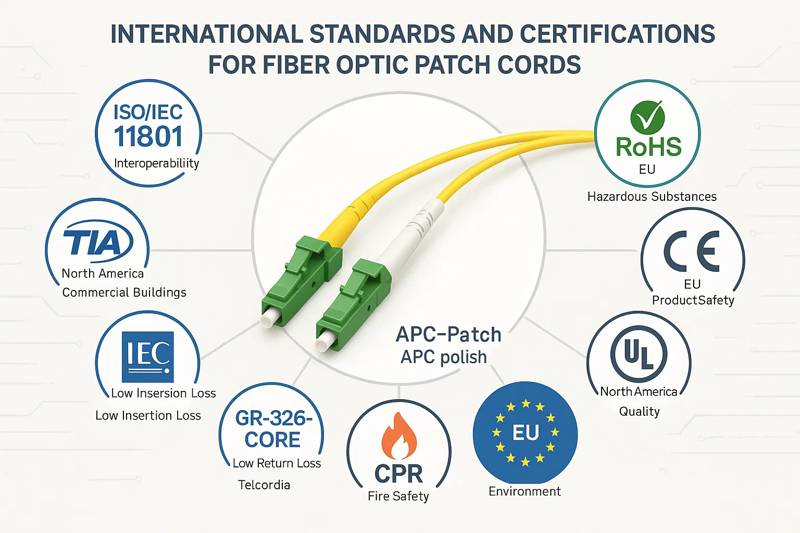
The high-quality fiber optic patch cords for the global markets should display one or more of these certifications, which show their compliance with the international standards:
Standards Related to Connectors and Ferrules
Each connector type must conform to the geometric and material specifications to achieve low insertion loss and high return loss.
PC, UPC, and APC Polish Standards: Grasp the right end-face geometry; avoid excessive reflection.
Compliance with Zirconia Ferrules: High-precision connectors utilize ceramic ferrules that meet IEC and GR-326 standards.
Interoperability Standards: Involves assurance of SC, LC, ST connectors across various manufacturers (as per IEC 61754).
Testing and Quality Assurance Protocols
The trustworthy manufacturers do the below tests through ISO 9001-certified production lines of their factories:
Insertion Loss Testing (IL) and Return Loss Testing (RL)
As per IEC 61300-3-4 and IEC 61300-3-6.
Temperature Cycling and Humidity Tests
Guarantees can be specified from -40°C to +75°C conditions.
Connector Durability Tests
To comply with GR-326, the connection must support the ≥500 mating cycles.
Visual End-Face Inspection (IEC 61300-3-35)
Ensures that the connectors are clean and checked for geometric tolerance.
![Adapted Certifications for Patch Cords]()
■ Compliance: Reasons to Follow
Patch cords that are not standard compliant:
Can lead to considerable signal loss, reflection, or mechanical failures.
Not being trusted for critical systems like 5G backhaul changes or cloud data centers.
Will regularly face rejection in Europe and North America due to errors in the manufacturing process.
■ Selecting the Manufacturer of High Repute
Make sure your fiber optic patch cable supplier:
Meets ISO 9001 and ISO 14001 quality control requirements.
Affords the test results and certification of each shipment.
Is familiar with the OEM and ODM fiber optic components business.
Will be fit for a custom patch cord requirement yet keeping the standard compliance.
■ Fiber Optic Patch Cord Standards & Certifications
Standard / Certification | Issuing Organization | Scope / Description | Region / Market | Key Benefits |
ISO/IEC 11801 | ISO / IEC | Generic cabling standard for commercial buildings | Global | Ensures interoperability and performance in structured cabling systems |
TIA-568 (EIA/TIA) | Telecommunications Industry Association (TIA) | Commercial building telecommunications cabling standards | North America | Defines fiber optic cable performance and installation guidelines |
IEC 61754 | International Electrotechnical Commission (IEC) | Fiber optic connector interface standards | Global | Ensures connector intermateability and standard interfaces |
IEC 60793 / 60794 | IEC | Optical fiber and cable specifications | Global | Defines fiber mechanical, optical, and environmental properties |
GR-326-CORE | Telcordia Technologies | Telecom-grade single-mode fiber optic connector specification | Primarily North America | Ensures durability, performance, and repeatability of connectors |
RoHS | European Union | Restriction of hazardous substances in electronic equipment | European Union (EU) | Limits toxic substances to ensure environmental and health safety |
UL Certification | Underwriters Laboratories | Safety testing for fire resistance and product safety | Mainly North America | Guarantees product safety and compliance with fire codes |
CE Marking | European Union | Product compliance with EU health, safety, and environmental requirements | European Union (EU) | Mandatory for products sold in EU markets |
CPR (Construction Products Regulation) | European Union | Fire performance classification for cables used in buildings | European Union (EU) | Ensures fire safety compliance for construction cabling |
REACH | European Union | Regulation on chemicals used in manufacturing | European Union (EU) | Controls use of hazardous chemicals to protect health and environment |
Contact us for more information

James is a technical manager and associate at Zion Communication.
Specializes in Optical Fiber communications, FTTH Solutions,
Fiber optic cables, ADSS cable, and ODN networks.
james@zion-communication.com
+86 13777460328