Cable & Wire | High quality and excellent service at reasonable prices.
info@zion-communication.com
Please Select Product Type Please Select Product Type
  • Optical Fiber Cable
    • ADSS cable
      • ADSS Single jacket
        • ADSS 80M Single Sheath

            No classification

        • ADSS 100M Single Sheath

            No classification

        • ADSS 120M Single Sheath

            No classification

      • ADSS Double sheath

          No classification

    • FTTH Drop Cable

        No classification

    • FTTH Drop Optic Patchcord

        No classification

    • Aerial Installation

        No classification

    • OPGW

        No classification

    • Duct Installation

        No classification

    • Direct Buried

        No classification

    • Air Blown Micro

        No classification

    • Cabling in Buildings

        No classification

    • Networks in Rural Areas

        No classification

    • Route Shortage

        No classification

    • Distributed Base Stations

        No classification

    • Biological Protection

        No classification

    • Fire-Resistance

        No classification

    • Fiber Optic Tether System
      • FPV Drone

          No classification

      • FPV Drone Optical Fiber Kit

          No classification

      • Fiber Optic Guidance Wire

          No classification

  • Fiber Optic Tools
    • Fiber Optic Installation Tools/Accessories/Fittings
      • ADSS Cable Guy Grips

          No classification

      • ADSS Cable Suspension Grips

          No classification

      • OPGW Cable Guy Grips

          No classification

      • OPGW Cable Suspension Grips

          No classification

      • Stainless steel strip &buckle

          No classification

      • Stainless Banding Tool

          No classification

      • Aluminum hoop&Pole Bracket

          No classification

      • Hoop Retractor&Pole Brackets

          No classification

      • Fittings

          No classification

      • Immobility Clamp

          No classification

    • FTTH Fiber Optic Tools
      • FTTH stainless steel flat drop cable clamp

          No classification

      • FTTH nylon cable flat drop cable clamp

          No classification

      • FTTH combination flat drop cable clamp

          No classification

      • FTTH Hook

          No classification

      • FTTX ADSS Suspension clamp

          No classification

      • FTTX ADSS Tension clamp

          No classification

    • Fiber Termination Tools

        No classification

    • Fiber Optic Test Tools

        No classification

    • OTDR Accessories

        No classification

    • Fiber Optic Cleaning Tools

        No classification

  • LAN/Ethernet Cable
    • CAT8

        No classification

    • CAT7 / CAT7A
      • CAT7

          No classification

      • CAT7A

          No classification

    • CAT6A
      • U/UTP

          No classification

      • U/FTP

          No classification

      • F/UTP

          No classification

      • F/FTP

          No classification

      • S/FTP

          No classification

      • CAT6A AMOUR/CST

          No classification

    • CAT6
      • U/UTP

          No classification

      • F/UTP

          No classification

      • SF/UTP

          No classification

      • Dual

          No classification

      • Armour CAT6

          No classification

    • CAT5E
      • U/UTP

          No classification

      • F/UTP

          No classification

      • SF/UTP

          No classification

      • Dual

          No classification

    • Copper Patch Cord Cable
      • CAT5E

          No classification

      • CAT6

          No classification

      • CAT6A

          No classification

      • CAT7

          No classification

      • CAT7A

          No classification

      • CAT8

          No classification

      • Special type

          No classification

    • Ethernet Plenum Cable

        No classification

    • Network Cable

        No classification

    • Copper Trunk Cable

        No classification

    • Direct-Burial Outdoor Ethernet Cables

        No classification

  • Coaxial Cable
    • Low Loss Cable

        No classification

    • RF Corrugated Coax Cable
      • 1/4"

          No classification

      • 3/8"

          No classification

      • 1/2"

          No classification

      • 7/8"

          No classification

      • 1 1/4"

          No classification

      • 1 5/8"

          No classification

    • Radiating Leaky Coaxial Cable

        No classification

    • RG MIL-C-17 Cable

        No classification

    • PTFE-FEP Coaxial Cable

        No classification

    • D-FB Coax Cable
      • D-FB cable

          No classification

      • Connectors for D-FB cable

          No classification

      • Grounding Kit, Clamp, Weatherproof for D-FB cable

          No classification

    • 75 ohm Coaxial Cable
      • RG6 coax cable
        • RG6 S

            No classification

        • RG6 Tri

            No classification

        • RG6 Q

            No classification

        • RG6 Dual

            No classification

      • RG59 coax cable
        • RG59 S

            No classification

        • RG59 Tri

            No classification

        • RG59 Q

            No classification

      • RG11
        • RG11 S

            No classification

        • RG11 Tri

            No classification

        • RG11 Q

            No classification

      • SAT coax cable

          No classification

      • HD coaxial cable

          No classification

      • VHF Leaky Feeder Cable

          No classification

      • Trunk cable/Hardline cable
        • PS

            No classification

        • QR

            No classification

      • CT coax cable

          No classification

      • KX coax cable

          No classification

      • VATC coax cable

          No classification

      • PK75 coax cable

          No classification

    • Plenum Coaxial Cable

        No classification

    • EN 50117 Coaxial Cable
      • Broadband double shield SA Class A++ >105dB

          No classification

      • Broadband Triple shield SA Class A++ >105dB

          No classification

      • Digital Drop shield SA Class A+>95dB

          No classification

      • Digital Drop shield SA Class A>85dB

          No classification

    • Coaxial Jumper Cables
      • 1/2" Super Flex Jumper Cable

          No classification

      • 1/2" Feeder Jumper Cable

          No classification

      • 3/8" Super Flex Jumper Cable

          No classification

      • 1/4" Super Flex Jumper Cable

          No classification

      • RG141 Jumper Cable

          No classification

      • RG142 Jumer Cable

          No classification

      • RG58 Jumper Cable

          No classification

    • 50 Ohm Coaxial Cable

        No classification

    • Semi-Flexible Series Cable

        No classification

  • Fire, Security & Alarm Cable
    • Fire Cables

        No classification

    • Fire Resistance Cable
      • EN50200 PH30 Cable

          No classification

      • EN50200 PH120 Cable

          No classification

      • JB-Fire Alarm Cable

          No classification

      • Standard BS 6387 Cable

          No classification

      • Standard BS 7629 Cable

          No classification

      • FRLS & FRFH
        • FRLS & FRFH Unshielded

            No classification

        • FRLS & FRFH Shielded

            No classification

      • Silicon Insulation

          No classification

    • Fire Alarm Cable
      • UL Fire alarm cable-MENA

          No classification

      • UL 1424 FPL Unshielded

          No classification

      • UL 1424 FPLR Unshielded

          No classification

      • UL 1424 FPLP Unshielded

          No classification

      • UL 1424 FPL Shielded

          No classification

      • UL 1424 FPLR Shielded

          No classification

      • UL 1424 FPLP Shielded

          No classification

      • UL 1424 Solid
        • UL 1424 Solid S

            No classification

        • UL 1424 Solid U

            No classification

      • UL 1424 Stranded
        • UL 1424 Stranded U

            No classification

        • UL 1424 Stranded S

            No classification

      • UL Standard

          No classification

    • CCTV Surveillance Cable
      • Siamese Coaxial Cable
        • RG59+2c

            No classification

        • RG6+2c

            No classification

        • Other

            No classification

      • Siamese Ethernet Cable

          No classification

      • KVK CCTV Cable
        • КВК-В-1,5

            No classification

        • КВК-В-2Э

            No classification

        • КВК-П-1,5

            No classification

        • КВК-П-2Э

            No classification

      • Custom CCTV Combined Cable
        • HD

            No classification

        • PTZ

            No classification

        • RG59

            No classification

        • MENA

            No classification

      • RG6 CCTV

          No classification

      • RG59 CCTV

          No classification

      • RG11 CCTV

          No classification

      • PK75 CCTV
        • Паракс РК 75-2-110

            No classification

        • Паракс РК 75-2-111

            No classification

        • Паракс РК 75-2-122

            No classification

        • Паракс РК 75-2-13M

            No classification

        • Паракс РК 75-2-310

            No classification

        • Паракс РК 75-2-311

            No classification

        • Паракс РК 75-3-313 нг(А)

            No classification

        • Паракс РК 75-3-314 нг(А)

            No classification

        • Паракс РК 75-3-315 нг(А)

            No classification

        • Паракс РК 75-3-316 нг(А)

            No classification

        • Паракс РК 75-3-32

            No classification

        • Паракс РК 75-3-322

            No classification

      • JIS C CCTV

          No classification

      • MINI CCTV

          No classification

      • Other

          No classification

    • Burglar Alarm cable
      • Alarm, signal cable

          No classification

      • Mylar Pair Cable

          No classification

      • Solid Cond. global alarm cable

          No classification

      • Stranded Cond.unshielded global alarm cable

          No classification

      • Stranded Cond.shielded global alarm cable

          No classification

      • UL Standard security,sound, alarm cable

          No classification

      • General Purpose

          No classification

    • Access Control Cable

        No classification

    • Fire Alarm System
      • Cables De Alarma Incendio

          No classification

      • Cabos De Alarme De IncÊndio

          No classification

    • Lutron Cables

        No classification

    • Plenum Security Cables

        No classification

  • Voice, Audio & Video Cable
    • Flat Telephone Cable

        No classification

    • Circular Audio Speaker Cable

        No classification

    • Circular Shielded Audio Cable

        No classification

    • Multicore Circular Speaker Cable

        No classification

    • Parallel Speaker Cable

        No classification

    • Media Composite Cable

        No classification

    • Coax Jumper Cable/F Type Cable

        No classification

    • Audio Speaker Cable

        No classification

    • Audio XLR Cable

        No classification

    • HDMI
      • HDMI Cable

          No classification

      • HDMI Extender

          No classification

    • DisplayPort Cable

        No classification

    • DVI Cable

        No classification

    • VGA Cable

        No classification

    • Adaptors

        No classification

  • Universal Serial Bus
    • USB C Cable

        No classification

    • USB C Converter

        No classification

    • USB Cable

        No classification

    • USB Hub

        No classification

    • USB to Serial Cable

        No classification

    • USB Bluetooth/Network/Sound Adapter

        No classification

  • Control Cable
    • Fieldbus Cable

        No classification

    • Industrial Ethernet Cable

        No classification

    • PROFINET Cable

        No classification

    • Marine LAN Cable

        No classification

    • Flexible Control Cable

        No classification

    • Chain Cable

        No classification

    • SERVO Motor Cables

        No classification

    • Robotics Cables

        No classification

  • Power & Control Cable
    • Solar Cable
      • H1Z2Z2-1 Single

          No classification

      • H1Z2Z2-1 Twin

          No classification

      • UL4703

          No classification

      • TUV 2 pfG 2642/01.22

          No classification

      • Material

          No classification

    • Battery Cable

        No classification

    • General Power Cable

        No classification

    • KNX Cable

        No classification

    • LV Armoured Cable SWA & AWA

        No classification

    • Automotive cable
      • American Standard
        • American Standard Battery Wire

            No classification

        • American Standard Primary Wire

            No classification

        • American Standard-More Type Wire

            No classification

      • Germany Standard

          No classification

      • Japanese Standard

          No classification

    • High Temperature Cable
      • Silicone 180℃ cable

          No classification

      • Silicone 200℃ cable

          No classification

      • Silicone 450℃ cable

          No classification

    • Flex Control Cable

        No classification

    • Sensor & Actuator Cables

        No classification

    • Hook Up wire

        No classification

  • other
    • Cable Materials
      • CCA WIRE

          No classification

      • CCAM WIRE

          No classification

      • Aluminum Foil

          No classification

      • Al-Mg alloy wire

          No classification

      • CCS WIRE

          No classification

      • Enameled aluminum wire(EAL)

          No classification

      • Enameled copper clad aluminum wire (ECCA)

          No classification

      • Enameled copper wire(EC)

          No classification

      • TCCA WIRE

          No classification

      • TCCAM WIRE

          No classification

      • Galvanized Steel Wire

          No classification

      • Stranded Wire

          No classification

Please select

    Please select superior classification

Please select

    Please select superior classification

Please select

    Please select superior classification
Please select

    Please select superior classification
loading

G.657.A2 Bend-Insensitive Single-Mode Optical Fiber for FTTH & Drone Fiber

  • Single-Mode Optical Fiber

  • Zion Communication

  • Fiber Optic System

  • UL, ETL, CE,CPR, RoHS

  • 50km

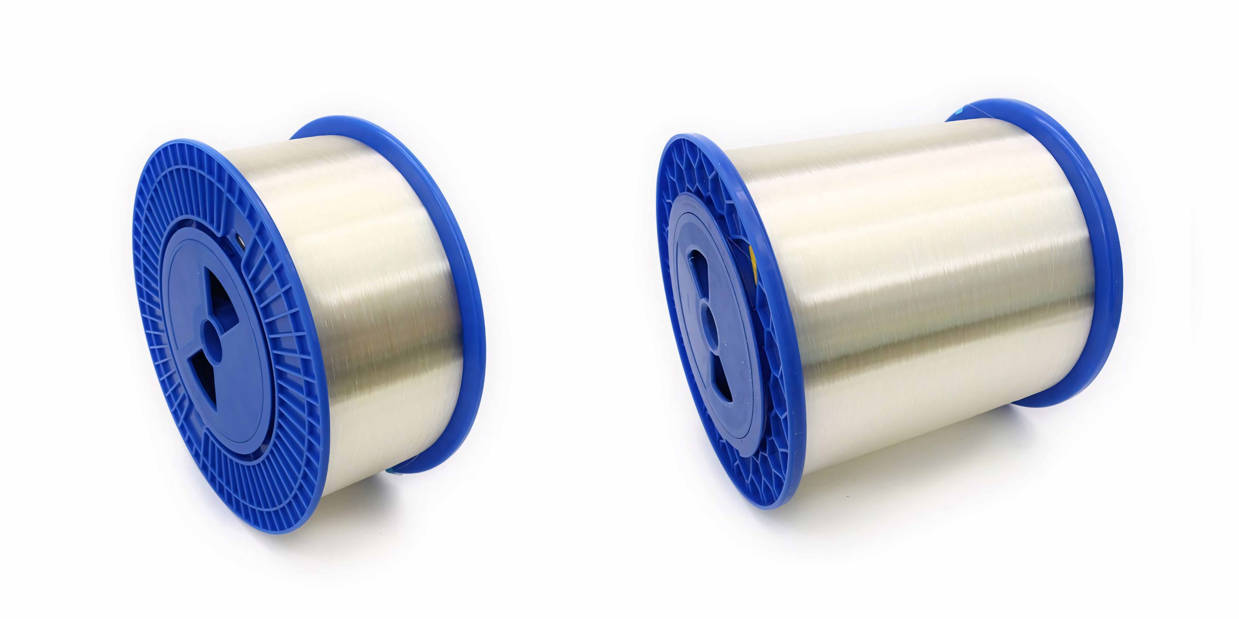
  • plastic reel/shell

  • Normally 15 working days

  • NINGBO, SHANGHAI

  • 30%TT as deposit,70%Balance before shipping.

Availability:
Optical Fiber Product Detail

G.657.A2 Bend-Insensitive Single-Mode Optical Fiber

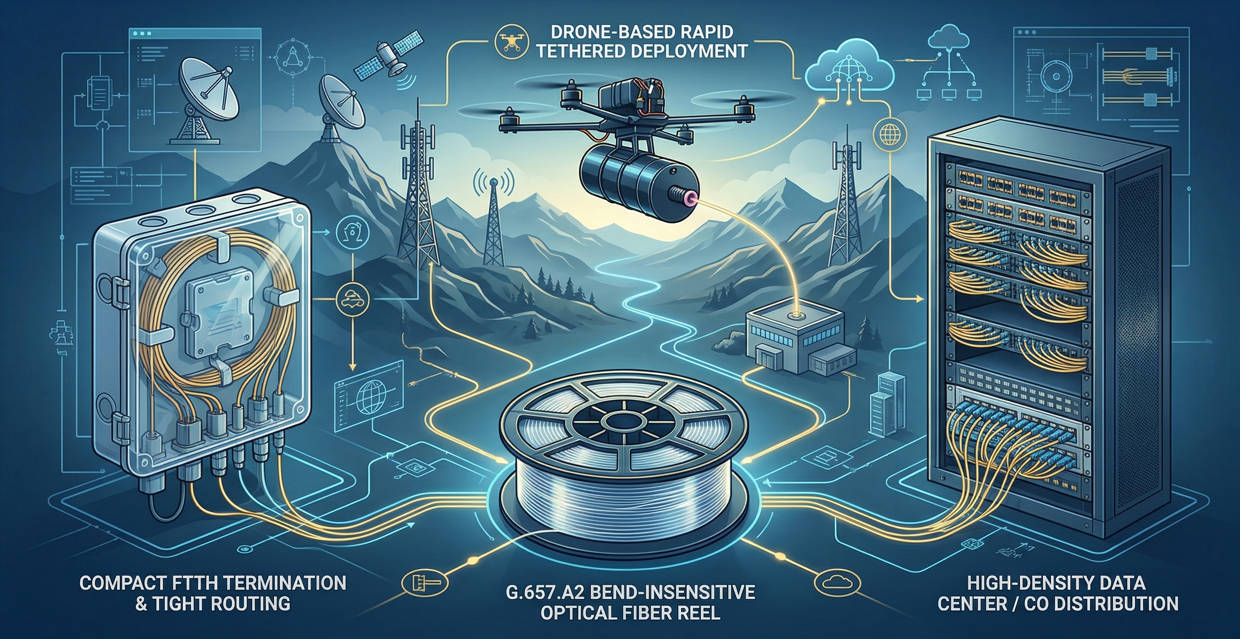
A practical single-mode fiber option for compact routing, dense fiber management, FTTH access, and reel-based systems such as drone fiber and FPV fiber tether where bend-loss control matters in real installation and maintenance conditions.

Fiber Engineers Cable Designers Procurement Teams System Integrators FTTH Projects Drone Fiber Systems
Request Datasheet / Sample          
  • Choose G.657.A2 when the project has tight routing, compact storage, or repeated field handling that raises bend-loss risk.

  • Do not treat G.657.A2 as a universal upgrade; for standard backbone routes with generous space, G.652.D or G.657.A1 may be more economical.

  • For drone fiber and FPV tether systems, the fiber type helps, but final suitability depends on complete cable design, spool geometry, tension control, and validation.

G.657.A2 Single-Mode Optical Fiber

1) Product Overview

G.657.A2 is a 125 μm cladding, low-water-peak, low-loss, bend-insensitive single-mode optical fiber intended for transmission systems operating in the 1310 nm and 1550 nm wavelength regions. In practical product selection, its main value is not a generic “better fiber” claim, but a measurable reduction of bend-related risk in compact routing, dense storage, and maintenance-sensitive environments. The standard delivery length is 50.4 km per spool.

This means G.657.A2 is most relevant when the project really has small-radius routing, limited box space, dense fiber organization, reel-based deployment, or repeated field handling. If the route is generous and bend control is easy, G.652.D is often the more cost-effective solution. If some bend improvement is needed but space pressure is moderate, G.657.A1 may already be sufficient.

Field reality / Practical rule: A2 should be specified because the installation geometry demands it, not because the name looks more advanced. The most common over-specification mistake is using A2 on normal backbone runs where routing is already well controlled.

2) Key Features

Stronger bend performance for compact routing

The most important value of G.657.A2 is its macro-bending loss performance. The product specification lists low macro-bending loss under small-radius conditions, which is why this fiber is more suitable for terminal boxes, compact fiber management, dense indoor routing, and reel-based systems than conventional single-mode fiber.

Low attenuation in standard single-mode windows

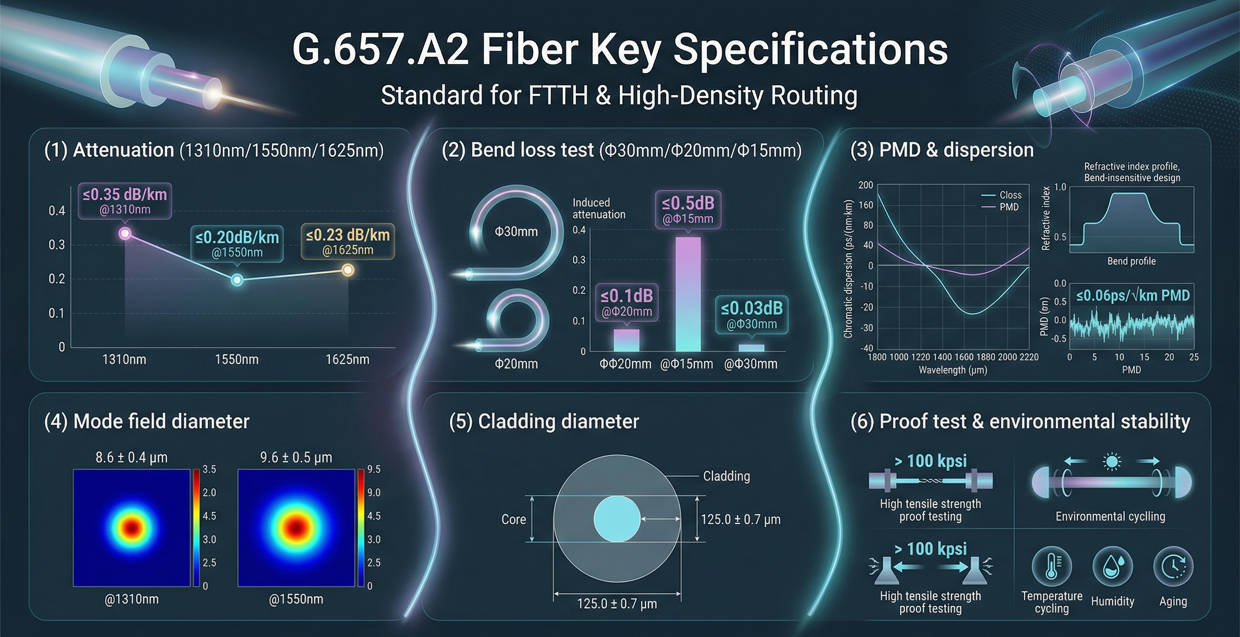
The technical sheet lists attenuation values of ≤ 0.344 dB/km at 1310 nm, ≤ 0.20 dB/km at 1550 nm, and ≤ 0.22 dB/km at 1625 nm. These values support practical single-mode system design while leaving room for monitoring and maintenance-related wavelengths.

Stable dispersion and PMD characteristics

The G.657.A2 data also provides zero-dispersion wavelength, zero-dispersion slope, chromatic dispersion, and PMD values that fit standard single-mode transmission design expectations. This matters in projects where performance consistency is more important than marketing claims.

Reliable mechanical and environmental behavior

The general specification lists proof test, coating strip force, dynamic fatigue resistance, and induced attenuation limits under temperature cycling, humidity, heat aging, and water immersion. For procurement and engineering teams, this matters because field reliability depends on more than attenuation alone.

Key takeaway: G.657.A2 is most useful when bend margin improves real installation tolerance, maintenance stability, or reel-based handling. Its benefit is strongest when geometry is tight, not when the route is already easy.

3) Technical Data

Item Typical Value / Specification Engineering Relevance
Fiber type ITU-T G.657.A2 Bend-insensitive single-mode fiber
Attenuation @1310 nm ≤ 0.344 dB/km Standard single-mode operating window
Attenuation @1383 nm ≤ 0.344 dB/km Low water peak related performance
Attenuation @1550 nm ≤ 0.20 dB/km Main low-loss transmission window
Attenuation @1625 nm ≤ 0.22 dB/km Maintenance / monitoring wavelength reference
Zero dispersion wavelength 1300–1324 nm Standard design reference
Zero dispersion slope ≤ 0.092 ps/nm²·km Dispersion stability
Dispersion @1285–1330 nm ≤ 3.5 ps/nm·km Link design reference
Dispersion @1550 / 1625 nm ≤ 18 / ≤ 22 ps/nm·km Link design reference
PMD, individual / link ≤ 0.10 / ≤ 0.06 ps/√km Transmission stability
Cutoff wavelength λcc / λc ≤ 1260 nm / 1200–1330 nm Single-mode transmission requirement
Mode field diameter @1310 nm 8.6 ± 0.4 μm Splicing and matching reference
Cladding diameter 125.0 ± 0.7 μm Standard geometry
Core/cladding concentricity error ≤ 0.5 μm Connection quality control
Proof test ≥ 100 kpsi (1.0% strain) Mechanical reliability
Coating strip force 1.3–8.9 N Processing / installation reference
Environmental induced attenuation ≤ 0.05 dB/km under cycling / humidity / heat aging / water immersion Environmental stability
Test Condition 1550 nm 1625 nm Practical Meaning
Φ30 mm, 10 turns ≤ 0.03 dB ≤ 0.1 dB Suitable for compact fiber storage
Φ20 mm, 1 turn ≤ 0.1 dB ≤ 0.2 dB Useful for dense routing and terminal boxes
Φ15 mm, 1 turn ≤ 0.5 dB ≤ 1.0 dB Shows strong bend tolerance, but not a substitute for good installation practice
G.657.A2 Fiber Key Specifications

4) Typical Applications

G.657.A2 is better suited for applications where bend tolerance has direct engineering value rather than theoretical value. Typical examples include FTTH access, compact indoor routing, terminal boxes, dense fiber management zones, maintenance-sensitive nodes, and compact pre-terminated assemblies. Its value becomes clearer when the fiber is likely to be bent, re-handled, stored tightly, or deployed in space-limited structures.

Field reality / Practical rule: The most relevant application question is not “Can A2 work here?” but “Will bend margin reduce operational risk here?” That question is especially important in access boxes, dense cross-connect areas, and reel-based systems.

5) Drone Fiber / FPV Tether Use

G.657.A2 can also be a practical candidate for drone fiber optic cable, FPV fiber tether, and reel-based lightweight fiber systems. The reason is straightforward: these systems often use smaller spools, tighter winding geometry, repeated deployment and recovery, and more field handling uncertainty than static installed links. In those conditions, stronger macro-bending performance has real operational value.

That said, the fiber type alone does not qualify a complete drone tether system. Final suitability still depends on total cable weight, cable diameter, reinforcement design, outer jacket, reel mechanics, dynamic tension control, repeated winding life, connector protection, and actual insertion-loss / OTDR validation. The fiber’s optical and mechanical characteristics support this direction, but they do not by themselves certify a full drone cable design.

Scenario Prioritize G.657.A2? Why Note
FPV fiber tether Yes Small spool diameter, repeated deployment, bend-loss sensitivity Complete cable validation still required
Drone reel-based fiber system Yes Tighter winding geometry and dynamic handling Check tension, torsion, and life cycle
Lightweight micro-cable direction Yes Better fit for compact routing structures Balance weight with protection
Nearly static aerial or fixed route Not necessarily A2 advantage may not convert into real operational benefit Evaluate A1 or G.652.D if cost dominates
Key takeaway: In drone fiber projects, A2 is helpful because it improves bend margin, not because it eliminates the need for full cable engineering. Spool diameter, dynamic tension, and whole-cable validation still control the final result.

6) Application / Selection Guidance

Use Scenario Prioritize G.657.A2? Why Alternative
FTTH access, building risers, compact terminal boxes Yes Tight routing and smaller management space No better mainstream substitute in tighter routing cases
Indoor high-density routing and patching Yes Lower bend-loss risk in compact layouts G.657.A1 if routing is less constrained
Compact pre-terminated assemblies Yes Better margin in tight internal routing G.657.A1 for more cost-sensitive designs
Standard campus backbone or normal duct route Not necessarily Bend performance may not justify added cost G.652.D
Conventional long-distance single-mode link Usually no Cost and standard transmission often matter more G.652.D
Moderate bend-sensitive project without extreme space pressure Depends A1 may already be sufficient G.657.A1
Repeated maintenance and frequent re-handling Yes Better tolerance against handling risk A1 only if risk is lower
Drone fiber / FPV tether / reel-based lightweight fiber system Yes Small spool diameter and repeated deployment increase bend sensitivity A1 if spool is larger and cost is prioritized
Decision Item Cost Impact Risk Impact Maintainability Impact Procurement Guidance
Use G.657.A2 instead of G.652.D Usually higher Lower bend-related risk in compact environments Better for maintenance-sensitive nodes Use only where tight routing is real
Use G.657.A2 instead of G.657.A1 Slightly higher Lower risk in tighter layouts Better margin in dense routing Prefer A2 when bend pressure is clearly higher
Order standard 50.4 km spool Most stable Lower misunderstanding risk Easier batch control Best default product-page rule
Request non-standard spool length May increase scheduling cost Higher order-confirmation risk No direct gain Confirm length and packing before PO
Ignore link budget and focus only on bend claims May distort selection Higher field troubleshooting risk Harder diagnosis later Validate with OTDR, IL, and real design budget
Assume 60.4 km is standard Can create spec error Higher commercial dispute risk No direct gain Default to 50.4 km unless otherwise confirmed

G.657.A2 Fiber Application Selection Guidance

7) Decision Rules / Engineer’s Shortcut

Decision Condition Choose G.657.A2 When Do Not Prioritize G.657.A2 When Alternative Cost / Risk / Maintainability Impact
Tight minimum bend radius and compact termination space Yes Not applicable No better standard substitute in tight cases Higher cost, lower bend-loss and rework risk
Indoor routing or access boxes with repeated maintenance Yes Not applicable A1 only when handling risk is lower Better maintenance tolerance
Standard duct backbone or normal long-distance route Usually no Yes G.652.D Lower cost and common standard choice
Some bend sensitivity but not extremely compact routing Possibly If bend control is manageable G.657.A1 Often the balance point between cost and bend performance
Single-mode architecture with dense routing concern Yes Not applicable A1 or G.652.D depending on space Better risk margin in compact routing
Highly cost-sensitive project with well-controlled bend radius Usually no Yes G.652.D Lowest procurement cost, but stricter installation discipline needed
Drone spool is small and deployment is repeated Yes If the system is nearly static and spool diameter is large A1 or G.652.D depending on design A2 adds cost but improves handling margin and small-spool stability
Spool length, packaging, and test documents are not fixed yet Do not lock the order yet Yes Clarify specification first Main risk is unclear commercial definition, not fiber type itself
Field reality / Practical rule: If the project team cannot clearly describe minimum bend condition, storage geometry, maintenance frequency, or spool handling requirement, the fiber discussion is incomplete. In those cases, specification clarification is more urgent than model comparison.

8) Packaging and Delivery

The product technical sheet shows a standard delivery length of 50.4 km per spool. The packing comparison information also shows a 60.4 km packing option, but the safer product-page wording is to treat 50.4 km as the standard default and state that other spool lengths are subject to order confirmation.

Item Data
Length per spool 50.4 km
With plastic reel 4.08 kg
With plastic shell 4.38 kg
Single spool box size 190 × 290 × 275 mm
Carton quantity 5 reels / box
Shipping carton size 515 × 600 × 315 mm
Carton weight 25 kg / box
Boxes per pallet 28 boxes
Spools per pallet 140 spools
Total length per pallet 7056 km
Pallet size 1.03 × 1.23 × 2.35 m
Pallet weight 725 kg
40HQ loading 20 pallets
Total spools per 40HQ 2800 spools
Total length per 40HQ 141120 km
Key takeaway: For commercial accuracy, the safest wording is: Standard delivery length 50.4 km per spool; other spool lengths, labels, and packaging arrangements are subject to order confirmation.

9) FAQ

1. When should I choose G.657.A2 instead of G.652.D?

Choose G.657.A2 when the project involves tight routing space, small bend radius, dense fiber management, compact terminal boxes, reel-based deployment, or repeated maintenance handling. If routing is spacious and bend control is easy, G.652.D is often the more economical option.

2. Can G.657.A2 be used in existing single-mode networks or spliced with G.652.D systems?

The data shows G.657.A2 as a 125 μm cladding single-mode optical fiber for standard single-mode transmission windows. In real projects, compatibility should still be verified through splice loss, link budget, installation quality, and field test results rather than assumed from the fiber name alone.

3. What standards or certifications can be confirmed from the current documents?

The technical sheet states compliance with ISO9001 and presents the fiber under ITU-T G.657.A2 technical criteria. If the project requires additional approvals, environmental compliance, or customer-specific certification documents, those should be confirmed separately before order release.

4. What customization can be confirmed from the current files?

The current files directly support a standard delivery length of 50.4 km per spool and related packaging data. Other spool lengths, labels, and packaging arrangements should be treated as order-specific and confirmed before production.

5. What about MOQ and lead time?

The current product documents do not define a fixed MOQ or standard lead time. A practical product-page statement is: standard delivery length is 50.4 km per spool, while MOQ, lead time, non-standard spool length, and packaging are subject to order confirmation.

6. What should engineers focus on for testing and maintenance?

Testing should include attenuation against link budget, splice and connector stability, storage or reel bend condition, insertion-loss and OTDR consistency, and repeated handling effects during maintenance. G.657.A2 improves bend tolerance, but it does not replace proper installation discipline.

7. Is G.657.A2 suitable for drone fiber optic cable or FPV fiber tether applications?

Yes, it can be a suitable fiber-type candidate for drone fiber optic cable, FPV fiber tether, and reel-based lightweight fiber systems, especially where small spool diameter, repeated deployment, and bend-loss control matter. Final suitability still depends on the complete cable design.

8. What should be checked in addition to choosing G.657.A2 for a drone fiber project?

In addition to the fiber type, engineers should verify spool diameter, dynamic tension, repeated winding and unwinding performance, total cable weight, reinforcement design, outer jacket structure, connector protection, and field test results such as insertion loss and OTDR performance.

10) Conclusion

G.657.A2 is a practical single-mode fiber choice when the project has real bend-related constraints: compact boxes, dense indoor routing, maintenance-sensitive access points, reel-based deployment, or drone fiber systems that require tighter winding geometry and better bend-loss control. It should not be positioned as a universal upgrade for every single-mode application. The better decision rule is simple: use A2 when smaller-radius handling, repeated re-routing, or compact storage is likely to affect real link behavior; use G.652.D or G.657.A1 when routing conditions are easier and cost efficiency matters more. For procurement, the most important execution items remain spool length, packaging definition, test documentation, and any non-standard delivery conditions before order release.

FINAL CTA

Send your target application and key parameters so the fiber choice can be matched to real installation conditions instead of generic assumptions. Useful inputs include: application type, minimum bend condition, spool diameter, link length, required delivery length, cable structure target, and whether the project is for FTTH, indoor routing, or drone / reel-based deployment.

Previous: 
Next: 
CONTACT US
Professional OEM - Zion Communication
picture1

Request a Quote
Contact Us
We use cookies to enable all functionalities for the best performance during your visit and to improve our services by giving us some insight into how the website is being used. Continued use of our website without changing your browser settings confirms your acceptance of these cookies. For details, please see our privacy policy.
×