Industrial Ethernet Cable Guide: How to Choose the Right Cable
Author: Site Editor Publish Time: 28-04-2026 Origin: Site
Industrial Ethernet Cable Guide: How to Choose the Right Cable for Harsh Environments
A practical engineering guide for selecting industrial Ethernet cables by environment, shielding, jacket material, connector type, flexibility, PoE requirements and long-term reliability.
Industrial Ethernet cable is not just a stronger office cable; it must resist EMI, oil, vibration, bending, moisture and temperature stress.
Shielding, jacket material and connector type are often more important than category alone.
For factories, automation lines and outdoor cabinets, choose cable based on the real installation environment, not only Cat5e, Cat6 or Cat6A rating.
■ Quick Answer
Industrial Ethernet cable is designed for network communication in harsh environments such as factories, automation lines, outdoor cabinets, machines, transportation systems and industrial control panels. Compared with standard office Ethernet cable, it usually requires stronger jackets, better shielding, wider temperature resistance, higher mechanical durability and more secure connectors.
The best cable choice depends on the application. A fixed control cabinet may only need a shielded industrial Cat5e or Cat6 cable, while a moving robot arm may require high-flex cable with oil-resistant jacket and strong strain relief. Outdoor or wet environments may require UV-resistant, waterproof or ruggedized cable assemblies.
Do not choose industrial Ethernet cable by category alone. Start with the environment: EMI, oil, temperature, movement, moisture, connector protection and PoE load.
■ What Is Industrial Ethernet Cable?
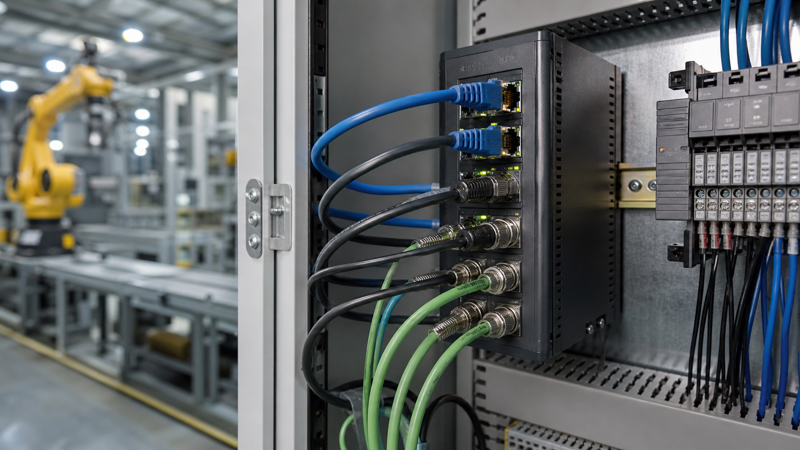
Industrial Ethernet cable is a copper network cable used to transmit Ethernet data in industrial environments. It can support common network standards and industrial communication systems while providing stronger environmental protection than standard office cabling.
Typical applications include PLC communication, machine vision, industrial switches, IP cameras, sensors, robots, control cabinets, automation lines and industrial IoT devices.
Data Transmission
Supports Ethernet communication between controllers, switches, sensors and industrial devices.
Environmental Protection
Designed to resist oil, abrasion, vibration, moisture, UV exposure or temperature stress depending on jacket and construction.
Stable Operation
Improves network reliability where office-grade cables may fail due to EMI or mechanical stress.
■ Industrial vs Commercial Ethernet Cable
Commercial Ethernet cable is suitable for offices, data rooms and normal indoor environments. Industrial Ethernet cable is selected when the cable must survive environmental and mechanical stress.
| Comparison Item | Commercial Ethernet Cable | Industrial Ethernet Cable | Decision Logic |
|---|---|---|---|
| Environment | Office, data room, indoor cabling | Factory, machine, outdoor cabinet, automation line | Use industrial cable when environment is unstable or harsh. |
| EMI Protection | UTP often acceptable | Shielding often required | Motors and drives can create strong interference. |
| Jacket Strength | Standard PVC or LSZH | PVC, PUR, TPE, PE or special jacket | Choose jacket based on oil, abrasion, UV and chemicals. |
| Movement | Mostly fixed | Fixed, flexing or continuous motion | Moving applications need high-flex design. |
| Connector | RJ45 commonly used | RJ45, M12 or ruggedized connector | M12 is preferred where vibration or waterproof protection is needed. |
■ Key Selection Factors
Industrial Ethernet cable selection should follow the installation environment. The table below summarizes the most important buying factors.
| Selection Factor | What to Check | Why It Matters | Common Mistake |
|---|---|---|---|
| Cable Category | Cat5e, Cat6, Cat6A | Determines bandwidth and network performance margin. | Choosing category without checking environment. |
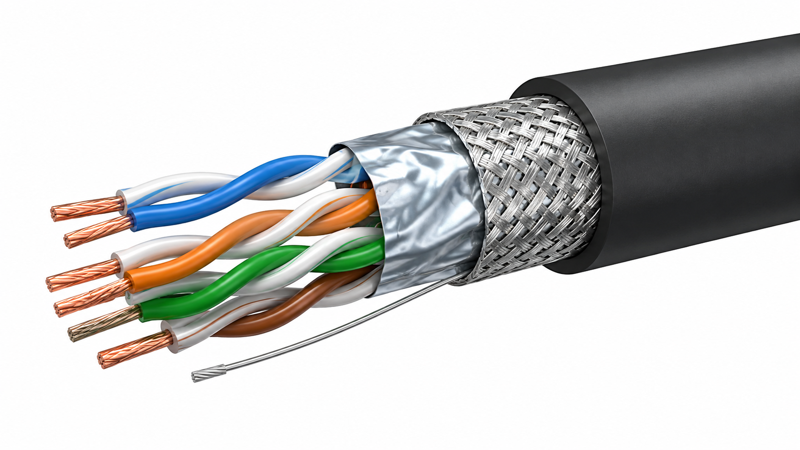
| Shielding | UTP, FTP, STP, S/FTP | Protects against EMI in industrial areas. | Using UTP near motors or VFD equipment. |
| Jacket Material | PVC, PUR, TPE, PE, LSZH | Affects oil resistance, flexibility, UV resistance and flame performance. | Using normal PVC in oil-heavy or outdoor areas. |
| Flex Requirement | Fixed, flexible, high-flex, drag chain | Moving machines require cables built for repeated bending. | Using fixed cable on moving equipment. |
| Connector Type | RJ45, M12 D-coded, M12 X-coded | Affects vibration resistance, sealing and installation space. | Using office RJ45 where rugged locking is needed. |
| PoE Requirement | PoE, PoE+, PoE++ power level | Higher power increases cable heat and voltage-drop concerns. | Ignoring AWG, conductor material and bundle heat. |
■ Jacket Material and Environment
Jacket material is one of the most important choices for industrial Ethernet cable. It determines how well the cable resists oil, abrasion, sunlight, moisture, chemicals and mechanical wear.
| Jacket Material | Typical Strength | Typical Use | Buyer Note |
|---|---|---|---|
| PVC | Cost-effective, general industrial use | Control cabinets, indoor fixed wiring | Check oil and temperature requirements carefully. |
| PUR | Oil-resistant, abrasion-resistant, flexible | Machine tools, robots, automation lines | Good option for demanding industrial movement. |
| TPE | Flexible and low-temperature friendly | Flexible equipment and outdoor industrial use | Confirm chemical and flame performance. |
| PE | Moisture and outdoor resistance | Outdoor cabinets, external routes | Check UV resistance and flame rating if used indoors. |
| LSZH | Low smoke and halogen-free performance | Transit, public buildings, enclosed spaces | Useful where smoke and halogen control matters. |
■ Shielding and EMI Protection
Industrial sites often contain motors, variable-frequency drives, welding equipment, power cables and electrical cabinets. These sources can create electromagnetic interference that affects network stability.
Recommended near motors, drives, industrial power lines and control cabinets with EMI risk.
Shielded cable needs proper grounding. Poor grounding can reduce shielding benefit.
Unshielded cable near strong industrial interference may cause unstable communication.
For many industrial projects, shielded Cat5e or Cat6 is enough. For higher-speed links, dense cabinets or future-ready installations, shielded Cat6A may provide better margin.
■ RJ45 vs M12 Connectors
Connector choice is critical in industrial Ethernet systems. RJ45 is common and familiar, while M12 connectors provide rugged locking and better protection for vibration, moisture and machine-level use.
| Connector Type | Best For | Strength | Buyer Note |
|---|---|---|---|
| Industrial RJ45 | Cabinets, switches, panels, standard Ethernet equipment | Easy to use and widely compatible | Choose shielded or ruggedized RJ45 when needed. |
| M12 D-coded | Industrial Ethernet up to 100 Mbps in many automation systems | Rugged screw-locking and vibration resistance | Common in sensors and industrial devices. |
| M12 X-coded | Gigabit and high-performance industrial Ethernet | Better high-speed performance in rugged environments | Useful for machine vision and higher-bandwidth applications. |
■ Industrial Ethernet Cable Risk Levels
Use the following risk guide to quickly evaluate whether a standard cable is enough or an industrial cable is required.
Indoor cabinet, stable temperature, no oil, low EMI, fixed cable route and protected equipment.
Moderate EMI, occasional vibration, cable tray installation, limited oil exposure or outdoor cabinet route.
Moving machinery, drag chain, heavy oil, outdoor UV, water exposure, high EMI or frequent mechanical stress.
■ Decision Rules / Engineer’s Shortcut
The correct cable is the one that matches the environment, not the one with the highest category printed on the jacket.
| Application | Recommended Cable Choice | Reason | Checkpoint |
|---|---|---|---|
| Control cabinet | Shielded Cat5e or Cat6 industrial cable | Good balance of cost and reliability. | Check grounding and cable routing. |
| Factory automation line | Shielded cable with oil-resistant jacket | Protects against EMI and industrial contamination. | Confirm jacket material and temperature range. |
| Robot or moving equipment | High-flex industrial Ethernet cable | Built for repeated bending and movement. | Check bend radius and flex cycle requirement. |
| Outdoor cabinet | UV-resistant and moisture-resistant cable | Outdoor exposure affects jacket life. | Check waterproof connector and IP rating. |
| Machine vision | Cat6A or high-performance industrial Ethernet cable | Higher bandwidth and stable data transmission. | Check connector locking and EMI protection. |
Cabinet = shielded industrial cable. Motion = high-flex cable. Oil = PUR or oil-resistant jacket. Outdoor = UV and moisture resistance. Vibration or water = M12 or ruggedized connector.
■ OEM Ordering Notes
For OEM buyers, industrial Ethernet cable should be specified with a complete application profile. A simple description such as “Cat6 industrial cable” is not enough for reliable production and delivery.
Cable Construction
Confirm Cat5e/Cat6/Cat6A, conductor size, solid or stranded, shielding type, pair construction and cable OD.
Environment Requirement
Confirm oil, UV, moisture, temperature, abrasion, flexing, EMI and installation route requirements.
Connector and Packaging
Confirm RJ45, M12, shielded connector, cable length, overmold, label, barcode, OEM brand and carton packing.
A good RFQ should include cable category, shielding, jacket material, connector type, flex requirement, temperature range, oil/UV/water resistance, PoE requirement and testing standard.
■ FAQ
What is industrial Ethernet cable used for?
It is used for Ethernet communication in factories, automation systems, control cabinets, machines, sensors, industrial switches and outdoor industrial networks.
Is industrial Ethernet cable different from normal Ethernet cable?
Yes. Industrial cable usually has stronger shielding, tougher jacket materials, wider environmental resistance and more rugged connector options.
Should industrial Ethernet cable be shielded?
Shielding is recommended when the cable is installed near motors, drives, power lines, welding equipment or other EMI sources.
When should I choose M12 instead of RJ45?
Choose M12 when vibration, waterproof protection, rugged locking or machine-level connection reliability is required.
What jacket is best for industrial Ethernet cable?
It depends on the environment. PUR is often suitable for oil and abrasion resistance, PE for outdoor moisture resistance, and LSZH for low-smoke requirements.
What should buyers confirm before ordering?
Confirm cable category, shielding, jacket, connector, flex requirement, temperature range, oil/UV/water resistance, PoE level, length and test requirement.
Need Industrial Ethernet Cable for Your Project?
ZION Communication can support industrial Ethernet cables, shielded network cables, RJ45 cable assemblies, M12 cable assemblies and customized copper cabling solutions for automation, factory networks, outdoor cabinets and OEM projects.