Fiber cable projects now need network resilience planning because physical communication routes face more pressure from cable cuts, extreme weather, route concentration, construction damage and maintenance complexity. For buyers, resilience is not only a network design topic. It affects how ADSS cable, duct fiber optic cable, FTTH drop cable and ODN accessories should be selected before purchasing. A resilient project should reduce single-route dependence, match cable structure to the real installation environment, keep ODN points maintainable and prepare enough documentation and spare capacity for future repair.
What network resilience means in a fiber cable project
Network resilience is the ability of a communication network to maintain service, reduce failure impact and recover quickly after abnormal conditions. In a fiber cable project, resilience is not created by one cable type alone. It is the result of route planning, cable structure, ODN layout, termination quality, spare capacity and maintenance documentation.
A project may use high-quality fiber cable but still have poor resilience if the route has no backup, the closure layout is confusing or the drop cable is not suitable for field conditions. Procurement teams therefore need to look beyond fiber count and initial price.
| Planning area | Resilience question | Procurement impact |
|---|---|---|
| Route design | Can service continue or recover quickly if this route is damaged? | May require route diversity, spare fibers or better documentation. |
| Cable structure | Does the cable match aerial, duct, indoor or outdoor exposure? | Affects ADSS, duct cable, drop cable and sheath selection. |
| ODN layout | Can technicians identify, access and repair fibers quickly? | Affects closure, splitter box, distribution box and labeling choices. |
| Expansion planning | Will the network need new users, new routes or service migration? | May require spare capacity and standardized accessories. |
Why the discussion starts with submarine cable security
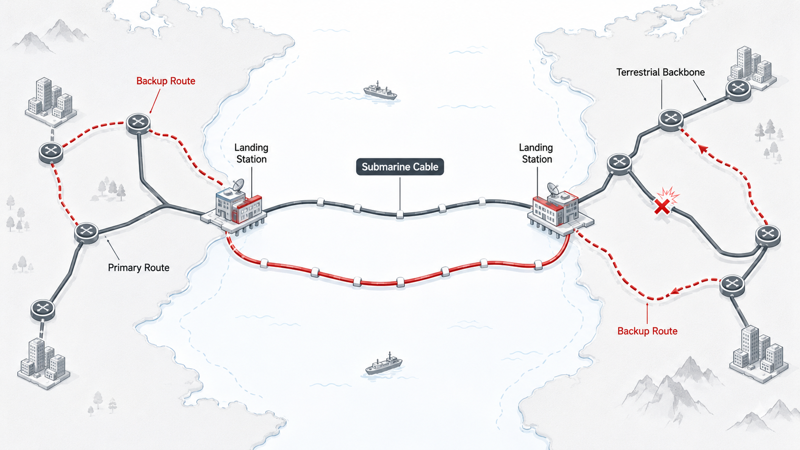
Submarine cable security is often discussed at national or international level, but the practical lesson also applies to ordinary terrestrial fiber networks. Communication services depend on physical routes. When a major route is damaged and alternatives are limited, the impact becomes larger and restoration becomes slower.
For city access networks, industrial parks, campus backbones and FTTH rollout areas, the same principle matters. A critical route should not be planned only around the shortest path or the lowest installation cost. It should also be reviewed for exposure, repair access and route concentration risk.
Resilience planning does not always mean buying more cable. It means buying the right cable for the route, reserving capacity where the network is critical and making sure maintenance teams can restore service without unnecessary delay.
How FTTH redundancy changes access network procurement
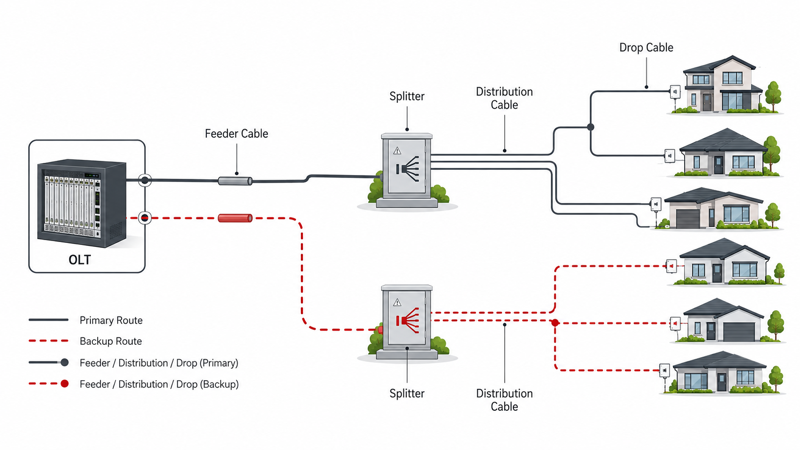
FTTH networks are often built under strong cost pressure. That makes practical resilience planning even more important. If every cost-saving decision reduces future repair speed, the long-term operating cost may become higher than expected.
FTTH resilience should be considered in three layers: feeder and distribution route planning, ODN design and the last drop section. Critical feeder routes may need alternative paths or spare fibers. ODN cabinets and boxes should support clear port identification. Drop cable should match the actual installation route, whether it is indoor, outdoor wall-mounted, aerial or used at building entry points.
Why ODN maintenance is where resilience becomes visible
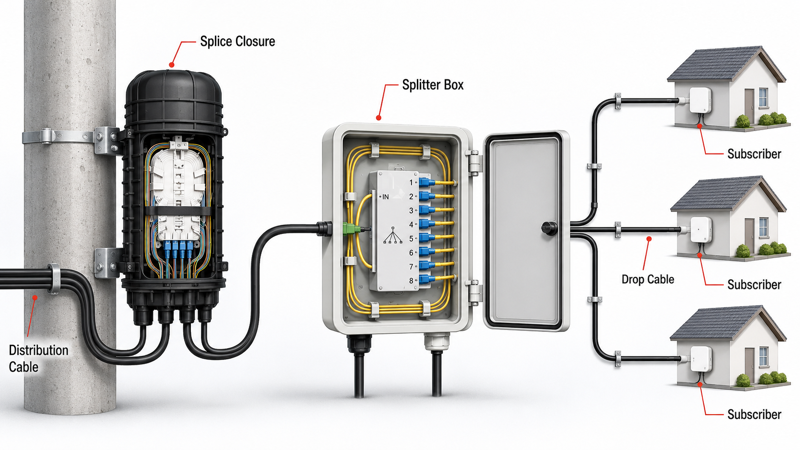
Many network problems are not caused by the optical fiber itself. They are caused by poor maintenance conditions. A distribution box may lack clear port numbering. A splice closure may not reserve enough space for future splicing. A drop cable route may not be recorded correctly. These issues may not appear during project acceptance, but they can increase repair time later.
ODN accessories are therefore part of resilience planning. Splice closures, fiber distribution boxes, splitter boxes, patch panels, adapters, pigtails, cable clamps and protection sleeves all affect how quickly technicians can test, identify and repair the network.
How to select ADSS, duct fiber, FTTH drop cable and ODN accessories
Each cable family supports a different part of the network. Procurement teams should match product selection to route exposure, mechanical stress, installation method and maintenance requirements.
| Product family | Typical use | Selection focus | Resilience value |
|---|---|---|---|
| ADSS fiber optic cable | Aerial routes along poles or utility corridors | Span length, tensile strength, jacket, UV exposure, wind and ice load | Supports aerial deployment without metallic messenger wire in many applications. |
| Duct fiber optic cable | Underground duct networks, campus routes and city access routes | Duct condition, pulling distance, water blocking, cable diameter and sheath material | Improves route protection and can make future replacement easier when ducts are well planned. |
| FTTH drop cable | Last-mile connection to subscriber side or building entry | Indoor or outdoor use, bending performance, strength member, sheath and termination method | Reduces service calls when the exposed last section matches real installation conditions. |
| ODN accessories | Splicing, splitting, distribution, patching and cable management | Sealing, capacity, cable entry, splitter space, adapter type and labeling area | Improves repair speed, expansion flexibility and field maintenance clarity. |
Confirm span, tensile requirement, pole condition, weather exposure and whether the route is near power lines.
Confirm duct size, pulling distance, water blocking needs, cable diameter and future expansion plans.
Confirm indoor or outdoor use, wall or aerial routing, connector requirement and batch packaging method.
Confirm cable entry, splice capacity, splitter space, adapter type, mounting method and labeling plan.
Procurement checklist before RFQ
A clear RFQ helps suppliers recommend the right cable structure and compatible accessories. It also reduces quotation errors, unnecessary substitutions and field installation conflicts.
| RFQ item | Information to provide | Why it matters |
|---|---|---|
| Route type | Aerial, duct, direct burial, indoor, outdoor wall or mixed route | Determines cable structure, sheath and accessory selection. |
| Fiber count | Required fibers plus spare fibers for future growth | Supports expansion and emergency rerouting options. |
| Mechanical exposure | Pulling distance, span, tensile load, crush risk or repeated handling | Prevents under-specified cable selection. |
| Environmental exposure | UV, water, temperature, rodent risk, indoor fire requirement or outdoor route condition | Helps confirm sheath and protection requirements. |
| ODN layout | Closure capacity, splitter plan, box mounting and adapter type | Improves maintainability and future expansion. |
| Documentation | Drum number, jacket printing, cable list and as-built records | Helps maintenance teams trace and repair the network faster. |
Related ZION products for this application
For resilience-focused fiber projects, buyers usually need more than one product family. The following ZION product categories can be reviewed together according to route condition and ODN layout.
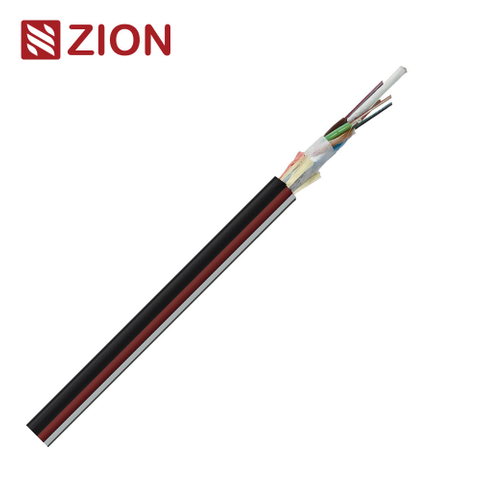
ADSS fiber optic cable
Used for aerial fiber routes where span, tensile strength and outdoor exposure must be considered before purchasing.
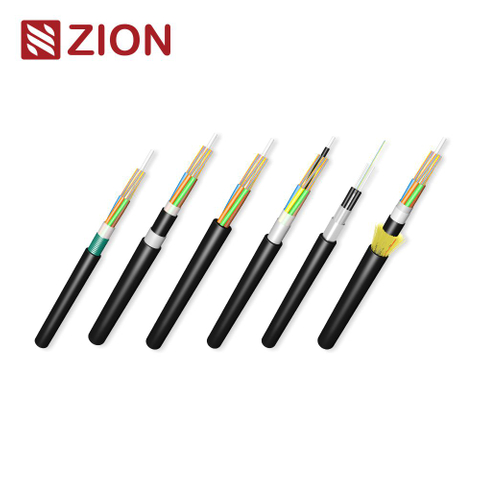
Duct fiber optic cable
Suitable for protected underground routes where pulling distance, water blocking and duct condition affect reliability.

FTTH drop cable
Used for subscriber-side connections where bending, handling, sheath type and termination method affect service reliability.
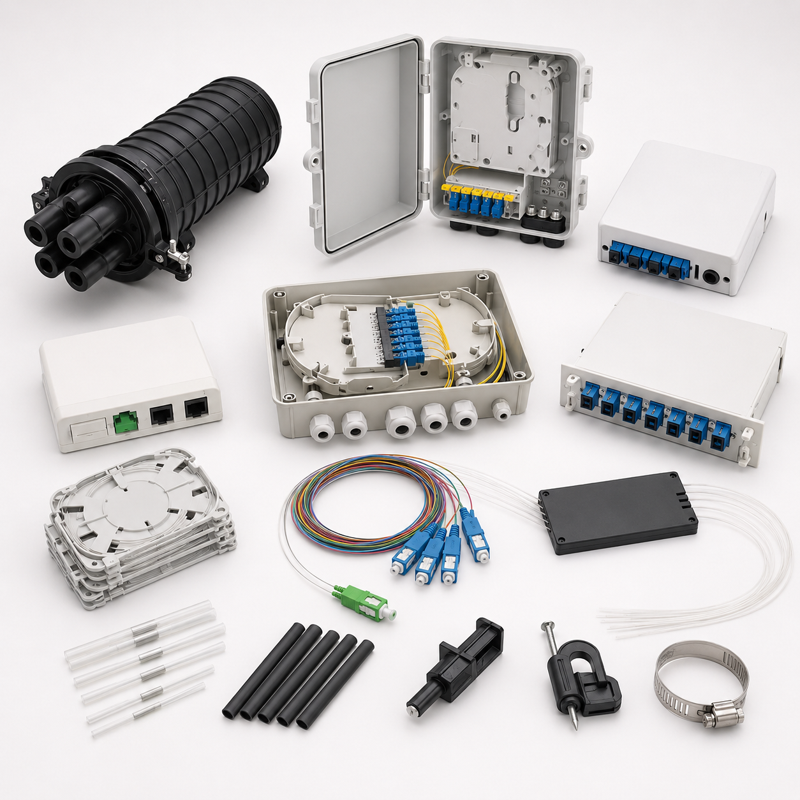
ODN accessories
Supports splicing, splitting, distribution, patching and cable management for maintainable fiber networks.
What ZION Communication can support
Zion Communication can support product selection across different parts of a resilience-focused fiber network. Buyers can prepare route conditions, cable lists, ODN layout drawings or RFQ notes before confirming specifications.
- Specification matching for ADSS, duct fiber optic cable and FTTH drop cable.
- Project BOM review for cables, closures, boxes, splitters and cable management accessories.
- Sample and datasheet support when product structure needs to be checked before ordering.
- OEM / ODM packing and labeling support for distributors and project supply.
- Quotation support based on route condition, fiber count, drum length and accessory requirements.
FAQ
What does network resilience mean in a fiber cable project?
It means the network is planned to reduce service impact and recover faster when routes, cables, closures or distribution points are damaged. In procurement, resilience depends on route design, cable structure, ODN layout, spare capacity and maintenance documentation.
Why is submarine cable security relevant to local fiber networks?
Submarine cables show how physical route concentration can affect communication service. The same principle applies to city access networks, industrial parks and FTTH rollouts: if one exposed route carries too much critical traffic, restoration becomes harder when damage occurs.
When should ADSS cable be considered for a resilient route?
ADSS cable is suitable for many aerial routes where an all-dielectric self-supporting cable is required. Buyers should confirm span length, tensile strength, wind or ice load, UV exposure and whether the cable will be installed near power lines.
What should buyers check before ordering duct fiber optic cable?
Buyers should confirm duct condition, pulling distance, cable diameter, tensile strength, water blocking structure, sheath material, bend radius and future replacement needs. Clear jacket printing and drum records also help long-term maintenance.
Why is FTTH drop cable important for network resilience?
The drop section is often the most frequently handled and exposed part of an FTTH network. A suitable drop cable should match indoor or outdoor use, bending conditions, mechanical stress, termination method and batch consistency requirements.
How do ODN accessories affect maintenance speed?
ODN accessories such as splice closures, distribution boxes, splitter boxes and cable clamps influence how quickly technicians can identify, access, test and repair fibers. Clear port layout, sealing performance and space for future splicing are important.
Evidence note: This article avoids project-specific claims, certification promises, inventory statements and fixed performance values. For final technical publication, confirm any required local standards, cable test data, jacket requirements and installation limits against the selected datasheet and project specification.