Outdoor fiber optic cable should be selected by installation route first, not only by fiber count. A long-distance telecom or industrial communication project may include duct sections, direct buried sections, aerial pole routes and building entry points. Each section exposes the cable to different risks such as pulling tension, soil pressure, moisture, UV exposure, wind load or rodent damage. Before procurement, buyers should confirm the route type, required fiber count, cable structure, sheath material, water-blocking method, mechanical protection and drum length.
Why route condition comes before fiber count
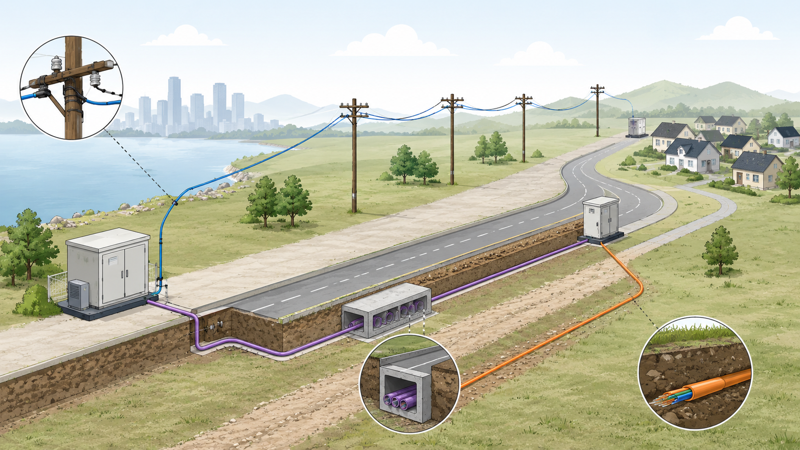
Fiber count defines network capacity, but route condition defines whether the cable can survive installation and long-term service. A 24F cable for protected duct installation and a 24F cable for direct burial may require very different construction. The route should be divided into duct, direct burial, aerial, utility-adjacent and building entry sections before the cable family is selected.
For a broad product starting point, buyers can review Outdoor Fiber Optic Cables and then narrow the option by installation method.
Quick decision table for outdoor cable type
| Project route | Suitable cable direction | Main risk to control | Buyer should confirm |
|---|---|---|---|
| Duct route | Outdoor duct fiber cable | Pulling tension, cable OD, water ingress | Duct size, pulling length, bend path |
| Direct burial | Armored direct buried fiber cable | Crush, moisture, rodents, soil pressure | Soil condition, burial route, armor need |
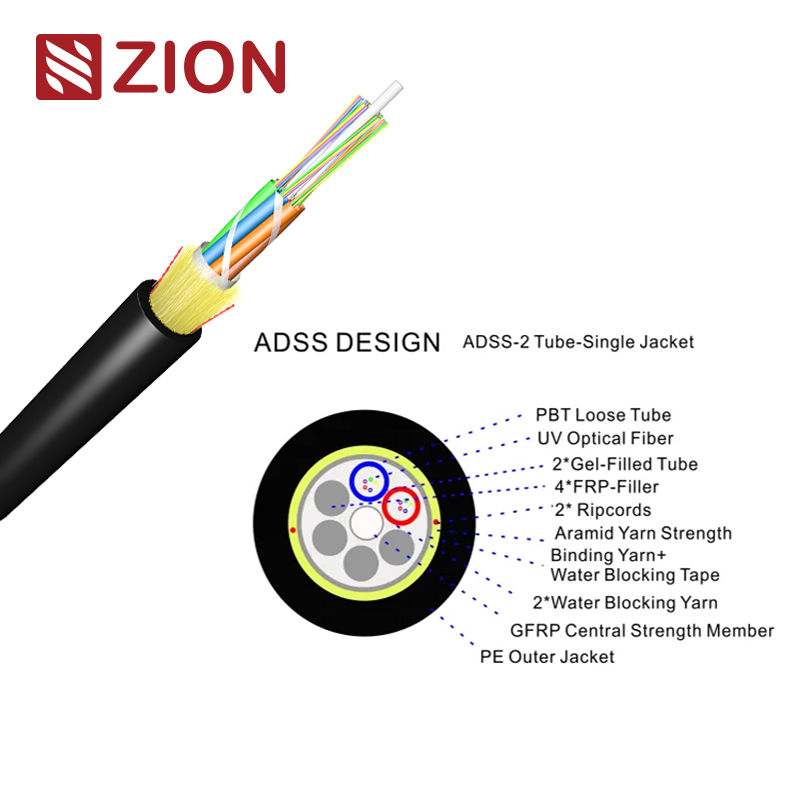
| Aerial pole route | ADSS or Figure-8 fiber cable | Span, sag, wind, ice, pole hardware | Span length, pole distance, installation method |
| Utility-adjacent route | All-dielectric or special utility cable | Induced current, grounding, clearance | Voltage environment and utility rules |
| Mixed route | Section-by-section cable plan | Wrong cable used in one route section | Route map and transition points |
Key selection factors for long-distance routes
- Route type and installation method
- Fiber type and fiber count for current capacity and expansion
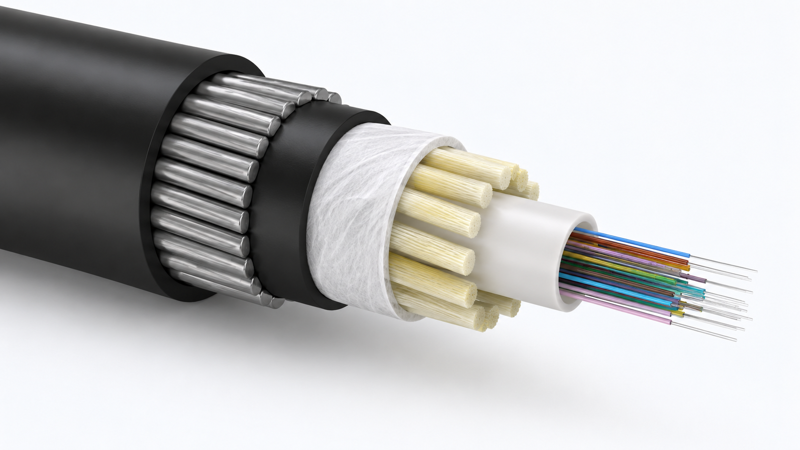
- Cable structure, such as central tube, stranded loose tube, armored or self-supporting design
- Jacket material and water-blocking method
- Mechanical risks, including tension, crush, rodents and bending path
- Drum length, packing and documentation requirements
What buyers should prepare before RFQ
| RFQ item | Why it matters | Example input |
|---|---|---|
| Installation route | Determines cable family | Duct, aerial, direct burial, mixed |
| Fiber type | Defines transmission and compatibility | OS2 G.652.D / G.657.A1, OM3, OM4 |
| Fiber count | Affects cable diameter and future expansion | 12F, 24F, 48F, 96F |
| Cable structure | Controls protection level | Central tube, stranded loose tube, armored |
| Jacket material | Supports outdoor environment | PE / HDPE, UV-resistant sheath |
| Packing length | Affects installation and logistics | 2 km, 3 km, 4 km per drum |
| Documentation | Supports project approval | Datasheet, test report, packing list |
A clearer RFQ reduces the risk of receiving a quotation for the right fiber count but the wrong cable structure.
Related ZION products and solutions
Outdoor Fiber Optic Cables
Main category for aerial, duct, direct buried and other outdoor cable options.
Outdoor Fiber Deployment Solution
Route-based solution page for comparing aerial, duct, buried and utility route conditions.
What ZION can support
Review cable structure, fiber type, jacket and protection data before procurement.
Match cable family to aerial, duct, buried or mixed route requirements.
Check cable and related accessories for long-distance outdoor projects.
Prepare a quotation based on route length, fiber count and packing requirements.
FAQ
What is the first thing to confirm before choosing outdoor fiber optic cable?
The first item is the installation route. A duct cable, direct buried armored cable and aerial self-supporting cable are designed for different mechanical and environmental conditions.
Can one outdoor fiber cable be used for every section of a long route?
Sometimes, but it is not always the safest choice. Long routes often include different sections, and each section should be checked separately before one cable type is selected for the whole project.
Is fiber count more important than cable structure?
No. Fiber count is important for capacity, but cable structure decides whether the cable can survive the installation environment.
When should armored outdoor fiber cable be considered?
Armored cable is usually considered when the route has direct burial, rodent risk, higher crush risk or rough handling. The final armor type should be confirmed with the supplier.
What should be included in an outdoor fiber cable RFQ?
A good RFQ should include route type, fiber type, fiber count, cable structure, jacket material, water-blocking method, drum length, packing and required documents.
Sources and references
- Outdoor Fiber Optic Cables category page for ZION outdoor cable families.
- Outdoor Fiber Deployment Solution for route-based deployment logic.