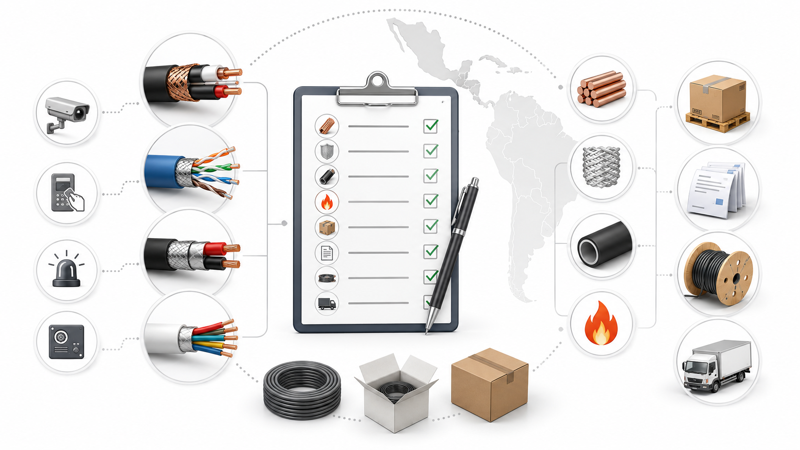
Before visiting ESS+ Colombia 2026 or discussing security projects in Latin America, buyers should prepare a clear security cable RFQ instead of only asking for “alarm cable price” or “CCTV cable quotation.” A useful RFQ should separate CCTV, access control, alarm, fire alarm, data and control cable requirements, then define conductor material, cable size, shielding, jacket, fire rating, installation route, certificate documents, packing, delivery term and sample needs. This helps suppliers quote comparable products and helps integrators avoid missing accessories, wrong cable type, unsuitable jacket or delayed project approval.
Why security cable RFQs should be prepared before ESS+ Colombia 2026
ESS+ Colombia 2026 is not only a place to see security equipment. For many LATAM buyers, it is also a practical moment to meet suppliers, compare solutions, request samples and discuss upcoming projects. The official ESS+ website lists the 2026 event at Bogotá Corferias from August 26 to 28, 2026, and describes the fair as a platform covering security sectors such as electronic security, fire and automated access.
For cable buyers, this means RFQs should be prepared before the exhibition. A security system may include IP cameras, analog CCTV, access control panels, door contacts, readers, alarms, fire alarm circuits, control panels, power-limited circuits, RS485 devices and building management interfaces. If these cable types are mixed into one unclear request, suppliers may quote different products and prices that cannot be compared fairly.
A strong RFQ helps both sides. Buyers can explain the project clearly, and suppliers can respond with the correct cable structure, datasheet, sample, packing and quotation basis.
What should a LATAM security cable RFQ include?
| RFQ Item | What the Buyer Should Specify | Why It Matters | Risk If Missing |
|---|---|---|---|
| Security system type | CCTV, IP camera, access control, intrusion alarm, fire alarm, intercom or control system | Different systems use different cable structures | Supplier may quote the wrong cable family |
| Cable application | Indoor, outdoor, conduit, tray, riser, plenum, duct or direct route | Jacket and fire rating depend on installation | Cable may not pass project inspection |
| Conductor material | Bare copper, tinned copper or approved alternative | Affects cost and performance | Prices may not be technically comparable |
| Cable size | AWG, mm², core count, pair count or category | Defines electrical and mechanical design | Wrong cable size may affect voltage drop or signal |
| Shielding | Unshielded, foil shield, braid shield or drain wire | Protects signal in EMI-prone routes | False alarms or unstable communication may occur |
| Jacket | PVC, LSZH, PE or other required material | Affects indoor / outdoor use and fire behavior | Wrong jacket may fail site requirements |
| Fire rating | Required project standard, local code or certificate | Important for life-safety systems | Approval delay or rejection |
| Cable marking | Brand, size, standard, meter mark, language if needed | Helps installers and inspectors identify cable | Site confusion and traceability issues |
| Packing | Reel, box, drum, pallet, carton label | Affects delivery, warehouse and installation | Freight or site handling problems |
| Documents | Datasheet, certificate, test report or declaration if available | Supports tender and project approval | Missing document delays quotation approval |
| Delivery term | EXW, FOB, CFR, CIF, DDP or buyer forwarder | Defines freight responsibility | Supplier prices become hard to compare |
| Sample need | Length, purpose and required approval process | Helps technical confirmation | Sample may not match final purchase |
How should security cables be separated by system?
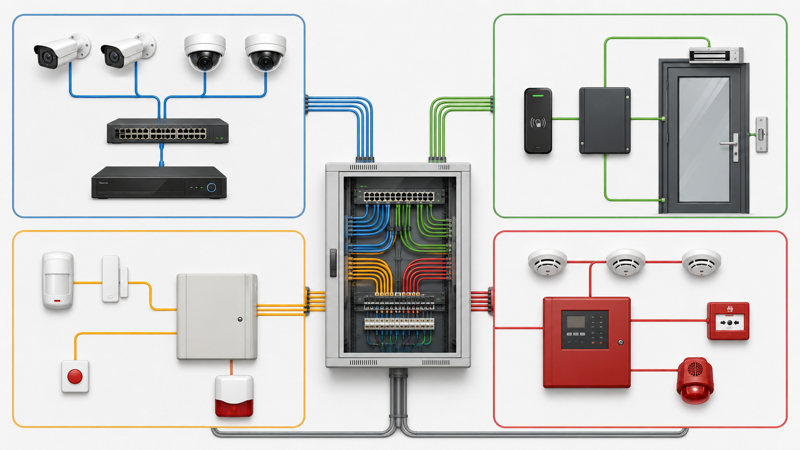
Security projects often fail at the RFQ stage because all low-voltage cables are grouped together. A better approach is to separate the BOM by system function.
For example, CCTV may require data cable, coaxial cable, power cable or hybrid cable depending on the camera type. Access control may require cable for readers, locks, door contacts, request-to-exit devices and control panels. Alarm systems may require multi-core or shielded cable for sensors, panels and signaling. Fire alarm circuits may require a specific cable type and documented compliance depending on the project requirements.
This separation helps suppliers understand whether the request is for electronic security, life-safety systems, building automation or general low-voltage wiring. It also helps the buyer avoid one common mistake: using a cable that is electrically possible but not suitable for the project approval process.
| System Area | Typical Cable Need | RFQ Should Confirm | Buyer Decision Value |
|---|---|---|---|
| IP CCTV | Data cable, patch cord, outdoor-rated cable if exposed | Category, shielding, jacket, route, PoE requirement if applicable | Prevents mismatch between camera network and cable route |
| Analog CCTV | Coaxial or hybrid cable depending on system design | Impedance, shielding, power pair, jacket | Helps quote the correct legacy or hybrid solution |
| Access control | Multi-core control cable, data cable, lock power cable | Core count, conductor size, shielding, panel-to-door distance | Reduces door hardware wiring errors |
| Intrusion alarm | Alarm cable, multi-core signal cable | Core count, shielding, jacket color, panel route | Supports sensors and zone wiring |
| Fire alarm | Fire alarm cable or project-specified life-safety cable | Required standard, rating, certificate and local approval | Avoids inspection or acceptance risk |
| Intercom / audio | Signal and power cable depending on equipment | Shielding, conductor size, route and device specification | Reduces noise and compatibility issues |
| Perimeter security | Outdoor control, data or fiber cable | UV, water, mechanical protection, route | Improves outdoor durability |
| Control room | Patch cords, panels, cable managers, labeling | Port count, rack layout, cable length | Improves maintenance and future expansion |
How should conductor, cable size and voltage be defined?
A security cable RFQ should not only state the system name. “Access control cable,” “alarm cable” or “CCTV cable” may mean different things in different countries, projects and supplier catalogs. The RFQ should define conductor material, conductor size, number of cores or pairs, voltage rating if applicable and whether stranded or solid conductor is required.
For LATAM projects, buyers may also need to clarify whether the project uses AWG, metric mm² or both. This is especially important when a distributor compares quotations from Asian, European and American suppliers. A cable described only by product name can lead to different conductor sizes and different prices.
If the project has a tender specification, send it with the RFQ. If the buyer only has a sample or photo, cable marking and cross-section details should be provided before quotation.
| RFQ Situation | Better RFQ Wording | Supplier Should Confirm | Why It Matters |
|---|---|---|---|
| Buyer knows exact cable size | Please quote 18 AWG 2C shielded security cable according to attached specification. | Conductor, insulation, shielding and jacket | Keeps quotation aligned with tender |
| Buyer has only system type | Please recommend cable options for access control reader and lock wiring. | Device load, distance, conductor size and shielding | Avoids guessing from system name |
| Buyer compares LATAM suppliers | Please provide AWG and mm² reference where applicable. | Size equivalence and tolerance | Improves quotation comparison |
| Buyer has sample | Please match the attached cable sample and confirm any difference. | Marking, conductor, color, shield and jacket | Supports replacement sourcing |
| Buyer accepts alternatives | Quote the original specification and list alternative options separately. | Difference in material, jacket, size or standard | Prevents mixing original and alternative specs |
What should buyers confirm about jacket and fire rating?
The jacket should match the installation environment. Security cables may run through ceilings, conduit, trays, risers, equipment rooms, outdoor walls, gates, parking areas, warehouses or industrial sites. A cable used inside a control room may not be suitable for outdoor access control gates. A general indoor cable may not be accepted for a fire alarm route.
For fire alarm cables, project requirements may reference standards, cable types or local approval rules. UL Standards information for UL 1424 states that the requirements cover single- and multiple-conductor cables for fixed wiring within buildings, principally for power-limited fire-alarm circuits, including FPLP and FPLR cable types.
For LATAM projects, the safest RFQ wording is to state the installation route, the required document and the approving party. Do not assume that one fire rating, jacket material or certificate will be accepted across every country or project.
| Installation Condition | RFQ Should Mention | Cable Detail to Verify | Risk If Ignored |
|---|---|---|---|
| Indoor low-voltage route | PVC, LSZH or project-required jacket | Flame requirement and smoke requirement | Project may reject unapproved jacket |
| Outdoor camera route | UV exposure, water risk, conduit or open air | PE jacket, outdoor rating or protection method | Jacket cracking or water ingress |
| Access control at gate | Sun, rain, movement, conduit, power distance | Jacket durability, conductor size and shielding | Unstable lock or reader operation |
| Fire alarm circuit | Required standard and certificate | Cable type, fire rating and document availability | Inspection delay |
| Industrial facility | EMI, oil, abrasion, machinery nearby | Shielding and jacket robustness | Signal noise or cable damage |
| Public building | Local code and project authority | Fire performance and documentation | Approval risk |
| Export project | Destination country and language needs | Marking, datasheet and label language | Customs or site confusion |
When is shielding important for security systems?
Shielding is often treated as a small option, but it can affect security system reliability. Security cables may pass near power cables, motors, access gates, elevators, industrial equipment, LED drivers or electrical rooms. In these cases, foil shielding, braid shielding or a drain wire may be required by the project design.
The RFQ should not simply say “shielded if possible.” It should state the route condition and whether the cable needs foil shield, braid shield, overall shield, individual pair shield or a specific drain wire. If grounding practice is important, it should be checked with the system designer or installer.
Shielding can also change cable diameter, flexibility, termination process and cost. That is why shielded and unshielded options should be quoted separately when both are under review.
Which documents should LATAM security buyers request?
For LATAM security projects, documentation can be as important as cable price. Integrators may need datasheets for tender submission, certificates for fire alarm cable, packing lists for customs, and Spanish or bilingual information for project teams. If documentation is requested after production, the project schedule may be delayed.
The RFQ should specify which documents are required before order confirmation. If the buyer needs a certificate, the exact standard or certificate type should be named. If the buyer needs Spanish documentation, this should be discussed early.
For ZION-related content, certificate claims should only be made when a real product certificate is available. For example, if a fire alarm cable is described as UL certified, the specific product certificate or listing information should be checked before publication or quotation.
| Document Type | When It Is Needed | What Buyer Should Ask | Important Note |
|---|---|---|---|
| Product datasheet | Tender, technical approval, supplier comparison | Datasheet with construction, conductor, jacket and application | Do not rely only on catalog name |
| Certificate | Fire alarm or project-required systems | Specific certificate file or listing reference if available | Must match the quoted product |
| Test report | Project acceptance or quality review | Available test report for the product family | Confirm scope and date |
| Cable marking | Installation and inspection | Marking content, meter mark, language if needed | Helps site traceability |
| Packing list | Import and warehouse handling | Packing unit, gross weight, dimensions | Supports freight calculation |
| Spanish document | LATAM tender or local installer support | Spanish or bilingual datasheet / label if available | Should be requested before order |
| Sample record | Pre-order review | Sample length, marking, color and structure | Avoids sample vs order mismatch |
How should packing, labeling and delivery terms be described?
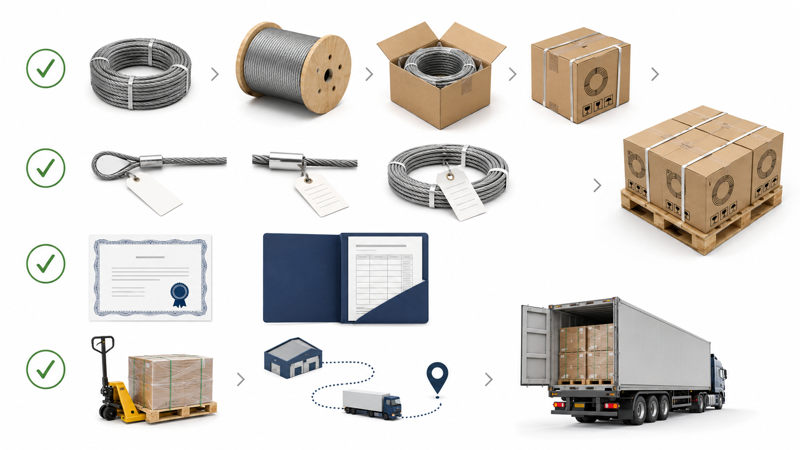
Export security cable orders should include packing and delivery information in the RFQ. A price based on coils may not be comparable with a price based on wooden drums or palletized cartons. For distributors, packing length and label format may affect resale. For contractors, packing by project phase or building zone may improve site installation.
Delivery terms should also be clear. EXW, FOB, CFR, CIF and DDP are not the same quotation basis. If freight is changing or the delivery destination is inland, the buyer should clarify whether the supplier needs to quote only goods, goods plus sea freight, or door delivery.
LATAM projects may also require country-specific import documents, Spanish labels, barcode labels or customer brand labels. These should be confirmed before quotation, not after shipment.
| RFQ Item | What to Confirm | Why It Matters |
|---|---|---|
| Packing type | Coil, reel, carton, wooden drum or pallet | Affects freight, handling and cable protection |
| Packing length | 100 m, 305 m, 500 m, 1,000 m or project-defined length | Affects installation and distributor resale |
| Labeling | Product label, project label, barcode, Spanish label | Improves warehouse and site identification |
| Destination | Port, airport, warehouse or full address | Required for freight calculation |
| Delivery term | EXW, FOB, CFR, CIF, DDP or buyer forwarder | Makes quotations comparable |
| Shipment grouping | By system, by building, by floor, by project phase | Helps site installation order |
| Document package | Invoice, packing list, certificate, datasheet | Supports customs and project handover |
| Sample shipment | Sample quantity, courier method, approval deadline | Speeds pre-order confirmation |
How should samples and alternatives be reviewed?
Samples are useful before ESS+ meetings, after supplier screening or before final project approval. However, the RFQ should explain the purpose of the sample. A sample for color review is different from a sample for cable marking, shielding, conductor verification or fire alarm documentation.
Alternative specifications can also be useful. For example, a supplier may suggest a different jacket, shielded version, outdoor version, packing length or document-supported option. But alternatives should be separated from the original request. The quotation should show the original specification and the alternative option clearly.
This is especially important for LATAM distributors. A lower-cost alternative may be useful for resale, but it should not replace a project-required specification without buyer approval.
| Alternative Option | When It May Help | What Buyer Must Check | Risk If Not Checked |
|---|---|---|---|
| Shielded vs unshielded | EMI risk or cost comparison | Route condition and equipment requirement | Signal instability or unnecessary cost |
| PVC vs LSZH jacket | Indoor project requirement | Fire and smoke requirement | Project rejection |
| Indoor vs outdoor jacket | Camera, gate or perimeter route | UV, water and conduit protection | Jacket failure |
| Different conductor size | Cost or availability issue | Voltage drop, distance and load | Device malfunction |
| Different packing length | Distributor or contractor preference | Warehouse and installation method | Site handling issue |
| Document-supported option | Tender or fire alarm approval | Certificate scope and product match | Approval delay |
Buyer checklist before sending a security cable RFQ
Before sending the RFQ, buyers should prepare the following information. A complete RFQ helps buyers use ESS+ meetings more efficiently. Instead of collecting generic brochures, they can compare real cable options, document support and quotation conditions.
Related ZION support paths for security cable RFQs
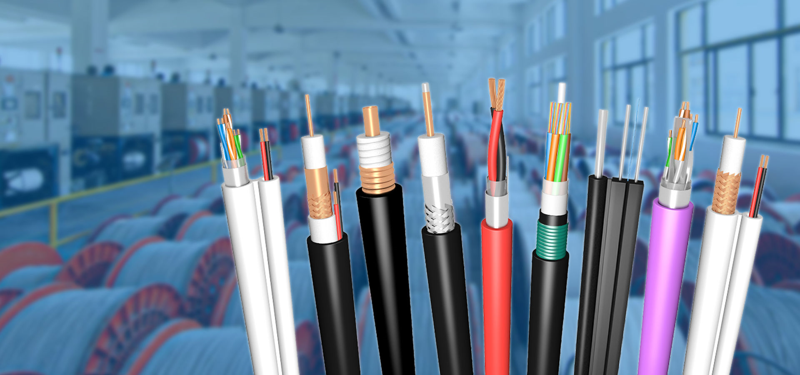
ZION Communication
Use the main website to review ZION product scope before narrowing the RFQ to fire alarm, access control, CCTV, data or shielded cable options.
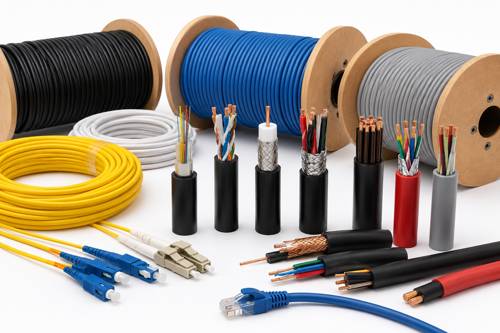
Security Cable RFQ Support
Send system type, cable specification, packing requirement, document needs and destination for quotation review.
What ZION can support before quotation
FAQ
What cable information should I prepare before ESS+ Colombia 2026?
Prepare the system type, cable size, conductor material, shielding, jacket, fire rating, installation route, quantity, packing and document requirements. If you already have a tender specification, send it with the RFQ. This helps suppliers quote the correct cable instead of making assumptions.
Should CCTV, access control and fire alarm cables be quoted together?
They can be included in one project RFQ, but they should be separated by system. CCTV, access control, alarm and fire alarm cables may have different structures, jackets, shielding and documentation needs. Separating them makes quotation comparison easier.
Is fire alarm cable the same as ordinary security cable?
No. Fire alarm cable may need specific ratings, documents or project approval depending on the installation and local requirements. A general security cable should not be used for a fire alarm circuit unless the project authority and specification allow it.
What documents should LATAM buyers request from cable suppliers?
Common documents include datasheets, certificates if available, packing lists, test reports when required, cable marking details and sample records. For LATAM projects, Spanish or bilingual documentation may also be useful. The exact document requirement should be confirmed before order.
When should I choose shielded security cable?
Shielded cable may be needed when the route is near power cables, motors, gates, elevators, machinery or other interference sources. The RFQ should specify whether foil shield, braid shield or drain wire is required. Shielded and unshielded options should be quoted separately if both are being compared.
What packing information should be included in the RFQ?
Include packing length, coil or reel type, carton or drum requirement, pallet requirement, label format and destination. Packing affects freight cost and site handling. For distributors, packing also affects warehouse storage and resale.
Can I ask for an alternative security cable specification?
Yes, but alternatives should be clearly separated from the original specification. The supplier should explain the difference in conductor, jacket, shielding, packing, certificate or application. Do not approve an alternative before checking project acceptance.
What is the best RFQ approach for LATAM distributors?
LATAM distributors should prepare both project requirements and resale requirements. This includes cable specification, certificate needs, packing length, Spanish label, barcode, neutral packing or customer branding. This helps the supplier quote products that fit both technical and commercial needs.
Sources and evidence notes
This article is written as an RFQ and procurement checklist. Product-specific claims about cable ratings, certificates, material properties, test reports, stock, price, lead time or country-specific approval should be supported by product datasheets, certificate files, project specifications, local requirements or ZION-confirmed sales information before publication.