
A freight index is a market indicator. A cable CIF quotation is a shipment-specific commercial offer involving an exact origin, destination, container type, cargo volume, shipping schedule, insurance arrangement, local charges, and validity period. Changes in vessel capacity, blank sailings, route diversions, surcharges, cable drum dimensions, and container utilization can prevent a lower market index from producing a lower final CIF price.
Understanding these differences helps buyers compare quotations more accurately and avoid unexpected logistics costs after an order is placed.
What Does a Falling WCI Actually Mean?
The Drewry World Container Index, commonly known as the WCI, is widely used to monitor movements in container freight rates on major international trade routes. When the WCI falls, it generally indicates that spot freight levels across the routes covered by the index are declining.

A falling index may be caused by lower cargo demand, additional vessel capacity, reduced port congestion, seasonal market changes, improved container availability, or stronger competition among shipping lines. It is useful for understanding the general direction of the container shipping market.
However, the WCI is not a universal freight quotation. A global or composite index cannot represent every combination of Chinese loading port, destination port, shipping line, direct or transshipment service, container size, equipment availability, weekly sailing, cargo ready date, free-time requirement, local port charge, and freight forwarder allocation.
For example, a decline on a major Shanghai-Europe trade lane does not automatically mean that freight from Ningbo to Jeddah, Shenzhen to Durban, or Shanghai to a secondary Latin American port has fallen by the same percentage.
A falling WCI suggests that the broader freight market may be softening, but it does not guarantee that the bookable rate for a particular cable shipment has decreased.
Why Blank Sailings Can Limit Freight-Rate Reductions
A blank sailing occurs when a shipping line cancels a scheduled voyage or removes a port call from its service rotation. Shipping lines may use blank sailings in response to weak demand, schedule disruption, port congestion, vessel repositioning, or operational problems.

By removing sailings, carriers reduce the amount of available space in the market. This can create a situation in which overall demand is weak but usable capacity on a particular route remains tight.
Suppose a trade lane normally has four sailings during a month. If one or two are cancelled, exporters must compete for space on the remaining vessels. The result may include limited space on the preferred sailing, rolled containers, longer booking lead times, higher rates for guaranteed space, fewer shipping line choices, longer transit times, and greater dependence on transshipment services.
A freight index may continue to decline because of weak global demand, while the actual rate available for a specific shipment remains stable or even rises because the relevant weekly sailing is full. Cable shipments are particularly sensitive to this issue because production may finish close to a project deadline, and the buyer may not be able to wait two or three additional weeks for the cheapest available vessel.
The lowest theoretical freight is therefore not always the lowest usable freight.
Spot Rates and Actual Booking Rates Are Not the Same
A published spot rate normally reflects a market price for a particular route and period. An actual booking rate is the price available for a specific shipment under specific conditions.
A benchmark may cover a base port, while the shipment uses a secondary or inland destination. Feeder charges, transshipment costs, and destination handling can change the final amount.
A low advertised rate has limited value if the required 20-foot, 40-foot, or 40-foot high-cube container is unavailable at the loading location.
A freight forwarder may publish an attractive rate but have limited space under that rate. Once the allocation is used, the next available booking may be more expensive.
A low-cost service may involve more transshipment ports, longer transit time, higher rollover risk, or more cargo-handling stages.
Two freight quotations with the same headline rate may not cover the same costs. One may include origin terminal handling, documentation, seal, and export-related charges, while another excludes them. A meaningful comparison must therefore use the total charge under the same commercial scope, not only the basic ocean freight.
Why Freight Validity Matters
Ocean freight rates normally have limited validity. Depending on the route and market conditions, a quoted rate may be valid for a specific sailing, one week, two weeks, until the end of the month, or until a specified price calculation or gate-in date.

Cable production, inspection, packing, and container loading may take longer than the freight-validity period. A supplier may issue a CIF quotation based on the freight available today, but if the buyer confirms the order ten days later and production takes three weeks, the cargo may become ready in a different freight cycle.
This is why a professional CIF quotation should clearly state the CIF destination port, freight basis, container type, estimated number of containers, freight-validity date, product-price validity, estimated cargo-ready date, whether freight will be reconfirmed before booking, treatment of new carrier surcharges, and treatment of buyer-requested schedule changes.
A statement such as "CIF price valid for 30 days" can be misleading if the underlying ocean freight is valid for only seven days. Product-price validity and freight validity should be shown separately whenever possible.
FOB, CFR and CIF: What Is the Difference?
FOB, CFR, and CIF are Incoterms® rules intended for sea and inland waterway transport. Under Incoterms® 2020, CFR and CIF have broadly similar seller and buyer obligations, except that CIF requires the seller to arrange insurance cover for the buyer. The ICC explains this distinction in its discussion of CFR and CIF under Incoterms® 2020.
| Term | Seller arranges main ocean freight | Seller arranges cargo insurance | Typical quotation scope |
|---|---|---|---|
| FOB | No | No | Goods delivered on board at the named port of shipment |
| CFR | Yes | No | Cost and freight to the named destination port |
| CIF | Yes | Yes | Cost, insurance and freight to the named destination port |
One important point is frequently misunderstood: paying freight to the destination under CFR or CIF does not mean that all risks remain with the seller until the cargo arrives. For FOB, CFR, and CIF, risk generally transfers when the goods are delivered on board the vessel at the port of shipment. CFR and CIF add freight arrangements, while CIF also adds the required insurance arrangement.
The chosen rule should always be followed by the named port and version, such as "CIF Jebel Ali Port, UAE, Incoterms® 2020." Writing only "CIF Dubai" leaves room for disagreement about the exact destination and cost boundary.
Route Changes and Additional Surcharges
The basic ocean freight rate is only one component of the logistics cost. Depending on the route and market, carriers may apply peak season surcharges, emergency contingency surcharges, fuel or bunker adjustment, war-risk surcharge, congestion surcharge, equipment imbalance surcharge, canal-related surcharge, security surcharge, or destination handling fees.

These charges may be introduced, removed, or revised independently of the main spot-rate trend. Carrier notices can show how route disruption creates emergency freight increases or contingency surcharges for specific regions even when broader market indicators move in another direction. Maersk, for example, has explained how alternative routing, storage, additional charters, and capacity constraints can generate extra costs in route-specific operational updates.
Route changes can also affect a cable shipment without changing the quoted port pair. A vessel may avoid a high-risk waterway, divert around the Cape of Good Hope, add a transshipment port, change port rotation, discharge at an alternative port, or extend transit time.
Before confirming a CIF order, the buyer should ask whether the quotation includes all currently known route-related surcharges and how newly introduced charges will be handled.
Cable Drums, Pallets and Container Utilization
For cable orders, freight should not be evaluated only as a price per container. It should also be evaluated as a logistics cost per kilometer, per meter, per drum, or per unit. The final result depends heavily on packaging and container utilization.
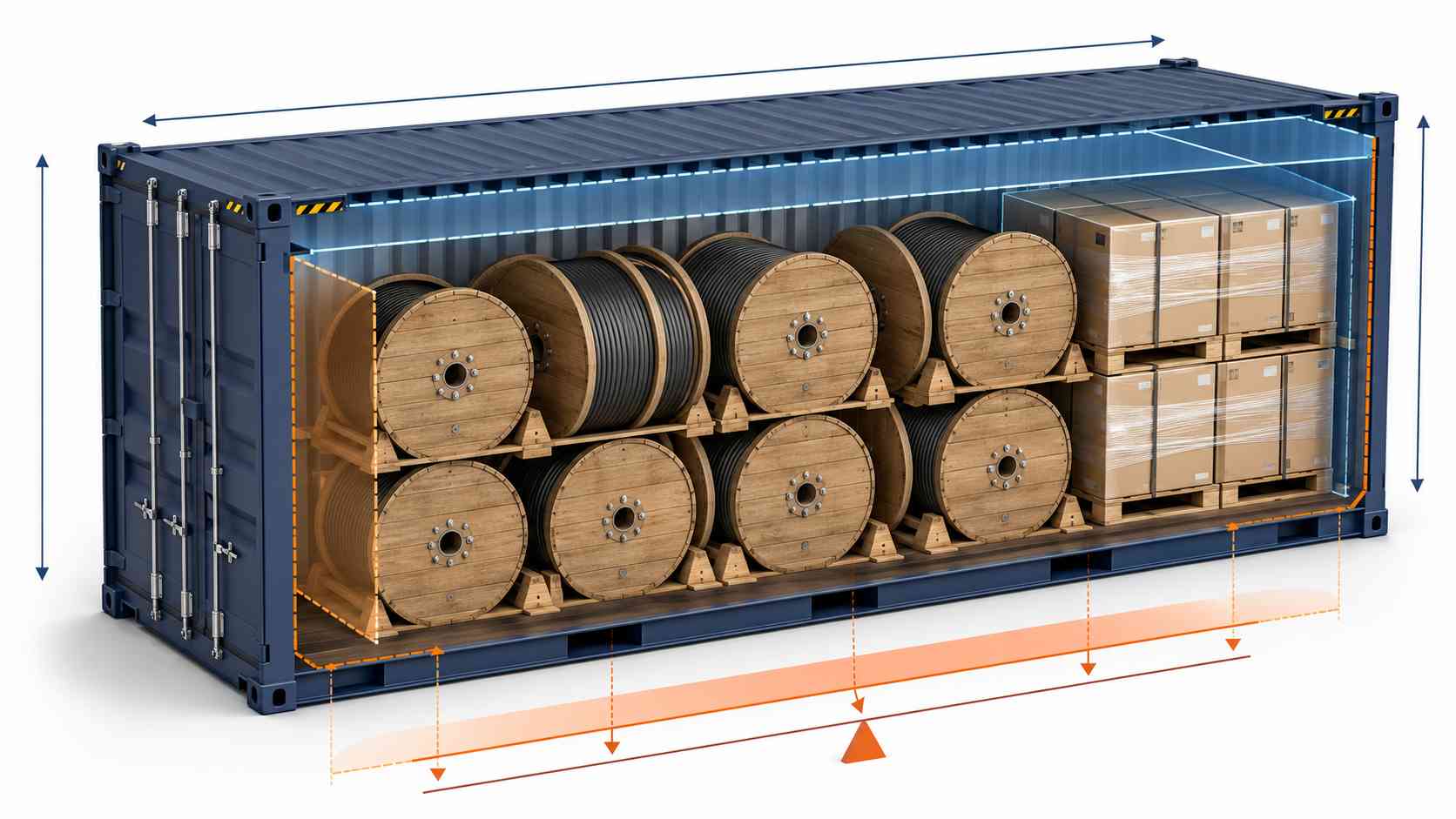
Large wooden or steel drums may leave unusable space between drums. Two packing plans with the same total cable length may require different numbers of containers because of drum flange diameter, drum width, maximum cable length per drum, cable bending-radius requirements, drum orientation, blocking and bracing, container door dimensions, and unloading requirements.
Patch cords, connectors, splitters, ODFs, closures, and other accessories may be packed in cartons or on pallets. Pallets improve handling and protection but consume additional space and add weight. If a buyer requests palletized cargo after receiving the original quotation, the container quantity may change.
Copper communication cable can reach the container's practical weight limit before using all available cubic capacity. Fiber-optic cable and accessories may fill the container by volume before reaching the weight limit. The most suitable equipment may therefore differ between a 20-foot container, a 40-foot container, and a 40-foot high-cube container.
| Packing plan | Freight per container | Containers required | Total ocean freight |
|---|---|---|---|
| Plan A | USD 3,000 | 3 | USD 9,000 |
| Plan B | USD 3,300 | 2 | USD 6,600 |
Plan B has the higher container rate but the lower total freight cost. This is why an accurate cable CIF quotation requires at least a preliminary packing calculation. If drum sizes or order quantities are still changing, the CIF price should be treated as provisional.
How Buyers Should Compare Cable CIF Quotations
A reliable comparison should normalize both the product specification and the shipping scope. Before deciding that one offer is cheaper, confirm that all suppliers are quoting the same cable construction, conductor or fiber specification, standards and test requirements, cable length per drum, drum material, pallet requirement, destination port, Incoterms® version, container type, sailing conditions, insurance scope, and included or excluded charges.
A low CIF price may be based on smaller drums, non-palletized loading, a slower transshipment service, shorter freight validity, or excluded destination costs. The buyer should compare the total landed-cost structure, not simply the CIF amount printed on the quotation.
Check whether cable structure, fiber or conductor type, standards, test requirements, and drum length are identical.
Confirm the named port, Incoterms® version, insurance scope, included origin charges, and excluded destination costs.
Compare container type, estimated container count, direct or transshipment service, transit time, and sailing reliability.
Separate product-price validity from freight validity and clarify how new carrier charges will be handled before booking.
Shipping Information Checklist for Cable Buyers
Providing complete shipping information allows the cable supplier to calculate container utilization and obtain a more accurate freight quotation. Useful inputs include destination and delivery terms, product information, container and cargo requirements, schedule requirements, and commercial confirmation details.
| Information area | Details to confirm |
|---|---|
| Destination and delivery terms | Required Incoterm, exact named port, final delivery country and city, port-to-port or door-delivery requirement, nominated forwarder, and insurance level. |
| Product information | Cable type, specification, quantity by item, length per drum or coil, drum material, markings, labels, palletization, and accessories shipped with the cable. |
| Container and cargo requirements | Preferred container type, maximum gross weight, unloading limitations, maximum drum diameter or weight, forklift or crane availability, stacking limits, blocking, bracing, and moisture protection. |
| Schedule requirements | Cargo-ready date, latest acceptable vessel departure, required arrival date, direct-service preference, maximum transit time, transshipment tolerance, and tolerance for schedule changes. |
| Commercial confirmation | Product-price validity, freight-validity date, included surcharges, origin charges, destination charges, free time, documentation, and treatment of demurrage, detention, storage, inspection, and customs delays. |
Final Takeaway
A lower WCI or spot-market index is positive information for cable buyers, but it is not sufficient evidence that a specific CIF price should immediately fall. The final cable CIF price depends on product cost, packing and container utilization, actual bookable freight for the required sailing, insurance, route-related charges, and applicable surcharges.
The best way to obtain a competitive CIF price is not simply to request "the latest lower freight." It is to provide a stable bill of quantities, confirm drum and pallet requirements, specify the exact destination port, define the required shipment window, and ask for a clearly itemized freight basis.
When these details are controlled, buyers can distinguish a genuine logistics saving from a temporary market headline and compare cable quotations on a fair, practical basis.
FAQ
Does a falling freight index guarantee a lower cable CIF price?
No. A freight index shows a market direction, while a cable CIF quotation depends on the exact port pair, sailing, container type, packing plan, insurance, local charges, and rate validity.
Why can blank sailings keep actual booking rates high?
Blank sailings reduce usable vessel space on a route. Even when broader demand is weak, exporters may compete for fewer departures, which can limit rate reductions or raise the cost of guaranteed space.
What should buyers confirm before comparing cable CIF quotations?
Buyers should confirm the same cable specification, drum or pallet requirement, named destination port, Incoterms® version, container type, sailing conditions, insurance scope, included charges, excluded charges, and freight validity.
How can packing change the final logistics cost?
Cable drum size, palletization, weight limits, volume utilization, and loading design can change the required number of containers. A slightly higher rate per container may still produce a lower total freight cost if it reduces the container count.



 Fiber Optic Cable
 Fiber Optic Tools
 Ethernet Cable
 Coaxial Cable
 Fire & Security Cable
 Voice, Audio & Video
 Power & Control Cable