What is the GYTA fiber optic cable?
Author: James Xu Publish Time: 18-09-2018 Origin: https://www.zion-communication.com/
What Is GYTA Fiber Optic Cable? GYTA is a stranded loose-tube outdoor optical cable with a metallic central strength member, an aluminum-polyethylene laminate moisture barrier, and a polyethylene outer sheath. It is commonly specified for duct routes and may suit supported aerial routes when the selected product datasheet and installation design permit it.
GYTA is not a universal direct-burial cable designation. A standard single-sheath GYTA construction is typically selected for protected outdoor pathways such as ducts. When a route requires direct burial, enhanced crush protection, or stronger rodent resistance, compare a double-sheath armored design such as GYTA53 and verify the exact construction against the project specification.
GYTA Cable Structure
In a typical GYTA design, 250 µm optical fibers are placed in high-modulus plastic loose tubes. The tubes contain a water-blocking compound or another specified water-blocking system and are stranded around a central steel strength member. Fillers may be used to maintain a round cable core. An aluminum-polyethylene laminate (APL) is applied around the core, followed by a black polyethylene (PE) outer sheath.
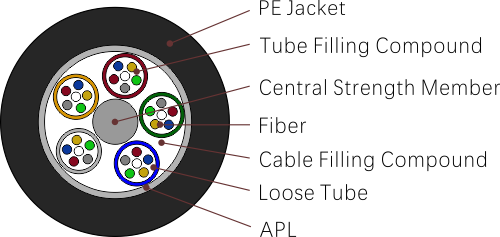
Optical fibers and loose tubes: Isolate the fibers from part of the mechanical strain and allow the cable to accommodate temperature changes.
Central steel strength member: Supports tensile loads during manufacture and installation; it also makes the construction metallic.
Water-blocking system: Limits longitudinal water migration. The exact gel, filling compound, yarn, or tape arrangement must be confirmed on the product datasheet.
APL and PE sheath: The aluminum-polyethylene laminate provides a moisture barrier and light metallic protection, while the outer PE jacket protects the cable in outdoor environments.
For a current example of this construction, see ZION's GYTA-1 APL armored stranded loose-tube optical fiber cable. Published values on any product page apply only to the listed model; they should not be treated as universal GYTA specifications.
Where GYTA Cable Is Used
GYTA is primarily an outdoor communications cable. Its suitable installation method depends on the exact mechanical ratings, sheath construction, pathway, local rules, and installation accessories.
Duct and conduit routes: a common use because the pathway supplies additional mechanical protection while the cable's water-blocking system and PE sheath address outdoor moisture exposure.
Supported aerial routes: possible only when the cable datasheet, messenger or support method, span, sag, wind, ice, and installation tension are suitable. GYTA is not automatically self-supporting.
Direct burial: do not assume a single-sheath GYTA cable is suitable. For unprotected soil installation, compare purpose-designed GYTA53 and other direct-buried optical fiber cable constructions.
GYTA vs GYTA53: Do Not Confuse the Two
GYTA
Typical outer construction: APL moisture barrier with a single PE outer sheath.
Common route: protected duct; supported aerial use only when approved by the design.
Verify: tension, crush, bend radius, temperature, water penetration, and pathway support.
GYTA53
Typical outer construction: additional inner sheath and steel-tape armor with an outer PE sheath; exact layers vary by model.
Common route: duct or direct burial when the specific product is rated for the route.
Verify: all GYTA checks plus armor, sheath, soil, rodent, corrosion, and grounding requirements.
The designation is a construction guide, not a complete procurement specification. Similar names can cover different fiber counts, tube arrangements, cable diameters, mechanical ratings, and environmental test results. Use the specific model datasheet and project requirements as the controlling documents.
Fiber and Loose-Tube Color Identification
A 12-color sequence is commonly used to identify fibers and loose tubes. Confirm the applicable color-coding standard, ring marks, binder colors, and tube sequence for the ordered cable, especially when the fiber count exceeds 12.
Fibers or tubes 1–6: 1 Blue, 2 Orange, 3 Green, 4 Brown, 5 Gray, 6 White.
Fibers or tubes 7–12: 7 Red, 8 Black, 9 Yellow, 10 Violet, 11 Pink, 12 Aqua.
How to Specify GYTA Cable
A useful request for quotation should describe the route and required evidence, not only the cable code. Provide the following information:
Installation route: duct, tray, supported aerial, or another protected pathway.
Fiber count and fiber type, including the required ITU-T or IEC fiber specification.
Required cable length, drum length, installation pulling plan, and allowable splice locations.
Minimum tensile, crush, impact, bend-radius, and temperature requirements for installation and operation.
Water penetration, UV exposure, fire-performance, rodent, chemical, and corrosion conditions.
Applicable cable standard, test reports, identification, printing, packaging, and delivery documentation.
Metallic-component bonding, grounding, separation, and lightning-protection requirements established by the project designer and local rules.
ZION's GYTA loose-tube outdoor fiber optic cable page provides another construction reference. Confirm availability and current model data directly because product pages may describe different generations or configurations.
Frequently Asked Questions
Is GYTA an armored fiber optic cable?
GYTA includes an aluminum-polyethylene laminate around the cable core, so suppliers may describe it as light armored or APL armored. It does not provide the same protection as a double-sheath steel-tape design such as GYTA53.
Can GYTA cable be directly buried?
Do not assume that a standard single-sheath GYTA cable is rated for direct burial. Use a construction specifically documented for unprotected underground installation, such as an appropriate GYTA53 model, and verify the soil, mechanical, rodent, moisture, and local installation requirements.
Is GYTA self-supporting for aerial installation?
Not by designation alone. Aerial suitability depends on the support system, span, environmental loading, installation tension, and the specific cable's rated mechanical performance.
What fiber types and counts are available in GYTA?
Availability varies by manufacturer and cable design. Single-mode and multimode fibers may be offered, and fiber-count limits depend on tube size, tube count, cable diameter, and the qualified product design. Specify the required fiber standard and count rather than relying on a generic range.
What is the difference between APL and PSP?
APL is an aluminum-polyethylene laminate; PSP is a steel-polyethylene laminate. They are different metallic barrier or armor materials and should not be used interchangeably in a specification.



 Fiber Optic Tools
Products 6 families
Solutions 6 markets
Resources Tools & docs
Certificate
Certification and compliance references for project review, qualification and purchasing documentation.

 Fiber Optic CableAccess and backbone
 Ethernet CableCat5e to Cat8
 Coaxial CableRF and video signal
 Fire, Security & AlarmSafety systems
 Voice, Audio & VideoSignal cabling
 Power & Control CableEnergy and control
Fiber optic cable systems
Outdoor, indoor, FTTH and distribution cable lines for access networks, backbone routes and campus deployments.
 Telecom & ISP NetworksFTTH, PON, ODN
 Data Center InfrastructureServer room cabling
 Building Low-Voltage SystemsBMS, AV, weak current
 Security & Fire ProtectionAlarm, CCTV, access
 Industrial Automation CablePLC, RS485, fieldbus
 Energy & Power InfrastructureSolar, battery, power
Telecom & ISP Networks
For FTTH / PON access, outdoor fiber deployment, aerial routes, duct routes, direct burial routes, rural broadband and ODN planning.
Tools
Use calculators and planning tools for conduit capacity, PoE voltage drop and fiber optic link loss budget work.