Why Operators Are Fiberizing More Telecom Towers
Mobile network upgrades are no longer limited to radios, antennas and spectrum. As 4G traffic continues to grow, 5G site density increases, fixed wireless access expands and tower sharing becomes more common, backhaul has become a strategic planning topic for mobile operators, tower companies and system integrators.
In August 2026, Melaka ICT Holdings and Maxis announced a tower fiberization initiative in Malaysia. The project aims to increase fiber connectivity across MICTH-owned telecom towers from about 40% to 80%, covering 151 towers with an investment of around RM30 million. Selected sites will move from microwave backhaul to a high-capacity optical fiber network.
This type of project shows that fiber-to-the-tower is more than a transport equipment upgrade. A tower can evolve from a single-purpose mobile backhaul point into a shared digital infrastructure node for mobile broadband, FWA, enterprise connectivity and nearby access networks.
Microwave Backhaul vs Fiber Backhaul
Microwave and fiber are not simply good or bad alternatives. They are two transport media that fit different deployment scenarios, and modern mobile networks often need both.

| Comparison | Microwave Backhaul | Fiber Backhaul |
|---|---|---|
| Capacity | From traditional hundreds of Mbps to modern E-band multi-Gbps and 10 Gbps-class links. | Can be upgraded through optics, transport equipment, WDM or PON architecture. |
| Latency | Usually low, but affected by hop count, equipment processing and congestion. | Stable propagation delay, suitable for high-capacity aggregation and low-jitter transport. |
| Deployment | No trenching required, suitable for rapid rollout and temporary sites. | Requires aerial, duct, buried or tower-entry routes. |
| Weather | High-frequency links can be affected by rain fade and antenna misalignment. | Not affected by radio propagation, rain fade or spectrum interference. |
| Scalability | Limited by spectrum, channel width, antenna conditions and site space. | Scalable through spare fibers, WDM, rings and equipment upgrades. |
| Best Fit | Remote, obstacle-crossing, temporary, lower-traffic or high-fiber-cost sites. | High-traffic, aggregation, tower-sharing, long-term growth and urban sites. |
Ericsson Microwave Outlook 2025 reports that microwave backhaul is used in about 75% of live 5G networks globally and forecasts a near-balanced 49% microwave and 51% fiber structure for global mobile backhaul by 2030. The direction is not a single winning medium, but a more mature hybrid transport architecture.
Which Towers Should Migrate First?
Operators do not need to fiberize every microwave site at once. A practical plan builds a priority model and directs budget, permits and installation resources toward towers where fiber creates the strongest long-term value.
Macro sites, regional aggregation sites, busy-hour constrained sites, 5G and FWA sites, multi-operator towers, and locations near existing ducts, poles or metro fiber.
Remote mountains, islands, river crossings, difficult civil routes, rural low-growth sites, temporary coverage and backup links for critical fiber routes.
A mature migration strategy does not simply remove microwave. It fiberizes high-value sites while keeping microwave where it remains operationally and economically appropriate.
Capacity and Latency Planning
The engineering team should not only compare theoretical medium capacity. The more important question is whether the complete transport path can support traffic growth over the next three to five years.
- Current busy-hour throughput and peak-to-average ratio.
- Combined 4G and 5G traffic at the same site.
- FWA, enterprise access, campus coverage and video traffic impact.
- Wholesale backhaul capacity for multi-operator towers.
- Aggregation oversubscription ratio and protection capacity.
- Microwave hop count, queuing, protection switching and congestion risk.
- Synchronization requirements such as SyncE and IEEE 1588v2 PTP.
- Different latency and jitter limits for backhaul, midhaul and fronthaul.
For ordinary mobile backhaul, latency is not determined by the physical medium alone. Equipment processing, hop count, routing, congestion, QoS and protection switching all affect the user experience. Fiber offers stronger long-term scalability, more stable jitter performance and a better foundation for shared aggregation networks.
Map the Existing Tower Topology
One common reason fiberization projects become difficult is incomplete understanding of the existing transport topology. Before migration, operators should build a detailed tower transport map that shows upstream relationships, downstream dependencies, available routes and single points of failure.

The survey should include each tower's uplink and downlink, current microwave frequency and capacity, nearest usable fiber access point, duct or pole availability, cabinet space, grounding, ODF position, route diversity requirements and future extension opportunities to FTTH, enterprise or campus customers.
ADSS or Underground Duct Cable?
Cable selection is one of the most important outside plant decisions in tower fiberization. Fiber cable should be selected according to the installation environment, not only by fiber count or unit price.

When to use ADSS cable
ADSS cable is suitable for areas with existing pole lines or aerial communication routes, especially where scattered towers need to be connected quickly and trenching would add cost or delay. Key parameters include span length, pole spacing, wind speed, ice load, RTS, MAT, installation tension, electric-field environment, sheath type, aramid yarn strength, suspension clamps and tension fittings.
When to use duct cable
Underground duct cable is suitable for urban routes, campus networks, backbone segments and environments that require stronger mechanical protection. Options may include conventional loose-tube duct cable, micro cable and microduct systems, armored duct cable, direct-buried cable and outdoor entry cable for tower cabinets.
For ZION customers, the key is not choosing ADSS or duct cable in isolation. A reliable design combines tower access segments, backbone segments and cabinet termination based on route environment, installation method, span, fiber count, mechanical protection and future sharing requirements.
Fiber Count and Route-Diversity Planning
Many towers may need only two or four fibers for current transport equipment, but cable procurement should not be based only on today's port count. Working fibers, protection fibers, spare fibers, additional 5G sectors, second or third operators, monitoring systems, CCTV, nearby access services and optical ring continuity can all affect the final fiber count.
The practical procurement principle is simple: select the cable by route function and future sharing potential, not only by the number of fibers required by today's radio equipment.
Closure, Mid-Span Access and Tower-Side ODF
Tower fiberization does not end when a cable reaches the tower base. Closure location, fiber branching, mid-span access and ODF design directly affect installation efficiency, maintenance complexity and future expansion.

Design questions include whether the closure will be installed on a pole, at the tower base, near a cabinet or inside a manhole; whether the backbone cable requires mid-span access without cutting all fibers; how many fibers are dropped and reserved; and whether the closure has enough trays and cable entry kits for future sharing.
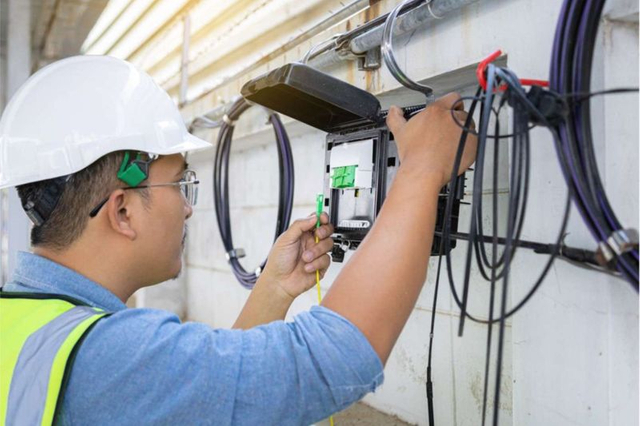
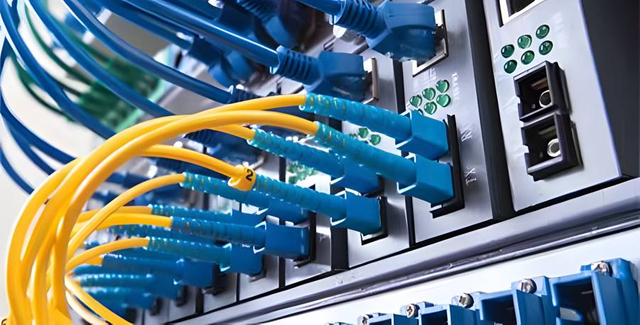
A complete tower-side termination path usually follows this route: outside plant cable, fiber closure, tower entry cable, ODF or wall-mount fiber box, patch cord and transport equipment. ODF selection should confirm port capacity, LC or SC interface, UPC or APC connector type, fusion-spliced or pre-terminated design, bend radius management, grounding, labeling, spare adapters and environmental protection.
A Low-Risk Migration Sequence
When migrating a tower from microwave backhaul to fiber backhaul, operators should build the new route in parallel, test it before cutover and keep microwave temporarily as a fallback.

- Audit existing microwave links, tower cabinet, power, grounding and space.
- Survey the fiber route and confirm poles, ducts, permits and tower entry.
- Select ADSS cable, duct cable, closures, ODFs and installation hardware.
- Install and test the passive fiber route.
- Activate optical transport equipment in parallel without immediately carrying all live traffic.
- Validate throughput, latency, synchronization, protection and alarms.
- Migrate live services during a controlled maintenance window.
- Keep microwave temporarily as fallback or backup.
- After acceptance, decide whether to decommission, repurpose or retain microwave equipment.
Testing, Acceptance and Maintenance
Fiber-to-the-tower acceptance should cover outside plant cable quality, splice performance, termination quality and service performance. Recommended checks include cable drum testing before installation, OTDR testing after installation, bidirectional insertion-loss testing, connector inspection and cleaning, polarity verification, optical power measurement, throughput and latency testing, SyncE/PTP validation, failover testing and restoration documentation.
| Microwave Network | Fiber Network |
|---|---|
| Antenna misalignment and tower movement | Cable cuts, macrobends and mechanical damage |
| Rain fade and link fading | Splice loss and connector contamination |
| Spectrum interference | Excavation damage, vehicle impact and route damage |
| RF unit and antenna maintenance | Closure, ODF, patch cord and pigtail maintenance |
| Wireless link performance monitoring | OTDR baseline, optical power and fiber record management |
Operators and tower companies should retain as-built route maps, OTDR baseline traces, splice records, fiber allocation tables, closure identification, spare pigtails, adapters, patch cords, emergency restoration cable and spare closure sealing kits.
Fiberization Readiness Checklist
The following questions help project teams decide whether a tower should be prioritized for fiberization.
- Is busy-hour backhaul utilization consistently above 70%?
- Is the site a key point in a microwave daisy chain?
- Does it support 5G, FWA, high-traffic areas or multi-operator sharing?
- Is there an existing fiber route, pole line or duct nearby?
- Can ADSS use an existing pole line for rapid deployment?
- Is route diversity, ring protection or microwave backup required?
- Does the tower cabinet have enough ODF, power and grounding capacity?
- Can the microwave link remain active during migration?
- Are spare fibers reserved for future services?
- Are OTDR, insertion-loss and service acceptance standards defined?
FAQ
Is fiber always better than microwave backhaul?
No. Fiber provides stronger long-term scalability for high-capacity and shared tower sites, but microwave remains useful for remote locations, difficult routes, temporary coverage and backup links.
Which telecom towers should be fiberized first?
Operators should usually prioritize macro sites, aggregation nodes, high-traffic 5G or FWA sites, multi-operator shared towers, and locations where existing poles, ducts or metro fiber routes can reduce deployment cost.
When should ADSS cable be used for tower fiber deployment?
ADSS cable is suitable when existing pole lines or aerial routes are available, trenching is expensive, and the design can meet span length, wind, ice, tension and electric-field requirements.
What information is needed before requesting a tower fiber BOM?
A project team should prepare tower locations, route type, span or duct conditions, required fiber count, protection design, closure locations, ODF requirements, connector type and acceptance test requirements.
Conclusion
Microwave remains an important mobile backhaul technology, especially for remote, temporary, obstacle-crossing and high-fiber-cost sites. At the same time, fiber provides stronger infrastructure capability for high-traffic sites, aggregation nodes, multi-operator shared towers and long-term network expansion.
A reliable 4G/5G tower backhaul strategy is not a simple choice between microwave and fiber. It is a site-by-site migration plan based on priority modeling, route conditions, capacity planning and controlled cutover procedures.
Sources and Further Reading
The Melaka tower fiberization figures in this article are based on public announcements from Maxis and BERNAMA, both published on August 27, 2026. Microwave adoption and 2030 backhaul mix references are based on Ericsson Microwave Outlook 2025.
Prepare a Passive Fiber Package for Your Tower Project
ZION can support project discussions around ADSS cable, duct cable, fiber closures, ODFs, patch cords and passive fiber infrastructure for telecom tower backhaul migration. Share your tower route, installation environment, fiber count and acceptance requirements to prepare a practical BOM.
Request Project Support



 Fiber Optic Cable
 Fiber Optic Tools
 Ethernet Cable
 Coaxial Cable
 Fire & Security Cable
 Voice, Audio & Video
 Power & Control Cable