
When copper prices, freight rates and lead times are changing, a cable RFQ should not only ask for a unit price. It should clearly define the cable specification, quantity, copper-related requirements, packing method, delivery term, quotation validity and acceptable alternatives. A good RFQ helps the supplier quote faster, reduces hidden cost, and makes it easier for procurement teams to compare offers fairly.
This guide is useful for system integrators, project buyers, distributors, contractors and OEM buyers planning communication cable, structured cabling, fiber optic cable, control cable, security cable or project cable assembly purchases. The focus is not market prediction. The focus is writing an RFQ that makes the quotation basis clear.
Why cable RFQs become risky when costs move

Cable pricing is affected by more than one factor. Copper content, jacket material, production schedule, packing volume, shipping route and delivery term can all change the final landed cost.
For copper-based cables, conductor material is often a major cost component. When the market moves quickly, a quotation that looks competitive today may no longer be valid after several days or weeks. For bulky cable products, freight cost can also change the real project cost, especially when the order includes reels, drums, cartons, racks, cabinets or mixed cable accessories.
A strong RFQ does not try to predict the market. Instead, it makes the quotation basis visible before purchasing approval.
What your RFQ must clarify first
| RFQ Area | Why It Matters | What to Ask the Supplier |
|---|---|---|
| Cable specification | Prevents wrong product selection | Cable type, conductor, fiber count, AWG or cross-section, shield, jacket, color, voltage or application requirement |
| Quantity and tolerance | Affects production planning and price | Exact quantity, acceptable tolerance and split shipment requirement |
| Copper-related condition | Reduces requotation risk | Quotation validity, copper basis and price adjustment condition if applicable |
| Packing method | Affects damage risk and freight volume | Reel, drum, carton, pallet, label and length per roll or drum |
| Delivery term | Affects landed cost comparison | EXW, FOB, CIF, DAP or other agreed Incoterms |
| Documentation | Prevents customs or project approval delay | Datasheet, test report, certificate-related document, packing list and label format |
What to include in a complete cable RFQ
A complete cable RFQ should help the supplier answer three questions: can this product be supplied according to the required specification, can the price be quoted accurately based on quantity and delivery term, and can the order be packed, shipped and documented in a way that matches the project requirement?
- Cable name or application
- Required standard or project specification
- Cable construction
- Conductor size, fiber count or pair count
- Shielding requirement, if any
- Jacket material and color
- Flame-retardant, fire-resistant or outdoor requirement, if applicable
- Length per roll, reel or drum
- Total quantity
- Packing method
- Delivery destination and trade term
- Required documents
- Target delivery schedule
- Quotation validity requirement
- Whether equivalent products are acceptable
If the project has strict approval requirements, ask the supplier to quote the exact specification first and list any equivalent option separately. This keeps engineering approval and budget comparison from being mixed together.
How to handle copper-related RFQ details
For copper communication cables, control cables, security cables, fire alarm cables and other copper-based products, the RFQ should clearly define the conductor requirement.
Do not only write “copper cable” if the project needs a specific conductor class, size, material or flexibility level. The supplier needs to know whether the cable requires solid conductor, stranded conductor, bare copper, tinned copper, CCA, CCS or another conductor type. If a project specification requires pure copper, that requirement should be clearly written.
| RFQ Item | Better Wording | Why It Helps |
|---|---|---|
| Conductor material | Bare copper, tinned copper or another confirmed material | Prevents substitution confusion |
| Conductor size | AWG, mm² or diameter requirement | Avoids under-specified quotation |
| Conductor structure | Solid or stranded | Affects flexibility and installation use |
| Standard | Project standard or product standard, if known | Helps supplier match the right datasheet |
| Copper basis | Ask supplier to state quotation validity or copper adjustment condition | Reduces price dispute when market changes |
| Equivalent option | State whether equivalent conductor options are allowed | Helps supplier propose cost-saving alternatives without changing the approved specification silently |
If your project does not allow alternative conductor materials, write this clearly in the RFQ. If alternatives are acceptable for budget comparison, ask the supplier to quote them as separate options rather than mixing them into one offer.
How to control freight, packing and delivery risk

Freight cost is often underestimated in cable procurement. Cable products may be heavy, bulky or difficult to consolidate with other goods. A low unit price may not be the lowest landed cost if packing volume, shipping route or delivery term is unclear.
For export projects, buyers should avoid comparing one supplier’s FOB quotation with another supplier’s CIF or DAP quotation without adjustment. The RFQ should ask every supplier to quote using the same delivery basis or clearly separate product cost and freight cost.
| RFQ Area | What to Confirm | Risk If Missing |
|---|---|---|
| Packing unit | Roll, carton, wooden drum, plywood drum or pallet | Freight volume may be wrong |
| Length per unit | Length per roll, reel or drum | Site handling may be difficult |
| Gross weight and volume | Estimated packing dimensions | Forwarder cannot estimate accurately |
| Container loading | Whether container loading data is available | Budget may miss space limitation |
| Shipping term | FOB, CIF, DAP or buyer forwarder | Cost comparison becomes unclear |
| Labeling | Shipping mark, project label and item code | Warehouse and site sorting errors |
| Split shipment | Allowed or not allowed | Production and delivery plan may change |
How to ask for quotation validity
When costs are changing, quotation validity should be written as a commercial condition, not assumed. A practical RFQ can say:
Please state the quotation validity period and any material-cost or freight-cost adjustment condition. If the price is based on current copper or freight cost, please indicate whether requotation is required after the validity period.
This wording does not force the supplier to absorb all cost changes. It simply makes the quotation basis visible before the buyer submits the offer for internal approval.
Common RFQ mistakes that create project risk
| Mistake | Possible Result | Better Practice |
|---|---|---|
| Asking only for unit price | Supplier may quote based on assumptions | Send full specification and quantity |
| Missing conductor details | Wrong copper structure or material may be quoted | Define conductor material and size |
| No packing requirement | Freight estimate may be inaccurate | Ask for packing method, weight and volume |
| Mixing trade terms | Offers cannot be compared fairly | Use the same Incoterm for all suppliers |
| No quotation validity | Price may change before approval | Request validity period clearly |
| No document list | Customs or project submission may be delayed | Ask for datasheet, test report and packing list |
| No alternative plan | Project may stop if cost rises | Request approved equivalent options separately |
What to verify before placing the order
Before confirming the order, procurement teams should verify both technical and commercial details. This step is especially important when the RFQ includes multiple cable types, mixed accessories, export packing or project-specific documents.
| Verification Item | Question to Ask |
|---|---|
| Product match | Does the quoted cable match the project specification or datasheet? |
| Material confirmation | Is the conductor, jacket and shielding structure clearly stated? |
| Standard or certification | Are required standards or certificates available for this exact product? |
| Packing | What is the packing method, size, gross weight and label format? |
| Lead time | Is the stated lead time based on current production capacity? |
| Quotation validity | How long is the price valid? |
| Freight | Is freight included or excluded? Which trade term is used? |
| Documents | Can the supplier provide datasheet, packing list, test report or certificate-related documents if required? |
| Alternative option | Are there equivalent options for budget control or faster delivery? |
When separate quotation options are useful
A clear RFQ can ask for more than one option. This is useful when the buyer needs both technical compliance and cost control.
- Option A: exact project specification
- Option B: supplier-recommended equivalent
- Option C: same cable with different packing method
- Option D: split shipment for urgent quantity first
- Option E: FOB price and freight estimate shown separately
Separate options help procurement teams make decisions without losing technical control. They also help engineering teams see whether a cost-saving proposal changes the approved specification or only changes the commercial arrangement.
Related ZION products and solutions for RFQ planning
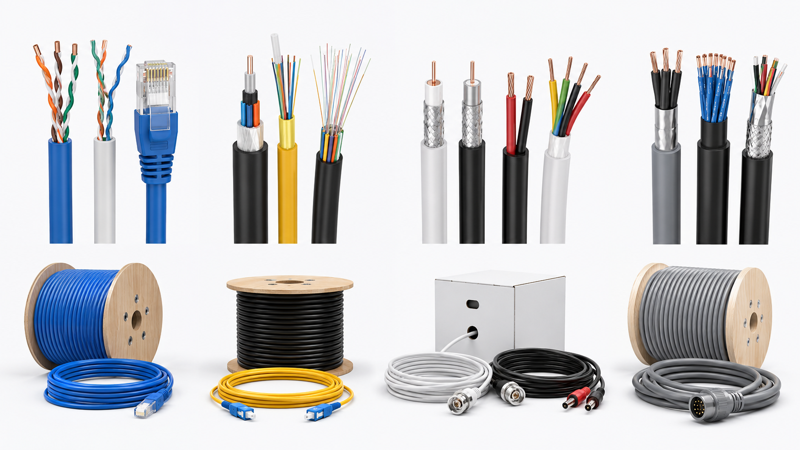
Project RFQs often include more than one cable family. A buyer may need copper communication cable, fiber optic cable, ELV cable, cabinets, patch cords or accessories in one BOM. The following product areas are commonly reviewed during RFQ preparation.
What ZION can support during RFQ preparation
ZION Communication can support buyers during the RFQ preparation stage by helping review cable specifications, project BOMs and quotation requirements before final order confirmation.
Review whether the RFQ includes enough specification, quantity, packing, delivery and document information.
Discuss product direction based on application, construction, installation environment and project requirements.
Check mixed cable and accessory lists for structured cabling, fiber optic, ELV and communication projects.
Support export buyers, distributors and OEM / ODM projects that require packing and label coordination.
FAQ
Why should quotation validity be included in a cable RFQ?
Quotation validity helps both buyer and supplier understand how long the offered price can be used for approval. When copper or freight costs move quickly, a supplier may need to requote after the validity period. Writing this clearly reduces later disputes.
Should a cable RFQ ask for FOB, CIF or DAP pricing?
The best trade term depends on how your company manages logistics. FOB is useful if you use your own forwarder, while CIF or DAP may be easier for landed-cost budgeting. The important point is to compare suppliers using the same delivery basis.
What cable details are most important for copper-based products?
The RFQ should define conductor material, conductor size, solid or stranded structure, shielding, jacket material and required standard. If the project requires pure copper, do not leave the conductor material open to interpretation.
How can buyers reduce freight cost uncertainty?
Ask the supplier to provide packing method, estimated gross weight, carton or drum size, pallet information and loading data if available. This allows your forwarder or procurement team to estimate freight more accurately.
Can buyers ask for equivalent cable options?
Yes, but equivalent options should be quoted separately. The supplier should clearly explain what changes, such as conductor structure, jacket material, packing method or delivery schedule. Do not mix exact-spec and alternative options in one unclear quotation.
What documents should be requested with a cable quotation?
Common documents include datasheet, product specification, packing list, test report and certificate-related documents if required. The exact document list depends on the product type and project approval process.
Why does packing affect the final cost?
Cable packing affects both product protection and shipping volume. Drums, reels, cartons and pallets may have different handling requirements and freight impact. For export orders, packing should be confirmed before comparing final landed cost.
Sources and references
For articles that mention copper prices, freight movements, standards, certification or performance data, use traceable sources and product-specific documents. The following references are useful for market context and quotation-basis discussion.
- London Metal Exchange copper data can be used as a public reference for copper market context.
- Drewry World Container Index can be used as a public reference for container freight market context.
- UNCTAD Review of Maritime Transport provides broader context on shipping costs and supply-chain volatility.
- Product-specific technical statements should be checked against the relevant ZION datasheet, product page, certificate file or confirmed project document.