Choose ADSS cable when the aerial route requires an all-dielectric self-supporting cable, especially where metallic messenger or grounding complexity should be avoided. Choose Figure-8 aerial fiber cable when an integrated messenger construction is suitable for economical pole-line access or rural distribution. The correct choice depends on span length, pole condition, wind and ice exposure, sag limits, electrical environment, installation hardware and maintenance plan.
ADSS and Figure-8 use different support methods
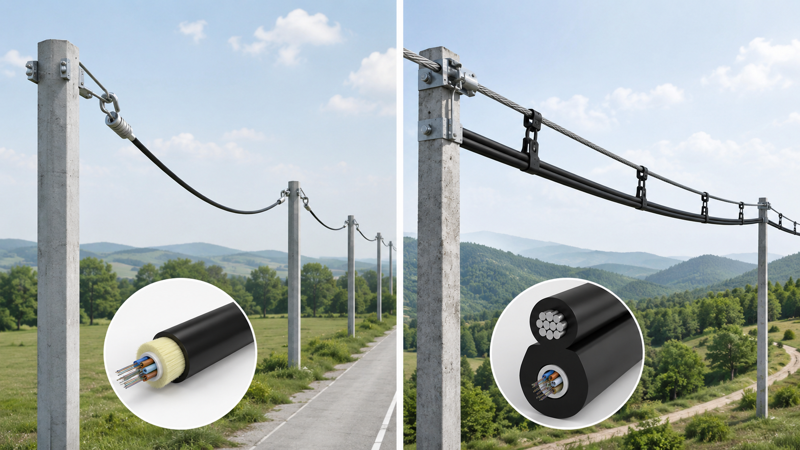
ADSS is selected around all-dielectric self-supporting design and span engineering. Figure-8 cable is selected around integrated messenger support and pole attachment. Both can be used in aerial routes, but they are not interchangeable by name or fiber count.
The following examples help explain the difference between ADSS and Figure-8 aerial cable selection. They should be used as model-specific references, not as universal limits for all aerial fiber cables.
For ADSS cable, ZION’s ADSS selection guidance emphasizes that buyers should start with maximum span, required fiber count and installation method. ADSS should not be selected by core count alone. Route condition, mechanical load, sheath requirement and matching accessories also need to be reviewed. ZION’s ADSS installation guidance also notes that the cable should follow the designed sag value and that cable tightening tension should be controlled according to RTS-based installation requirements.
For Figure-8 aerial cable, ZION GYFC8S is listed as a light armored self-supporting Figure-8 optic cable for aerial installation. The published model page lists 24, 48, 72, 96 and 144 fiber count options, FRP central strength member, water blocking tape and yarn, corrugated steel tape armor and 7×1.6mm messenger wire. The same page lists -40°C to +70°C operating temperature, 8000N / 2700N short-term / long-term tensile strength and 2000N/100mm / 600N/100mm short-term / long-term crush resistance.
In practical selection, ADSS is usually reviewed by maximum span, sag, RTS, wind and ice condition, sheath type and hardware matching. Figure-8 cable is reviewed by messenger structure, pole attachment method, route span, cable diameter and installation handling. Buyers should provide pole spacing, route length, climate condition and hardware requirement before quotation.
Aerial cable comparison table
| Decision point | ADSS cable | Figure-8 cable |
|---|---|---|
| Support logic | Self-supporting all-dielectric cable | Integrated messenger supports aerial installation |
| Main engineering input | Maximum span, sag, RTS, wind/ice load, sheath requirement | Messenger strength, pole attachment, cable OD, bend control |
| What to confirm | Span design, clamp matching, tension set, suspension set | Messenger structure, route span, pole hardware, installation method |
| Avoid writing | ADSS is always better for long span | All Figure-8 cables have the same tensile strength |
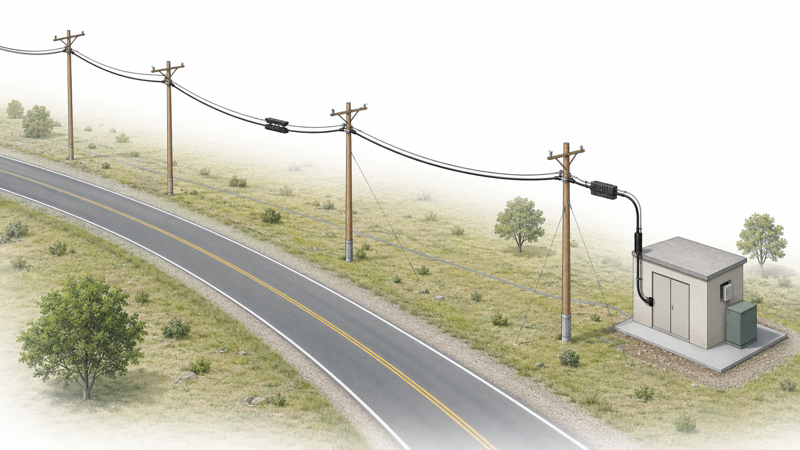
How route condition changes ADSS vs Figure-8 selection
| Project condition | Better direction | Why |
|---|---|---|
| Metal messenger is not preferred | ADSS | All-dielectric design simplifies metal-related concerns. |
| Short or medium rural access line | Figure-8 | Integrated messenger supports fast aerial deployment. |
| Utility-adjacent pole line | ADSS or special design | Electrical environment must be checked. |
| Existing pole attachment plan | Figure-8 may fit | Messenger attachment can be straightforward. |
| Long span or harsh weather | ADSS with proper design | Span and sag must be engineered. |
| Mixed aerial and FTTH drop | ADSS / Figure-8 plus drop cable | Backbone and subscriber drop should be separated. |
What to verify before quotation
- Maximum span and pole spacing, not only average route length.
- Wind, ice and local outdoor conditions.
- RTS, sag and installation tension for ADSS routes.
- Messenger wire and pole attachment method for Figure-8 routes.
- Matching accessories such as suspension clamps, tension clamps and closure positions.
Related ZION products and solutions
Aerial Fiber Cable Network Solution
Solution page for ADSS, Figure-8 and aerial FTTH route planning.
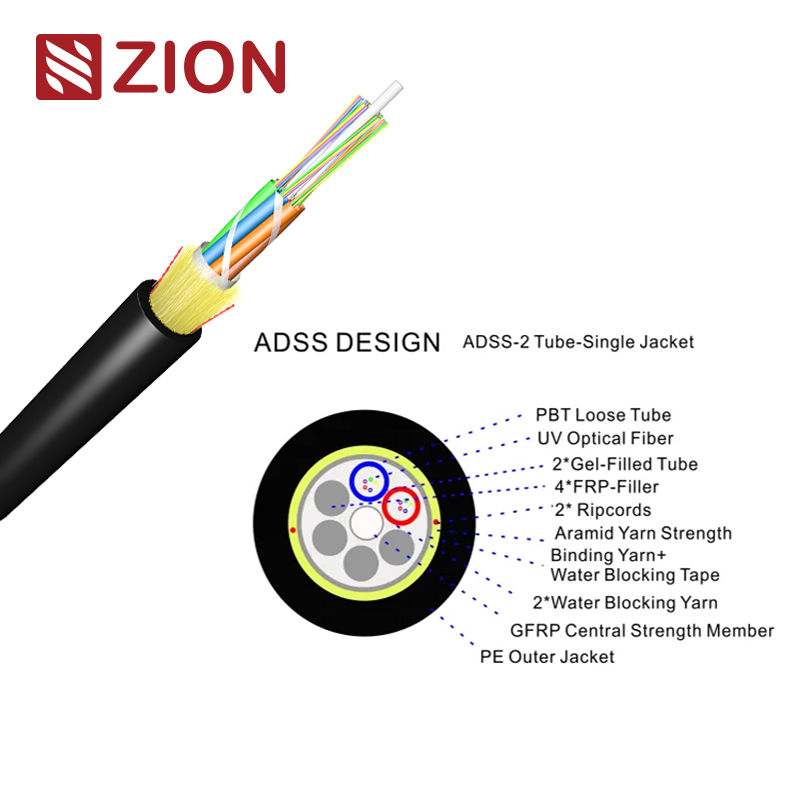
ADSS Cable
All-dielectric self-supporting cable family for aerial route selection.
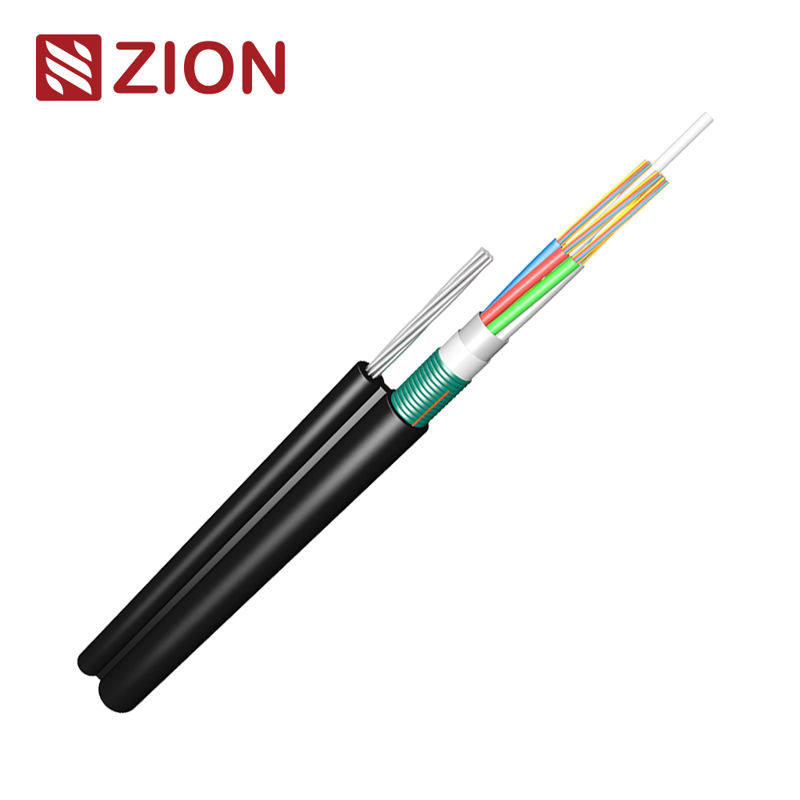
GYFC8S Figure-8 Optic Cable
Model-specific Figure-8 aerial cable example with integrated messenger wire.
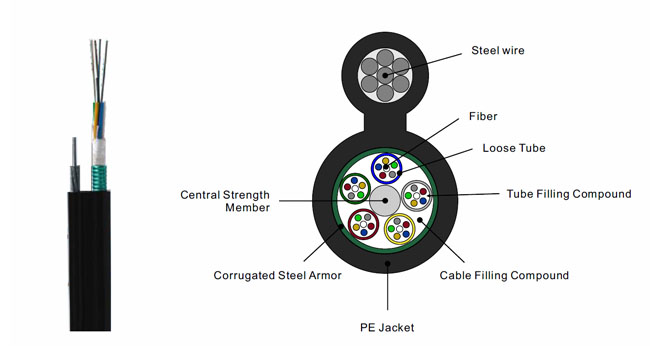
Figure-8 Self-Supporting Fiber Cable
Category page for self-supporting Figure-8 aerial fiber cable options.
What ZION can support
Review maximum span, sag and accessory matching before quotation.
Check messenger structure, pole attachment and route span.
Match cable with clamps, closures and route hardware.
Confirm model-specific mechanical and environmental data.
FAQ
Is ADSS the same as Figure-8 cable?
No. ADSS is an all-dielectric self-supporting cable, while Figure-8 cable uses an integrated messenger structure.
Can I choose ADSS cable only by core count?
No. ADSS cable selection should start from maximum span and route condition. Core count affects capacity, but span, sag, sheath and accessories define suitability.
Is Figure-8 cable only for short routes?
Not necessarily. It is commonly used for aerial distribution and access routes, but the suitable span must be confirmed by product design and installation plan.
What information is needed for an ADSS quotation?
Provide span length, pole distance, wind and ice conditions, fiber count, cable length, installation hardware expectations and project location requirements.
Can one aerial project use both ADSS and Figure-8 cable?
Yes. A project may use ADSS for backbone spans and Figure-8 or drop cable for access sections.
Sources and references
- ADSS Cable page.
- ADSS Installation Guide for installation guidance.
- ADSS Selection Guide for span/core count selection logic.
- GYFC8S Figure-8 Optic Cable product page.