AI Is Changing How Optical Capacity Is Purchased
For many years, optical procurement followed a familiar sequence: finalize the project, issue an RFQ, select a supplier, release the purchase order, and wait for production. That model works when standard products are widely available and upstream lead times are shorter than the project schedule.
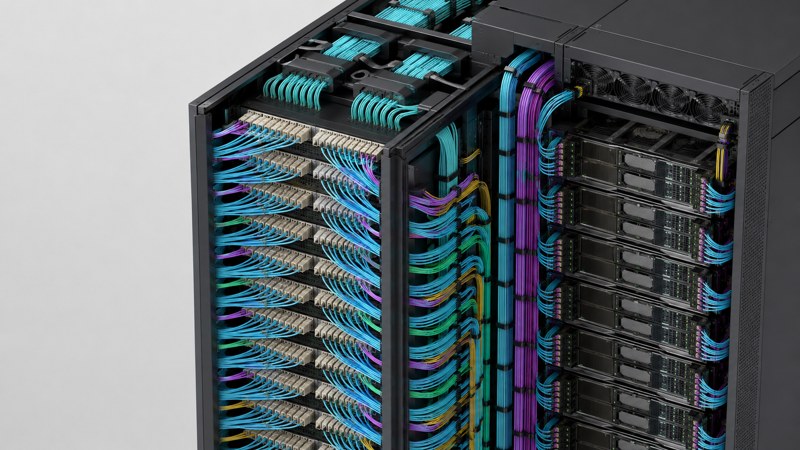
AI data centers, hyperscale campuses, data center interconnects, and high-capacity transport networks are pushing procurement toward a longer planning cycle. Buyers increasingly need to connect demand forecasts, qualification, capacity allocation, contract terms, and scheduled releases before the final bill of materials is frozen.
A purchase order may confirm demand, but it does not automatically create capacity for optical DSPs, lasers, photonic components, specialty fiber, cable, connectors, or pre-terminated assemblies.
What Recent Industry Signals Tell Optical Network Buyers
Recent announcements show the same procurement shift at several layers of the optical supply chain. They do not prove that every fiber-optic product is scarce; they show that critical, qualified capacity is increasingly secured through longer and more specific commercial arrangements.
Ciena: backlog and upstream supply commitments
Ciena reported fiscal third-quarter 2026 revenue of $1.671 billion, up 37% year over year. On its earnings call, management said backlog reached approximately $8.5 billion at quarter-end and was projected to exceed $10 billion by fiscal year-end. Ciena also said customer commitments extended through 2029 and that it had finalized long-term agreements securing selected key-component supply and incremental capacity through 2029.
This is primarily a signal from optical networking systems, coherent connectivity, and critical optical components, not evidence of a uniform shortage across the global fiber cable market.
Meta and Corning: long-term demand supporting new cable capacity
In January 2026, Meta and Corning announced a multiyear agreement valued at up to $6 billion for optical fiber, cable, and connectivity solutions. Corning said it would expand manufacturing in North Carolina, including significant optical cable capacity where Meta would serve as the anchor customer.
NVIDIA, Coherent, and Lumentum: purchase commitments plus capacity rights
NVIDIA announced separate multiyear agreements with Coherent and Lumentum in March 2026. Each included multibillion-dollar purchase commitments and future access or capacity rights for advanced laser or optical networking products. NVIDIA also announced a $2 billion investment in each supplier to support R&D and additional U.S. manufacturing capacity.
The distinction matters: buying products and securing future access to qualified production capacity are related, but they are not the same contractual right.
Long-term agreements extend into fiber, cable, and connectivity
In May 2026, NVIDIA and Corning announced a partnership under which Corning planned to increase U.S. optical connectivity capacity tenfold and expand U.S. fiber production capacity by more than 50%. Amazon followed in June with a multiyear, multibillion-dollar agreement for its expanding U.S. data center infrastructure.
In August 2026, Zayo announced a long-term agreement with Corning to secure a significant portion of the cable required for its network expansion through the remainder of the decade, supporting 15,000 planned route miles by 2030. Earlier Lumen-Corning and Molex-Prysmian agreements showed similar efforts to connect future network growth with defined cable supply.
| Industry signal | Supply-chain layer | Procurement lesson |
|---|---|---|
| Ciena backlog and agreements | Optical systems and critical components | Customer demand visibility and upstream security must move together. |
| NVIDIA with Coherent and Lumentum | Lasers and optical networking products | Future capacity access can be negotiated separately from purchases. |
| Meta, Amazon, NVIDIA, and Zayo with Corning | Fiber, cable, and connectivity | Long-term demand can support new factories, lines, and allocation. |
| Lumen-Corning and Molex-Prysmian | Network cable programs | Operators and suppliers are linking forecasts to longer agreements. |
Why AI Networks Raise Fiber Demand and Supply Risk
AI data centers are not simply larger versions of traditional server rooms. GPU clusters, high-speed switching fabrics, low-latency interconnects, and campus-scale architectures create more optical links inside facilities and between data halls, buildings, and metropolitan compute sites.

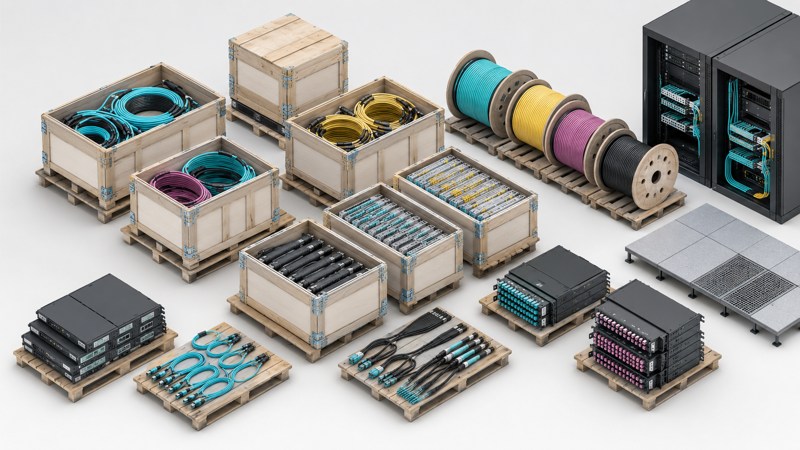
A project may need large quantities of OS2 single-mode fiber, MPO/MTP pre-terminated assemblies, LC patch cords, high-density cassettes, ODF systems, outdoor cable, labels, and replacement stock.
Dense racks increase links between servers, switches, and aggregation layers.
Scale-up and scale-out networks need predictable high-density connectivity.
Distributed compute requires outdoor fiber, diverse routes, and staged backbones.
Supply must align with power, activation, testing, and handover windows.
The procurement risk is therefore not only whether a cable meets its specification. It is whether the supplier can deliver the correct, qualified product mix in the sequence the site requires.
Why a Purchase Order Is No Longer Enough
A purchase order answers what the buyer wants now. Supply security also requires answers about forecasts, qualified capacity, lead-time start points, approved alternates, release schedules, price rules, and second-source readiness.
| Buyer question | What must be confirmed |
|---|---|
| Forecast | Which months are informational, adjustable, or commercially committed? |
| Available capacity | Is capacity qualified for the exact product, plant, line, and delivery window? |
| Lead time | Does the clock start at PO acceptance, drawing approval, or material release? |
| Approved alternate | Which substitute fibers, compounds, connectors, chips, lasers, or packaging are approved? |
| Release schedule | Can capacity be secured without receiving all inventory at once? |
| Price adjustment | What index, evidence, threshold, notice period, and cap apply? |
| Second source | Are qualification, documentation, logistics, and trial delivery complete? |
Without these answers, a purchase order may establish commercial intent while leaving the delivery schedule exposed to upstream constraints.
Match the Forecast Model to Qualified Capacity
Not every forecast creates the same protection. The right model depends on demand confidence, product criticality, qualification time, and the financial cost of delay.
| Model | What it provides | Main limitation |
|---|---|---|
| Non-binding forecast | Planning visibility | No guaranteed allocation |
| Rolling forecast | Updated material and labor signal | Near-term quantities still need a freeze window |
| Capacity reservation | Defined production access | May require fees, deposits, or minimum volume |
| Take-or-pay | Strong capacity visibility | Buyer accepts volume or payment risk |
| Blanket order with releases | Staged delivery framework | Release and cancellation rules must be explicit |
Qualified capacity matters more than nameplate capacity
A factory may have open machines and still be unable to produce an approved configuration immediately. Qualified capacity can depend on approved materials, trained operators, validated tooling, stable processes, test equipment, documentation, packaging, and country-of-origin requirements.
Buyers should ask for capacity by product family, factory, production line, qualification status, and delivery period. A general statement that capacity is available is not a reliable delivery metric.
Use Alternates, Release Schedules, and Price Rules to Control Risk
Supply assurance becomes practical when technical approvals and contract rules are completed before the project becomes urgent.
Approve alternate materials before a shortage
An alternate-material file should identify the affected part number, original material, proposed substitute, applicable standards, test results, mechanical and optical differences, regulatory impact, approval status, and change-control process. For cable and assemblies, this may involve fiber brand, jacket compound, aramid yarn, water-blocking material, armor, connector components, ferrules, fan-out tubing, or packaging.
Define a release schedule
One workable structure is a 12-month rolling forecast, a firm 90-day production window, an agreed adjustment range for months four to six, planning quantities for months seven to twelve, and non-cancellable windows for identified long-lead components. Urgent orders should have a separate process and price rule.
Treat price adjustment as a contract term
The contract should define eligible cost categories, supporting evidence or reference indices, review frequency, trigger thresholds, adjustment caps, effective dates, treatment of existing backlog, and whether downward adjustments apply when costs fall.
Ciena's fiscal third-quarter 2026 earnings discussion illustrates why buyers should avoid assuming one industry-wide increase. Management described expected adjustments ranging from high single digits to high teens or low 20s depending on the customer and product line. Pricing pressure is product- and contract-specific.
A Second Source Is Real Only After Qualification
A supplier name in a spreadsheet is not yet a second source. A usable source should have completed technical review, sample testing, documentation approval, commercial terms, production trial, logistics validation, and a defined activation process.

Buyers should also check whether two nominal suppliers depend on the same constrained upstream laser, DSP, fiber preform, compound producer, or contract manufacturer. Second-source planning must examine shared dependencies beyond the company name on the quotation.
Products that generally need earlier planning
- High-speed coherent optical transport systems.
- Optical DSPs, advanced lasers, and critical photonic components.
- 400G, 800G, 1.6T, and next-generation optical interconnect products.
- High-fiber-count or non-standard cable structures.
- Subsea, marine, mining, railway, industrial, and other special-environment cables.
- Customized pre-terminated trunks and high-density connectivity assemblies.
- Products requiring customer-specific, regional, safety, or environmental qualification.
Standard patch cords, adapters, common passive components, widely available indoor cables, and generic accessories may often remain under rolling procurement when several qualified sources exist. Local stock, approved brands, and replacement compatibility still need confirmation.
What Smaller EPCs, Integrators, and Distributors Should Confirm
Smaller buyers do not need to imitate a hyperscaler's multibillion-dollar agreement. Their strongest protection often comes from flexible, high-mix, staged supply combined with clear technical and commercial checkpoints.
| Checklist area | What to confirm | Why it matters |
|---|---|---|
| Capacity and lead time | Qualified line, current allocation, start point, and stability across phases | Protects commissioning from lead-time changes |
| Product mix | OS2 trunks, MPO/MTP assemblies, LC patching, cassettes, ODFs, and cable | Prevents one missing item from blocking testing |
| Configuration | Connector, polarity, fiber count, length, jacket, labeling, and packaging | Reduces mismatch, rework, and replacement |
| Approved alternates | Substitute part numbers, evidence, standards, and approval status | Allows controlled changes when materials tighten |
| Documentation | Datasheets, test reports, packing lists, BOM revisions, and traceability | Supports acceptance and handover |
| Delivery plan | Release by building, hall, route, room, rack zone, or phase | Aligns material flow with site execution |
| Second source | Qualification, trial delivery, capacity, and upstream dependencies | Makes the backup source usable |
ZION's structured cabling systems guide explains why fiber, copper, pathways, labels, testing, and documentation should be coordinated as one installation system.
A Practical Optical Supply Security Framework
Optical supply security can be managed through six connected controls:
- Visibility: build a realistic forecast by product family and phase.
- Capacity: confirm qualified availability rather than theoretical output.
- Qualification: approve primary and alternate materials early.
- Contract: define allocation, lead time, price adjustment, cancellation, and responsibility.
- Release: convert forecasts into controlled production and delivery windows.
- Verification: track quality, delivery, documentation, and upstream changes.
The objective is not to reserve every product years in advance. It is to identify the few items capable of delaying the network, secure them early enough, and keep the remaining project supply flexible.
Primary Sources
These sources support the industry examples and factual statements used in this article.
- Ciena Reports Fiscal Third Quarter 2026 Financial Results, September 3, 2026.
- Ciena Corporation Q3 2026 Earnings Call Transcript, September 3, 2026.
- Ciena Form 10-Q for the Quarter Ended August 1, 2026.
- Corning and Meta Multiyear Agreement, January 27, 2026.
- NVIDIA and Coherent Strategic Partnership, March 2, 2026.
- NVIDIA and Lumentum Strategic Partnership, March 2, 2026.
- NVIDIA and Corning Long-Term Partnership, May 6, 2026.
- Amazon and Corning Agreement, June 8, 2026.
- Zayo and Corning Long-Term Fiber Supply Agreement, August 20, 2026.
- Corning and Lumen Supply Agreement, August 1, 2024.
- Molex and Prysmian Long-Term Supply Agreement.
Frequently Asked Questions
Does AI demand mean all fiber-optic products are in shortage?
No. Public evidence points to concentrated pressure in high-speed optical systems, advanced laser and photonic components, AI data center connectivity, and selected large-scale fiber and cable programs. Availability varies by specification, supplier, factory, qualification status, and region.
Is a capacity reservation the same as a purchase order?
No. A purchase order requests defined products and quantities. A capacity reservation establishes access to production capability during an agreed period and may include fees, deposits, minimum purchases, forecast obligations, or take-or-pay terms.
Do smaller buyers need multiyear supply contracts?
Not always. Smaller buyers can often reduce risk through rolling forecasts, blanket orders, frozen production windows, approved alternates, local buffer stock, staged delivery, and qualified second sources.
What is the difference between available capacity and qualified capacity?
Available capacity describes general production room. Qualified capacity is the portion able to manufacture a specific approved product using validated materials, processes, tooling, testing, documentation, and compliance controls.
When should an optical buyer qualify a second source?
A second source should be qualified before supply becomes urgent. Qualification should cover samples, performance tests, documentation, manufacturing controls, commercial terms, logistics, and a trial order, including a review of shared upstream dependencies.
Prepare the Optical Supply Plan Before Final Release
Share cable and connectivity specifications, quantities, installation environment, destination, delivery windows, drawings, labeling rules, and test requirements so the project package can be reviewed for qualification, staged delivery, and supply risk.
Request Project Support



 Fiber Optic Cable
 Fiber Optic Tools
 Ethernet Cable
 Coaxial Cable
 Fire & Security Cable
 Voice, Audio & Video
 Power & Control Cable