OS2 Vs OM3 Vs OM4 Vs OM5 Fiber | 2026 ZION Selection Guide for FTTH, Data Centers & AI Networks
Author: James Publish Time: 07-01-2026 Origin: Site
OS2 vs OM3 vs OM4 vs OM5: ZION 2026 Fiber Selection Guide for FTTH, Data Centers & AI Networks
In 2026, choosing between OS2, OM3, OM4 and OM5 is no longer just a “speed vs distance” question. AI clusters, FTTH/FTTR, 400G/800G optics and ESG targets all push projects toward the right combination of single-mode and multimode fiber — especially low-loss OS2 and bend-insensitive G.657.B3.
OS2 is becoming the universal backbone — from FTTH/FTTR to 800G AI fabrics.
OM4 / OM5 stay in short, high-density runs; OM3 is legacy-only in new designs.
G.657.B3 bend-insensitive OS2 and low-loss fiber are now critical for FTTR and LPO/CPO AI optics.
■ 1) Why Fiber Choice Matters in 2026
For many years, fiber selection seemed simple: single-mode for long-distance, multimode for buildings. In 2026, this rule-of-thumb is no longer enough. Networks now have to serve very different roles at the same time: FTTH/FTTR, dense enterprise floors, 100G–400G–800G data centers and power-constrained AI clusters.
On top of that, project owners and investors are under pressure to meet ESG and carbon reduction goals. The medium you choose — OS2, OM3, OM4 or OM5 — directly affects not only bandwidth and reach, but also power, cooling, upgrade cycles and maintenance risk.
Many buildings and data rooms built between 2010–2020 are already facing re-cabling. 10G-only multimode backbones and non-bend-insensitive fibers cannot keep up with FTTR, 100G+ and AI workloads. The result: extra CAPEX, OPEX, downtime and tenant dissatisfaction.
In 2026, fiber is not a commodity; it is a long-term infrastructure decision that affects the next 10–15 years of your network.
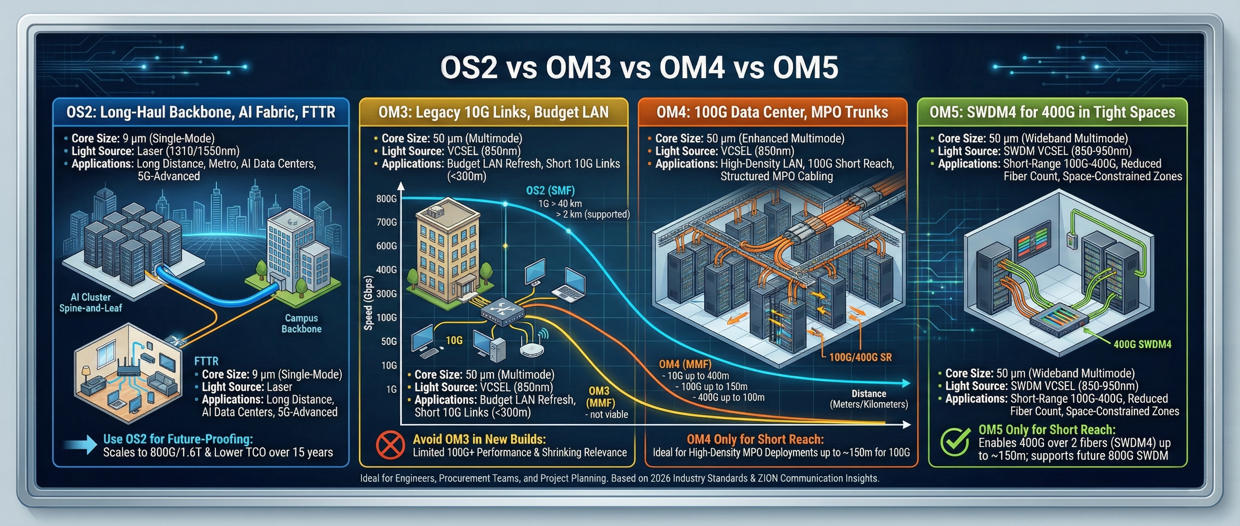
■ 2) OS2 / OM3 / OM4 / OM5 at a Glance
The table below summarizes the four main fiber classes used in modern projects. ZION COMMUNICATION offers each of these as part of our optical fiber cable portfolio.
| Fiber Type | Core Size | Key Standard | Typical Light Source | Primary Usage |
|---|---|---|---|---|
| OS2 (Single-Mode) | 9 µm | ITU-T G.652D / G.657.A2 / G.657.B3 | Laser (1310 / 1550 nm and beyond) | Backbone, FTTH/FTTR, campus, metro, AI clusters |
| OM3 (Multimode) | 50 µm | ISO/IEC 11801 OM3 | 850 nm VCSEL | Legacy budget LAN, short 10G links |
| OM4 (Enhanced Multimode) | 50 µm | ISO/IEC 11801 OM4 | 850 nm VCSEL | 10–100G data center and enterprise floors |
| OM5 (Wideband Multimode / WBMMF) | 50 µm | ISO/IEC 11801 OM5 | 850–953 nm SWDM VCSEL | 100–400G SWDM links in compact data rooms |
Use OS2 when distance, upgrade path or AI workloads matter; reserve OM4/OM5 for short, dense in-building links; treat OM3 as a legacy option in new designs.
■ 3) Speed–Distance & Performance Comparison (2026 Reality)
Modern Ethernet and InfiniBand links push optical reach and bandwidth harder than ever. Below is a practical, rounded view of what OS2, OM3, OM4 and OM5 can support in typical deployments.
| Speed Tier | OS2 | OM3 | OM4 | OM5 |
|---|---|---|---|---|
| 1G / 10G | > 40 km with proper optics | Up to ~300 m | Up to ~400–450 m | Up to ~450–500 m |
| 25G | 10–15 km+ typical | ~70–100 m | ~150 m | ~200 m |
| 100G Ethernet | Up to ~10 km (LR/ER); longer with CWDM/DWDM | ~70–100 m (MPO) | ~150 m (MPO) | ~200 m (SWDM) |
| 400G Ethernet | ~2–4 km (DR/FR/FR4 optics) | Not recommended | ~100–150 m (SR4) | ~200–300 m (SWDM4) |
| 800G Ethernet / NDR IB | Supported with appropriate SMF optics | Not viable | Very limited, niche use only | Limited, short reach and cost-sensitive |
■ 4) Where Each Fiber Type Makes Sense
OS2 Single-Mode: Universal Backbone & AI Fabric
OS2 is now the default choice for projects that care about distance, future upgrades or AI workloads. It is used in campus backbones, metro links, FTTH/FTTR, and increasingly inside data centers.
Backbone links between buildings, rooms and racks
FTTH and FTTR using G.657.A2/B3 bend-insensitive OS2 for invisible, tight-corner routing
100G/200G/400G/800G Ethernet and InfiniBand in AI clusters
Any design targeting 10–15 years of scalability

OM3: Legacy Budget Multimode
OM3 is still present in many existing buildings and can support 10G reasonably well, but in 2026 it is rarely the best choice for new installations that anticipate 40G, 100G or beyond. Treat OM3 as a cost-driven, legacy-only option when upgrades are not expected.
OM4: Workhorse Multimode for Enterprise & Data Centers
OM4 improves reach and performance over OM3 and remains widely used for:
10G / 40G / 100G short-reach links
High-density patching with MPO/MTP trunks
In-rack and row-to-row structured cabling
OM5: Wideband Multimode for SWDM in Tight Spaces
OM5 (WBMMF) is designed to extend multimode usefulness into the 400G era using SWDM4 technology. It is attractive where duct space is limited and fiber count must be reduced, especially in small data rooms and edge compute sites.
Use OS2 whenever distance, upgrade flexibility or AI workloads are in the picture; keep OM4/OM5 for short, dense, pre-planned paths inside rooms and racks. This keeps your long-term CAPEX and OPEX under control.
■ 5) AI Clusters, LPO/CPO & the Need for Low-Loss OS2
AI fabrics push fiber harder than Internet backbones ever did
2026 is the year AI training and inference clusters dominate new data center builds. These fabrics commonly use:
400G and 800G Ethernet
HDR/NDR InfiniBand
Leaf–spine or dragonfly topologies spanning thousands of GPUs
In these environments, OS2 single-mode is no longer just a “long-haul” medium. It increasingly becomes the default inside the data hall as well, because multimode reach and scaling become limiting.
LPO / CPO: why optics without DSP demand better cabling
To reduce power, AI designs are rapidly adopting LPO (Linear Drive Pluggable Optics) and CPO (Co-Packaged Optics). Removing or shrinking DSP-based equalization means:
Far less tolerance for attenuation variation and reflections
Stricter requirements on fiber geometry and connector quality
Higher sensitivity to modal noise and dirty interfaces
As AI clusters adopt LPO/CPO technologies to save power, the demand for premium low-loss OS2 cabling becomes non-negotiable. Poor cabling quality kills the very power savings LPO/CPO are intended to deliver.
In AI data centers, OS2 single-mode is taking over both long and short optical runs. OM4/OM5 remain important in edge and patching zones, but they are no longer the primary medium for internal fabrics.
■ 6) ESG, Lifecycle Cost & Energy Efficiency
Network architecture now appears in ESG and sustainability reports. Fiber choices affect:
Power draw of optics and switches
Cooling requirements and rack density
Frequency of re-cabling and material waste
Embodied carbon of metals vs glass
A single, well-designed OS2-based backbone can stay in place through multiple generations of transceivers (10G → 100G → 400G → 800G), whereas multimode or copper-based designs often need disruptive upgrades.
| Dimension | Copper / Short-range Multimode | OS2-centric Fiber Design |
|---|---|---|
| Energy per Gbps | Higher, especially at 100G+; more DSP and retimers | Lower — fewer repeaters, more efficient optics |
| Cooling requirements | Higher heat density in racks | Improved thermal profile, easier cooling |
| Upgrade cycles | Frequent re-cabling at each speed jump | Cabling stays; optics upgrade only |
| Material usage | More copper and plastics over time | Less cable volume per delivered bandwidth |
■ 7) Deployment Recommendations by Scenario
This section turns the theory into practical, project-level guidelines. Use it as a starting point before building your bill of materials with ZION.
| Deployment Type | Recommended Fiber | Reason / Notes | Typical ZION solution |
|---|---|---|---|
| FTTH / FTTR (homes, hotels, MDUs) | OS2 G.657.B3 | Bend-insensitive, ideal for tight cornering and invisible fiber routing | FTTH / FTTR indoor & drop cables |
| Enterprise campus backbone | OS2 (G.652D/G.657.A2) | Long runs, multiple buildings, 10–400G with upgrade path | Indoor/outdoor OS2 LSZH or armored cables |
| Horizontal cabling on floors | OM4 or OM5 | Short distance, high-density patch panels and cabinets | OM4/OM5 fiber patch cords & trunks |
| Data center cross-connect / MPO trunks | OM4 / OM5 | 40–400G short reach with SR/SR4/SWDM optics | MPO/MTP trunks + LC jumpers |
| AI / GPU compute fabrics | OS2 (low-loss) | 400G/800G Ethernet and NDR/HDR IB, LPO/CPO compatible | High-performance OS2 trunks + LC/SC patching |
| Outdoor trench / harsh environments | OS2 Armored | Mechanical strength, moisture protection, long-haul capabilities | GYTA / GYTS / direct-buried OS2 cables |

■ 8) Decision Rules / Engineer’s Shortcut
When time is short and stakeholders are asking for a clear answer, these shortcuts help you move from discussion to specification quickly.
| Situation / Requirement | Engineer’s Shortcut | Fiber Choice |
|---|---|---|
| “We might need 100G–400G–800G later, but don’t know when.” | Design for the highest speed now; let optics lag behind. | OS2 backbone (G.652D/G.657.A2) |
| “We want full-fiber FTTR with invisible cabling.” | Use bend-insensitive OS2 for every in-room link. | OS2 G.657.B3 + pre-terminated FTTR kits |
| “We have dense patch panels, all distances < 150 m.” | Keep single-mode for backbone, multimode for patching. | OM4/OM5 in panel area, OS2 beyond |
| “We are deploying 400G/800G AI fabrics with LPO/CPO.” | Minimize loss variation and reflections across the plant. | High-quality OS2 only, tight specs on installation |
| “Budget is tight, but we still want reasonable future-safety.” | Avoid saving a few dollars per meter at the cost of a re-cable later. | OS2 for backbone; OM4 minimum for multimode |
■ 9) Conclusion & Next Steps with ZION
Fiber is no longer just a “link” — it is the backbone of your AI, cloud, and FTTR strategy for the next decade. Choosing correctly between OS2, OM3, OM4 and OM5 means you can upgrade transceivers and electronics repeatedly without opening ceilings or trenches again.
In 2026 and beyond, the pattern is clear:
Short, dense links → OM4/OM5 with structured patching
Whole buildings and campuses → OS2 (G.652D/G.657.A2)
FTTR and invisible cabling → OS2 G.657.B3 bend-insensitive fiber
AI fabrics and LPO/CPO → low-loss OS2 everywhere
ESG & lifecycle → fiber-first, minimal recabling strategy
ZION COMMUNICATION provides a full stack of OS2, OM4 and OM5 optical fiber cables, along with fiber patch cords and jumper assemblies, allowing engineers to build a unified, AI-ready and ESG-aligned infrastructure with one supplier.
Short reach → OM4/OM5. Whole buildings and AI fabrics → OS2. FTTR and invisible cabling → G.657.B3 bend-insensitive OS2. The sooner this becomes your standard, the less you will spend on re-work later.
Design like you are building for 2035, not just catching up with 2015 mistakes.
Share your project type (FTTH/FTTR, campus, data center, AI cluster), expected link speeds (10G / 100G / 400G / 800G) and approximate distances. Our engineering team can help you choose the right mix of OS2, OM4 and OM5 cables, patch cords and accessories — including G.657.B3 bend-insensitive FTTR solutions.