How to Quote a Complete Structured Cabling BOM for Network Projects
Author: Site Editor Publish Time: 27-04-2026 Origin: Site
How to Quote a Complete Structured Cabling BOM
A complete structured cabling BOM is not just a price list for cables, patch cords, keystone jacks, patch panels, and cabinets. It is a project-level technical quotation that must match category, shielding, port count, cabinet layout, installation environment, accessories, labeling, packing, and testing requirements.
A project BOM should be quoted as a complete cabling channel, not as isolated materials.
Category, shielding, port count, patching logic, cabinet space, and test requirements must be checked together.
Hotel, office, CCTV, AP, and ELV projects need stronger quantity control because many systems share similar materials.
■ What Is a Structured Cabling BOM?
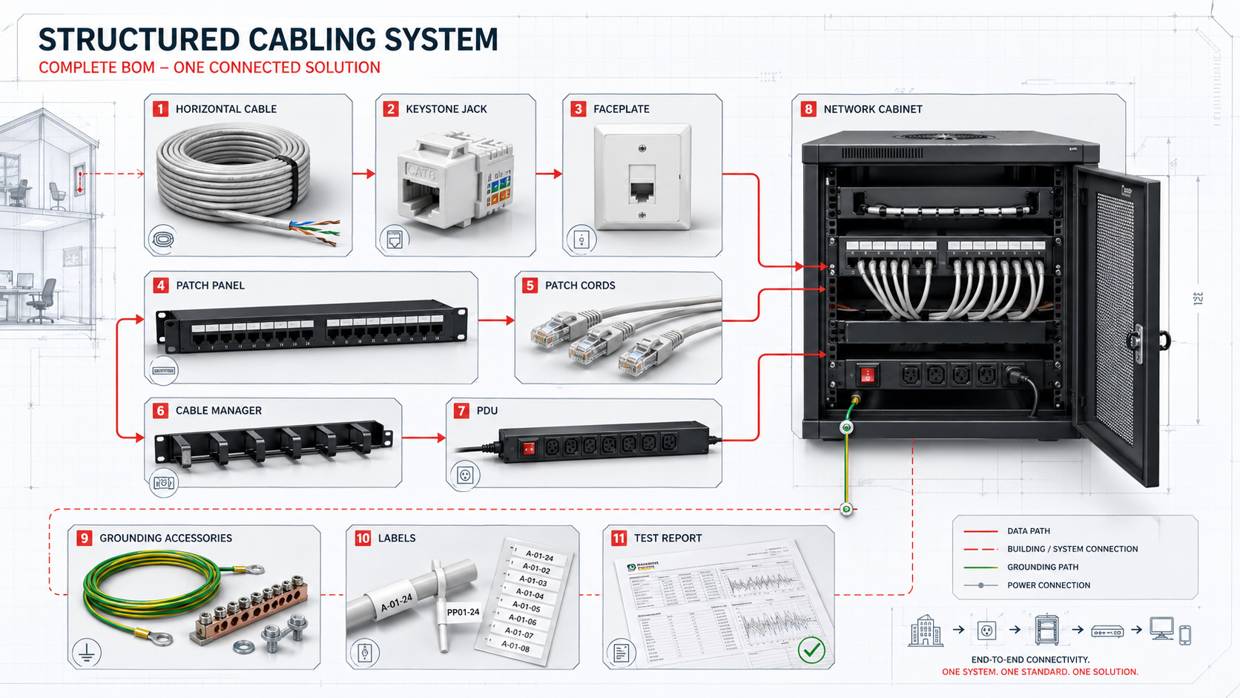
A structured cabling BOM is a complete list of network materials required to build a cabling system for a project. It normally includes horizontal cable, patch cords, keystone jacks, faceplates, patch panels, cabinets, cable managers, PDU, grounding accessories, labels, and sometimes testing or installation consumables.
For hotel, office, school, commercial building, CCTV, Wi-Fi AP, and ELV projects, the BOM should not be treated as a simple purchasing list. Each item must match the next item in the link. A Cat6A cable, for example, should be matched with Cat6A-rated jacks, patch panels, and patch cords if the project expects Cat6A channel performance.

■ Why Project BOM Quotation Is Easier to Get Wrong Than Single-Item Quotation
Single-item quotation is usually straightforward. A request such as “Cat6 UTP cable, 305m box” mainly requires cable category, conductor, jacket, color, and packing information. A project BOM is different because every component affects the final system.
If the cable is shielded but the patch panel is unshielded, the shielding path is broken. If the cabinet depth is too shallow, the switch and rear cable routing may not fit. If patch cords are counted only for the work-area side, the rack-side patching may be missing during installation.
| Risk Area | Typical Mistake | Possible Result |
|---|---|---|
| Category mismatch | Cat6A cable quoted with Cat6 jack or panel | Uncertain channel performance and possible rework |
| Shielding mismatch | FTP cable used with UTP patch cord or unshielded panel | EMC and grounding problems |
| Port count error | Patch panel ports not aligned with outlet quantity | Material shortage during installation |
| Cabinet size error | Cabinet depth or U height not confirmed | Switch, PDU, or cable manager cannot fit |
| Packing mismatch | Carton, pallet, or cabinet packing method ignored | Freight cost increase and site handling risk |
■ Technical Fields to Confirm Before Pricing
Before sending price, the supplier should not only ask for quantity. The quotation team should understand the technical logic behind the quantity. This is especially important when the inquiry says “quotation for network materials” or only gives a rough hotel project material list.
| BOM Field | What to Confirm | Why It Matters |
|---|---|---|
| Project type | Hotel, office, data room, CCTV, AP, ELV system | Determines cable grade, cabinet layout, and accessories |
| Cable category | Cat5e, Cat6, Cat6A, Cat7, Cat7A | Affects the matching jack, patch panel, and patch cord |
| Shielding type | UTP, F/UTP, FTP, S/FTP, F/FTP | Must be consistent across the cabling channel |
| Cable length | Total meters, box quantity, reel quantity, spare ratio | Prevents under-ordering and excessive waste |
| Port quantity | Outlets, cameras, APs, IPTV, workstations | Drives cable, jack, faceplate, and panel count |
| Cabinet size | Wall-mounted or floor-standing, U height, width, depth | Affects switch fit, PDU placement, and cable management |
| Test requirement | Factory report, channel test, permanent link test, Fluke test | Supports project acceptance and documentation |
■ How to Quote Cable, Patch Cord, Jack, Panel, and Cabinet Together
A complete quotation should follow the signal path from the work area to the telecom room or equipment room. The goal is to make sure the material list can support the real installation, not only satisfy a spreadsheet.
| System Part | Quotation Logic | Key Technical Checks |
|---|---|---|
| Horizontal cable | Count by route length, floor plan, point quantity, and spare ratio | Category, shielding, conductor, jacket, packing |
| Keystone jack | Usually one jack per outlet port | Category, shielded/unshielded, 180° or toolless, wiring scheme |
| Faceplate or surface box | Match room outlet layout | Single port, dual port, shutter, module size, color |
| Patch panel | Match total ports and rack layout | 24-port/48-port, loaded/unloaded, shielded/unshielded |
| Patch cord | Count both work-area side and rack-side patching | Length, category, shielding, color, boot type |
| Cabinet or rack | Match switches, panels, cable managers, PDU, and spare U space | Wall/floor type, depth, U height, load capacity |
| Accessories | Add labels, cable ties, grounding kits, screws, cable managers, PDU | Prevents missing low-cost but installation-critical items |
■ Engineering Matching Rules for a Reliable BOM
1. Match the category across the channel
If the project is Cat6A, cable, keystone jack, patch panel, and patch cord should all be Cat6A-rated. Do not let one lower-category item become the weak point.
2. Keep shielding consistent
For shielded projects, the shield path should continue from cable to jack, patch panel, patch cord, and grounding point.
3. Count patch cords carefully
Patch cords should include both user-side and rack-side quantities. Spare pieces should be added for maintenance and future changes.
4. Quote cabinet space by real equipment
Cabinet U height is not enough. Check switch depth, rear cable bending, PDU position, ventilation, and cable manager space.
| Project Condition | Recommended Direction |
|---|---|
| Standard office network with low EMI | UTP system may be sufficient |
| Hotel guest room network with normal routing | Cat6 UTP or Cat6A UTP depending on bandwidth plan |
| Dense cable tray or equipment room | Cat6A F/UTP, F/FTP, or S/FTP depending on project requirement |
| Industrial, elevator, power room, or high EMI route | Shielded system strongly recommended |
| Project requiring grounding control | Confirm shielded patch panel, cabinet grounding, and grounding accessories |
■ Hotel Project BOM: What Needs Extra Attention?
Hotel projects are easy to misquote because many systems use similar network materials but have different installation logic. Guest room data, IPTV, Wi-Fi AP, CCTV, POS, access control, office network, and back-office systems may all appear in one inquiry.
| Hotel Area | Common Materials | Quotation Attention |
|---|---|---|
| Guest room | Cable, keystone jack, faceplate, patch cord | Room count × port count, faceplate style, color, label plan |
| IPTV | Cable, jack, patch cord, patch panel | Separate labeling and port planning |
| Corridor AP | LAN cable, outlet or plug, ceiling route accessories | PoE requirement, ceiling route, installation position |
| CCTV | Cable, patch panel, cabinet, patch cord | Indoor/outdoor route, PoE load, jacket requirement |
| Floor cabinet | Patch panel, cable manager, switch space, PDU | Cabinet depth, spare U space, front/rear cable routing |
| Main equipment room | Floor-standing cabinet, high-density patching, PDU, grounding | Aggregation logic, future expansion, maintenance access |
■ Procurement, Engineering, and Sales: Who Should Confirm What?
A reliable project quotation requires cooperation between procurement, engineering, and supplier-side sales or technical support. Procurement controls budget and delivery, engineering controls compatibility, and the supplier checks availability, substitution risk, and quotation completeness.
| Role | Main Responsibility | Key Questions |
|---|---|---|
| Procurement | Budget, quantity, delivery, packing, payment terms | Is the BOM complete? Are accessories included? |
| Engineer or consultant | Technical standard, system design, compatibility | Are category, shielding, grounding, and cabinet layout correct? |
| Supplier sales | Product matching, quotation format, lead time | Are all items available and correctly specified? |
| Supplier engineer | Technical review, substitution check, risk warning | Are there mismatched components or missing fields? |
| Project owner | Acceptance requirement and maintenance expectation | Will the system support future operation and expansion? |
■ Practical Quotation Checklist Before Sending Price
Before submitting a complete structured cabling BOM quotation, review the list below. These items are often small, but they can decide whether the quotation is usable for real project purchasing.
■ FAQ
■ Conclusion
Quoting a complete structured cabling BOM requires more than adding prices to a list of network materials. The supplier must check cable category, shielding structure, port count, patching logic, cabinet space, accessories, packaging, and testing requirements as one complete system.
For hotel, office, CCTV, AP, and ELV projects, a clear BOM reduces installation delays, avoids compatibility mistakes, and helps procurement teams compare quotations more accurately.