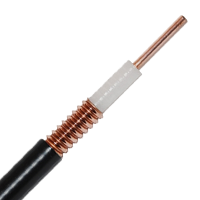


Easy to terminate and route. Choose a video-grade, solid-copper construction and verify the format-specific distance.
CCTV · CATV · RF · Tunnel communications
Coaxial Cable Selection Guide
Choose the right RG59 CCTV cable, CATV coax, low-loss 50-ohm feeder or radiating leaky cable by matching impedance, attenuation, shielding, distance, environment and connectors—not by cable name alone.
Start with the system
One cable name can hide very different performance
Impedance is the first filter. CCTV and CATV commonly use 75-ohm coax, while antenna and radio feeder systems commonly use 50-ohm coax. Next, compare attenuation at the actual frequency, conductor material, shielding, jacket, bend radius and compatible connectors.
RG6 balances handling and loss; RG11 is larger and generally better for long trunks where the level budget is tight.
Match the radio and antenna ports, then specify frequency, route loss, VSWR, power, PIM, environment and connectors.
CCTV video and power
RG59 CCTV coax and RG59+2C Siamese cable
A practical CCTV cable specification separates video performance from power delivery. The coax carries the 75-ohm video signal; the two power conductors must be sized from camera current, route length and acceptable voltage drop.
When RG59 is a sound choice
Quality RG59 remains suitable for analog CCTV and can support HD-TVI, HDCVI or AHD when the exact cable is approved for the camera resolution and distance. For longer routes, RG6 may provide more loss margin, but its larger size changes connectors and handling.
A planning figure of roughly 200–300 m is sometimes used for good solid-copper RG59, yet it is not a universal maximum transmission distance. Camera format, resolution, cable attenuation, equalization, connectors and interference all affect the result.
What to put in an RG59 RFQ
- 75 Ω nominal impedance and attenuation table
- Solid bare-copper center conductor, not unspecified CCA
- Braid material, coverage and any foil layer
- RG59+2C power-core gauge and conductor stranding
- PVC, PE, LSZH, plenum or project-specific jacket
- BNC compatibility, printing, length and packaging
Copper versus CCA: CCA has higher DC resistance than copper. That matters to both center-conductor loss and the voltage drop of Siamese power cores. Select CCA only when the equipment manufacturer and project specification explicitly approve the exact construction and route.
CATV coax cable
RG6 vs RG11 vs RG59 and CATV coax shielding
For a 75-ohm CATV network, the cable must preserve the level budget across the full channel range while controlling ingress and egress. Diameter and shielding generally increase from RG59 to RG6 to RG11, but model-specific data is decisive.
| Cable family | Typical role | Relative handling | Selection note |
|---|---|---|---|
| RG59 | Short video or legacy drops | Smallest and easiest to route | Usually the highest attenuation of these three; verify bandwidth and distance. |
| RG6 | CATV drops and medium runs | Balanced size and flexibility | A common distribution choice; shielding construction varies widely. |
| RG11 | Long CATV runs and trunks | Largest, stiffest and widest bend radius | Generally the lowest attenuation; account for connector size and pulling load. |
Class A++ coaxial cable
Class A++ describes high screening performance under relevant EN 50117-family requirements. It is a measured performance classification across defined frequencies—not a marketing synonym for “more layers.” Request a test report or data sheet stating the applicable standard, frequency range and result.
Single, double or triple shield coax cable?
Layer count describes construction, commonly a foil-and-braid combination. A triple shield coax cable can improve isolation, but foil bonding, braid coverage, transfer impedance and the installed connector determine real CATV shielding. Specify the required class or measured limit.
50-ohm coax manufacturer guidance
Low-loss RF feeder jumper and D-FB coaxial cable
A 50 ohm coax manufacturer should quote against operating frequency and route loss, not diameter alone. For an antenna feeder jumper cable, flexibility and connector repeatability are often as important as headline attenuation.
| Decision | Record in the specification | Why it changes the cable |
|---|---|---|
| Electrical | 50 Ω, frequency band, maximum loss, VSWR/return loss, power and PIM if required | Defines dielectric size, conductor, shielding and assembly quality. |
| Mechanical | Route length, minimum bend radius, flexibility, pulling tension and connector interface | Prevents damage and ensures the assembly fits the radio and antenna. |
| Environment | Indoor/outdoor, UV, water blocking, direct burial, temperature, smoke and flame rating | Determines jacket, water protection and installation method. |
| Accessories | Grounding kit, clamps, hoisting grip, entry seal, surge protection and RF connector weatherproofing | Keeps the installed system safe, supported and weather-resistant. |
What is D-FB coaxial cable?
D-FB coax cable is a common family designation for 50-ohm foam-dielectric RF cable. It does not replace a data sheet. Confirm conductor, dielectric, screen, jacket, attenuation, power, velocity factor, overall diameter and matching connector for the offered model.
5D FB vs 7D FB
7D-FB is larger and normally provides lower attenuation and higher power handling; 5D-FB is lighter and more flexible. Compare loss at the actual frequency over the installed length, then check bend radius, connector availability and mounting space.
Radiating leaky coax cable
Continuous RF coverage through tunnels and confined routes
Slots or apertures in the outer conductor allow controlled RF coupling along the cable, so the cable behaves as a distributed antenna. Tunnel leaky feeder cable is used in metros, railways, roads and mines for radio, cellular, emergency and operational communications.
Manufacturer and procurement
How to source standard or customized coaxial cable
Whether you need a 75 ohm coax manufacturer, 50 ohm coax manufacturer or a supplier of customized CCTV composite cables, make each quotation comparable by issuing the same measurable RFQ.
Technical information
- Application, impedance, frequency band and route length
- Maximum attenuation, screening class and conductor material
- Core count, power-wire gauge or custom composite drawing
- Connector type, bend radius and installation environment
Commercial and quality information
- Applicable standards, certificate scope and test reports
- Sample or first-article approval and batch traceability
- Quantity, unit length, marking, drum and packaging
- Destination, delivery window and required documents
Buyer and engineer FAQ
24 coaxial cable questions answered
The answers below are concise selection guidance. Final distances and compliance must always be verified against the offered cable, connected equipment and adopted project standard.
RG59 CCTV and Siamese cable
Who manufactures RG59 CCTV coaxial cable?
Specialist coaxial cable manufacturers such as ZION Communication can supply RG59 CCTV cable. Evaluate the exact construction, conductor material, braid coverage, impedance, jacket rating, test reports, customization and batch traceability rather than selecting by company name alone.
Where can I buy RG59 Siamese cable with power conductors?
Buy from a CCTV cable manufacturer or authorized distributor that can document both the coax and power-core construction. Include conductor material, power-core gauge, voltage-drop basis, jacket, length, marking and packaging in the RFQ.
What is the difference between RG59 and RG6 for CCTV?
Both are normally 75-ohm cables, but RG6 is generally larger and lower-loss, while RG59 is smaller and easier to route. Actual camera distance depends on the cable data sheet, signal format, frequency, connector quality and installation environment.
Is RG59 suitable for HD analog surveillance cameras?
Yes. A verified 75-ohm solid-copper RG59 designed for video can support HD-TVI, HDCVI or AHD on model-specific distances. Confirm the camera maker’s distance table and cable attenuation instead of treating every RG59 construction as equivalent.
What is the maximum transmission distance of RG59 CCTV cable?
There is no universal maximum. Many system guides use roughly 200–300 m as a planning range for good solid-copper RG59, but the approved distance must come from the camera and cable data sheets for the exact resolution and format.
Should I choose copper or CCA RG59 cable?
Choose solid bare copper for predictable video loss, connector performance and power voltage drop. CCA has higher DC resistance and should be used only when the equipment vendor and project specification explicitly permit that exact construction and distance.
What is an RG59+2C Siamese cable?
RG59+2C combines one 75-ohm RG59 video coax with two insulated power conductors in a joined or common jacket. It lets an analog CCTV camera receive video and low-voltage power through one coordinated cable run.
Which coaxial cable is suitable for HD-TVI, HDCVI or AHD?
Use a 75-ohm CCTV video coax qualified by the equipment vendor, commonly solid-copper RG59 for normal runs or lower-loss RG6 for longer routes. Match BNC connectors to the cable diameter and verify the resolution-specific distance.
Who manufactures customized CCTV composite cables?
ZION Communication can discuss customized CCTV composite cables, including coax plus power or control cores, conductor gauge, shielding, jacket, printing, drum length and packaging. Final feasibility depends on the approved drawing, quantity and compliance requirements.
What cable is required for analog CCTV camera power and video?
Use 75-ohm coax for video plus a correctly sized low-voltage power pair, or an RG59+2C Siamese cable containing both. Size the power conductors from load current, route length and acceptable voltage drop.
CATV cable and shielding
What is the difference between RG6, RG11 and RG59?
RG59 is normally the smallest and most flexible, RG6 provides lower attenuation for medium runs, and RG11 is the largest and usually lowest-loss for long trunk routes. Compare actual diameter, conductor, shielding and attenuation because RG labels alone do not define performance.
Which coaxial cable is suitable for long CATV runs?
RG11 or a larger hardline cable is commonly selected for long CATV trunks because it generally attenuates less than RG6 or RG59. Calculate the level budget at the highest operating frequency and include splitters, taps, connectors and design margin.
What shielding level is required for CATV cable?
Specify shielding by the network’s frequency, leakage and ingress limits, applicable EN 50117 class or operator requirement. Dense RF environments and higher frequencies often justify Class A, A+ or A++ products, but the required class belongs in the project specification.
What does Class A++ shielding mean?
Class A++ is a high screening-performance classification used with EN 50117-family coaxial cable specifications. Compliance must be supported by test data across the applicable frequency range; a layer count by itself does not prove Class A++.
What is the difference between single, double and triple shielding?
The terms describe the number and arrangement of foil and braid layers. Extra layers can improve screening, but foil bond, braid coverage, transfer impedance and connector termination determine the result, so compare measured screening class rather than layer count alone.
50-ohm RF feeder and D-FB cable
When should low-loss 50-ohm coaxial cable be used?
Use it in antenna, radio, cellular, GNSS and test systems where the equipment ports are 50 ohms and route loss at the operating frequency must be controlled. Select by attenuation, power, VSWR, flexibility, environment and connector interface.
What is the difference between 50-ohm and 75-ohm coax?
Fifty-ohm coax is standard for many RF transmission and antenna systems, while 75-ohm coax is common in video, CCTV and CATV. Do not substitute them casually: an impedance mismatch can create reflections and degrade system performance.
What cable is suitable for antenna feeder jumpers?
A flexible, low-loss 50-ohm cable assembly with compatible connectors is normally used between the main feeder and radio or antenna. Specify frequency band, length, loss, VSWR or return loss, power, PIM where relevant, jacket and weather sealing.
What is D-FB coaxial cable?
D-FB is a common naming convention for 50-ohm foam-dielectric coaxial cable families used in radio and antenna feeds. Construction varies by manufacturer, so the data sheet—not the family name—must confirm attenuation, power, velocity factor and dimensions.
What is the difference between 5D-FB and 7D-FB?
7D-FB is larger and usually has lower attenuation and higher power handling than 5D-FB; 5D-FB is lighter, more flexible and easier to route. Confirm connector compatibility and compare loss at the project’s actual frequency and length.
Leaky feeder and installation accessories
What is radiating or leaky coaxial cable?
Radiating coax has engineered openings in its outer conductor, allowing controlled RF energy to couple along the route. It acts as a distributed antenna where conventional point antennas cannot provide uniform coverage.
Where is leaky coax used in tunnels?
It is installed along metro, railway, road and mine tunnels to support continuous radio, cellular, emergency and operational communications. The design must coordinate coupling loss, longitudinal loss, repeaters, fire performance, supports and tunnel geometry.
What accessories are needed for feeder cable installation?
A typical installation may require matched connectors, jumpers, hangers or clamps, coax grounding kit, surge protection, hoisting grips, entry seals, boots, identification labels and weatherproofing. Select every accessory for the exact cable size and site environment.
How do I select weatherproofing for RF connectors?
Follow the connector and cable manufacturer’s approved RF connector weatherproofing system. Common choices include cold-shrink, heat-shrink, self-amalgamating tape and protective overwrap; the system must suit connector geometry, UV, water, temperature and maintenance needs.
RG6 vs RG11 vs RG59CATV coax cableCATV coax shieldingClass A++ coaxial cabletriple shield coax cable50 ohm coax manufacturer75 ohm coax manufacturerRF feeder jumper cableD-FB coax cable5D FB vs 7D FBradiating leaky coax cabletunnel leaky feeder cablecoax grounding kitRF connector weatherproofing