UL 2196 Fire-Resistive Cable: What Is Circuit Integrity Cable?
Author: Site Editor Publish Time: 30-04-2026 Origin: Site
UL 2196 Fire-Resistive Cable: What Is Circuit Integrity Cable?
Fire-rated cable and fire-resistive circuit integrity cable are not the same. This guide explains how UL 2196, CI cable, listed fire-resistive systems, Product iQ verification, cost risk, and international standards affect engineering procurement decisions.
Fire-rated cable helps meet installation-area fire code requirements.
Circuit integrity cable is selected when a critical circuit must continue operating during fire exposure.
Do not substitute CMP, CMR, LSZH, or ordinary fire alarm cable for CI cable without listing evidence and project approval.
■ Answer First: Fire-Rated Cable Is Not Always Circuit Integrity Cable
A fire-rated cable is often selected to meet flame-spread, smoke, riser, plenum, or general installation requirements. A fire-resistive / circuit integrity cable is selected for a different reason: the circuit must continue operating during a fire for a defined period.
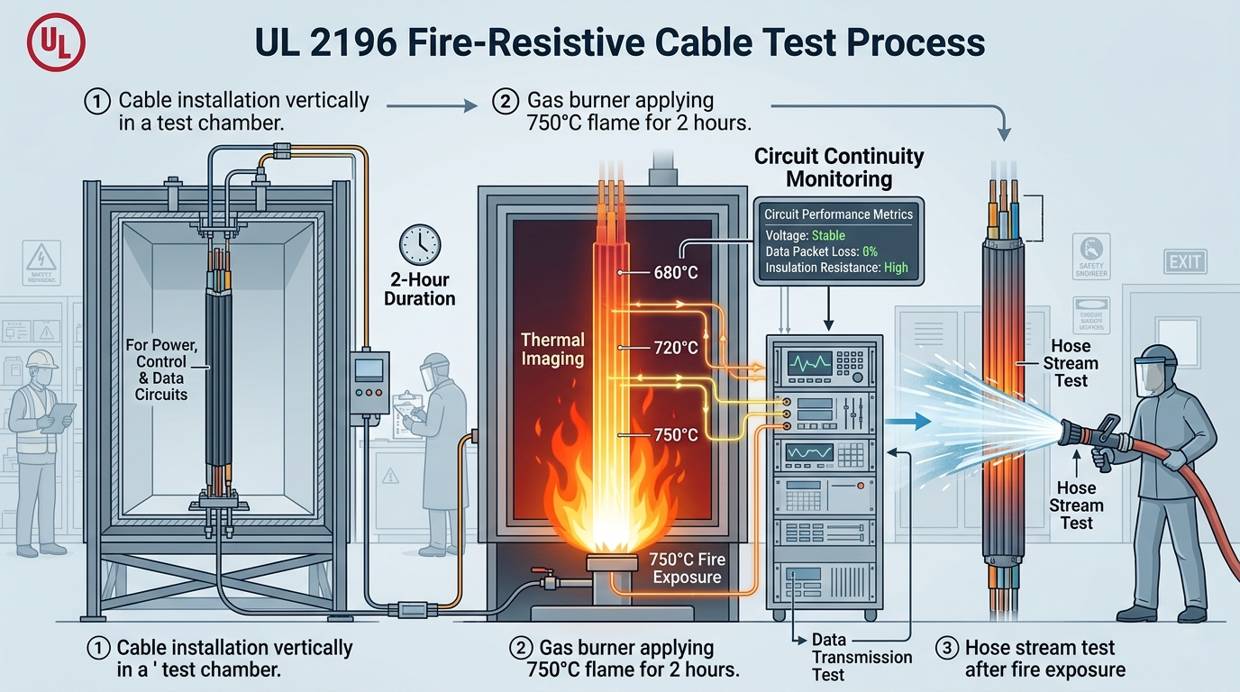
UL 2196 is a fire test standard used to evaluate whether power, control, instrumentation, and data cables can maintain circuit integrity when exposed to standard fire test conditions and an associated hose stream test. In procurement language, ordinary fire-rated cable helps control fire spread or meet installation-area code, while circuit integrity cable helps keep critical circuits functional during fire exposure.
■ What Is Circuit Integrity Cable?
Circuit integrity cable, often identified with a CI suffix in North American cable categories, is cable intended to maintain electrical or signal continuity during fire exposure for a specified time.
| Application Area | Typical Circuit Function |
|---|---|
| Fire alarm systems | Notification, control, signaling, emergency communication |
| Emergency voice / alarm communication | Evacuation instruction and life-safety messaging |
| Smoke control systems | Control circuits for fans, dampers, and related equipment |
| Transit, tunnel, and high-rise projects | Critical operation during fire scenarios |
| Healthcare and critical facilities | Systems where interruption may create life-safety or operational risk |
The key idea is not only that the cable jacket resists flame. The key idea is that the circuit remains functional under defined fire-test conditions.
■ Fire-Rated Cable vs Fire-Resistive / Circuit Integrity Cable
The most common buying mistake is treating all “fire-rated cable” as if it means the same thing. In many RFQs, “fire-rated” may refer to CMP, CMR, CM, FPLP, FPLR, LSZH, or other flame/smoke-related requirements. These may be important, but they do not automatically prove circuit survivability.
| Item | Fire-Rated Cable | Fire-Resistive / Circuit Integrity Cable |
|---|---|---|
| Main purpose | Limit flame spread, smoke, or meet installation-area code | Maintain circuit function during fire exposure |
| Main question | Can this cable be installed in this space? | Will this circuit continue operating during fire? |
| Typical examples | CMP, CMR, CM, FPLP, FPLR, LSZH cable | CI cable, fire-resistive cable, listed circuit integrity system |
| Test logic | Flame spread, smoke, vertical/riser/plenum behavior | Fire exposure, hose stream, continuity or data performance |
| Buyer’s evidence | Cable marking, datasheet, listing for installation rating | UL 2196 / CI listing / system documentation / installation instructions |
■ What Does UL 2196 Evaluate?
UL 2196 evaluates the ability of specific cable assemblies to maintain circuit integrity under defined fire-test conditions. Its scope covers power, control, instrumentation, and data cables. The standard includes fire exposure and an associated hose stream test. For power, control, and instrumentation cables, the cables are continuously energized during the fire test. For data cables, the evaluation includes the ability to maintain data transmission according to specified performance conditions.
| UL 2196 Evaluation Point | Why It Matters |
|---|---|
| Standard fire exposure | Evaluates performance under defined fire-test conditions |
| Hose stream test | Adds mechanical and thermal shock after fire exposure |
| Continuous energization | Checks whether power/control circuits continue operating |
| Data transmission evaluation | Important for communication cable applications |
| Installation configuration | Performance depends on tested assembly, raceway, support, and method |
■ CI Cable vs Complete Fire-Resistive Cable System
Not every fire-resistive solution is simply “a special cable.” In many projects, the listed performance may depend on the complete cable system, including raceway, protective material, supports, installation spacing, and termination conditions.
| Solution Type | What It Means | Buyer’s Main Risk |
|---|---|---|
| CI-suffixed cable | Cable category itself carries circuit integrity recognition | Must confirm exact category, duration, and installation condition |
| Fire-resistive cable system | Cable is part of a listed fire-resistive system | Buying only the cable may not satisfy the listed system |
| Cable with protective material | Cable requires approved fire-protective wrap or material | Labor, installation detail, and inspection documentation become critical |
| Protected pathway | Circuit is routed through rated construction or protected enclosure | Requires coordination with architect, fire engineer, contractor, and AHJ |
■ When Do You Need Circuit Integrity Cable?
Circuit integrity cable is usually considered when the circuit must continue operating during a fire. The requirement may come from the project specification, fire alarm design, local code, consultant notes, civil defense approval, or authority having jurisdiction.
| Project Condition | CI / Fire-Resistive Cable Needed? | Engineering Comment |
|---|---|---|
| Standard office Ethernet cabling | Usually no | Select CMP / CMR / CM according to pathway |
| Fire alarm cable without survivability requirement | Not always | FPLP / FPLR / FPL may be enough depending on code |
| Fire alarm notification circuit requiring survivability | Often yes | Confirm required survivability level |
| Emergency voice / alarm communication | Often yes | Critical communication circuits may need protected pathways |
| Tunnel, transit, high-rise, hospital, critical facility | Frequently possible | Survivability requirements are more common |
The practical trigger is simple: when the specification says circuit integrity, fire-resistive cable, fire survivability, 2-hour fire rating, CI, or UL 2196, procurement should stop treating the requirement as a normal flame-rating question.
■ Why CMP, CMR, LSZH or Fire Alarm Cable May Not Be Enough
A CMP cable may be suitable for a plenum air-handling space. A CMR cable may be suitable for riser shafts. An LSZH cable may reduce halogen acid gas and smoke characteristics in some markets. A fire alarm cable may be listed for fire alarm system use. But none of these automatically means the cable will maintain circuit operation during fire exposure.
| Misunderstanding | Correct Interpretation |
|---|---|
| CMP is the highest rating, so it can replace CI. | CMP is a plenum rating. It does not automatically prove circuit integrity. |
| CMR can survive a riser fire. | CMR addresses riser flame propagation, not functional survivability. |
| LSZH means fire-resistive. | LSZH relates to material smoke/halogen behavior, not circuit operation. |
| Fire alarm cable is always circuit integrity cable. | Fire alarm cable and CI fire alarm cable are different selection questions. |
| A 2-hour cable works in any installation. | The rating depends on the tested and listed installation method. |
■ Listing Evidence and UL Product iQ Verification
For North American projects, buyers should not rely only on a supplier statement such as “UL fire-resistant cable.” A safer approach is to verify the cable or system through the applicable UL certification information.
For projects requiring UL-listed circuit integrity solutions, ZION can support buyers by reviewing the required cable type, installation pathway, documentation package, marking requirements, and listing evidence needed for submittal. Before ordering, the project team should confirm that the selected cable or system matches the required fire-resistive duration, installation method, circuit type, and authority approval path.
| Suggested Website Visual Element | Purpose |
|---|---|
| Product iQ search interface screenshot | Shows buyers where certification information can be checked |
| Example listing result with sensitive details blurred | Explains category, file number, cable type, and limits |
| RFQ checklist overlay | Converts compliance verification into a procurement action |
| Project specification review CTA | Encourages qualified inquiry submission |
■ Cost and Risk Structure: Cable Price Is Not the Full Project Cost
CI cable is usually more expensive per meter than ordinary fire-rated cable. However, the lowest cable unit price is not always the lowest project cost.
In many projects, using ordinary cable may require additional fire-rated wrap, protective raceway, fire-rated enclosure, protected shaft routing, or rerouting through rated construction. These alternatives can increase labor hours, installation complexity, coordination burden, and secondary inspection risk.
| Solution Path | Cable Cost | Labor Cost | Inspection Risk | Best Used When |
|---|---|---|---|---|
| CI / fire-resistive cable | Higher | Medium | Lower if listing matches installation | Direct circuit survivability is required |
| Standard cable + fire-rated wrap | Medium | High | Medium to high | Retrofit or route-specific protection |
| Standard cable inside protected shaft | Medium | High | Depends on building design | New construction with coordinated fire-rated pathway |
| Ordinary fire-rated cable only | Lower | Lower | Very high if survivability is required | Only when CI is not required |
■ International Reference: UL 2196 vs BS 6387 vs EN 50200 vs IEC 60331
UL 2196 is highly relevant for North American and UL-based projects, but many international projects use different fire-resistance references. Middle East, European, UK, Commonwealth, infrastructure, and civil defense projects may mention BS 6387, EN 50200, IEC 60331, LPCB, BASEC, or local authority requirements.
These standards should not be treated as interchangeable certificates. They are project-specific compliance references.
| Standard | Common Market / Context | Main Focus | Procurement Note |
|---|---|---|---|
| UL 2196 | North America / UL-based projects | Circuit integrity of power, control, instrumentation, and data cables | Verify UL listing, CI suffix, system category, and installation method |
| BS 6387 | UK, Middle East, Commonwealth-influenced projects | Resistance to fire of cables required to maintain circuit integrity | Often appears in fire alarm, emergency lighting, and critical circuit specifications |
| EN 50200 | Europe and international EN-based projects | Resistance to fire of unprotected small cables for emergency circuits | Often associated with PH classes in cable specifications |
| IEC 60331 | International IEC-based projects | Circuit integrity under fire and mechanical shock for specified cable types | Confirm cable type, voltage rating, and applicable test part |
■ Procurement Checklist Before Quoting
Before quoting UL 2196 / CI cable, procurement should collect more than a cable size and jacket color. The main risk is not only cable price; it is failed submittal, rejected inspection, emergency redesign, or delayed commissioning.
| Item to Confirm | Why It Matters |
|---|---|
| Required survivability duration | Project may require 1-hour, 2-hour, or another defined rating |
| Cable category | Power, control, instrumentation, communication, fire alarm, coaxial, or fiber |
| Required standard | UL 2196, BS 6387, EN 50200, IEC 60331, or local civil defense requirement |
| CI suffix or listing evidence | Confirms whether the product is recognized for circuit integrity |
| Free-air or raceway installation | Some listings apply only under specific installation conditions |
| Splice and termination method | Splices inside fire zones may be restricted |
| AHJ / consultant approval route | Local interpretation may control final acceptance |
■ Engineer’s Shortcut: How to Choose
| Project Requirement | Recommended Decision |
|---|---|
| Cable only needs to run in plenum space | Check CMP or local plenum-equivalent requirement |
| Cable only needs to run through vertical riser | Check CMR or local riser-equivalent requirement |
| Fire alarm cable needs installation-area compliance only | Check FPLP / FPLR / FPL or local equivalent |
| Circuit must operate during fire exposure | Check CI cable or listed fire-resistive system |
| Specification says UL 2196 | Verify listing, duration, cable category, and installation condition |
| Specification says BS 6387 / CWZ | Confirm fire, water, and mechanical shock performance references |
| Route requires conduit, wrap, enclosure, or protected shaft | Confirm whether the complete installed system is listed or accepted |
■ Questions to Ask the Supplier Before Ordering
■ Common Buying Mistakes
| Mistake | Why It Creates Risk |
|---|---|
| Treating CMP as a substitute for CI | CMP is not automatic circuit survivability |
| Treating LSZH as fire-resistive cable | LSZH does not prove circuit continuity during fire |
| Buying ordinary fire alarm cable for a CI requirement | Fire alarm rating and CI performance are separate requirements |
| Ignoring installation method | The tested performance may not apply to the actual installation |
| Comparing only cable price | Labor, rework, delay, and inspection cost may be higher |
■ Application Examples
Commercial Office Data Cabling
If Ethernet cable is installed in ceiling air-handling spaces, the main question is often CMP plenum compliance, not UL 2196 circuit integrity.
High-Rise Fire Alarm Circuit
If the specification requires survivability for fire alarm notification circuits, ordinary fire alarm cable may not be enough.
Metro Tunnel Emergency Communication
Tunnel projects may include emergency communication, fire alarm, smoke control, or power/control circuits with strict survivability requirements.
Middle East High-Rise Project
Specifications may mention BS 6387, EN 50200, IEC 60331, civil defense approval, or consultant-specific requirements.
■ FAQ
1. Is fire-rated cable the same as fire-resistive cable?
No. Fire-rated cable may refer to flame spread, smoke, plenum, riser, or fire alarm cable classification. Fire-resistive or circuit integrity cable is intended to keep a circuit operating during fire exposure for a defined period.
2. What does UL 2196 mean?
UL 2196 is a fire test standard for evaluating the circuit integrity of fire-resistive power, instrumentation, control, and data cables under standard fire exposure and hose stream testing.
3. Does CMP cable meet UL 2196?
Not automatically. CMP is a plenum cable rating. UL 2196 circuit integrity must be separately verified by the cable or complete listed system.
4. What does “CI” mean on cable?
CI generally refers to circuit integrity. It indicates that the cable category or system is associated with maintaining circuit function under defined fire-test conditions, subject to the applicable listing and installation method.
5. Can conduit make a cable circuit-integrity rated?
Not by itself. Conduit may be part of a listed system, but the complete installation must match the tested and listed configuration.
6. Is LSZH cable the same as fire-resistive cable?
No. LSZH refers to low-smoke zero-halogen material behavior. It does not automatically prove circuit integrity during fire exposure.
7. Is CI cable always required for fire alarm systems?
No. Some fire alarm circuits may require only standard fire alarm cable ratings. CI cable or a listed fire-resistive pathway is needed when circuit survivability is required by code, project specification, consultant design, or AHJ.
8. What documents should buyers request?
Request datasheet, cable marking, test standard, listing evidence, fire duration or performance class, installation instructions, system limitations, splice/termination rules, and third-party certification where required.
■ Conclusion: Choose by Circuit Function, Not by Fire-Rating Words
The safest way to specify fire-related cable is to separate two questions.
First: Where will the cable be installed? This determines whether plenum, riser, general-purpose, LSZH, fire alarm, outdoor, or local installation ratings are needed.
Second: Must the circuit continue operating during fire exposure? If yes, ordinary fire-rated cable is not enough. The project should verify CI cable, UL 2196, BS 6387, EN 50200, IEC 60331, or another required fire-resistive cable system based on the project location, consultant specification, and authority approval path.
Need Help Selecting Fire-Resistive or Circuit Integrity Cable?
Send us your project specification, cable schedule, BOQ, or fire alarm / emergency circuit requirement. ZION can help review the required standard, cable type, installation route, documentation package, substitution risk, and lead time.