CCA CAT 6A S/FTP Ethernet Cable — What You Must Know Before Choosing It
Author: Michael Publish Time: 09-12-2025 Origin: Site
S/FTP CAT 6A LSZH Ethernet Cable with CCA Conductors: Characteristics, Limitations and Appropriate Applications
(Official Technical Overview — Neutral, Standards-Compliant, Non-Marketing)
The S/FTP CAT 6A LSZH Ethernet cable with Copper Clad Aluminum (CCA) conductors is an affordable compromise cabling solution suitable for everyday applications.
This document serves as an impartial technical overview of the S/FTP CAT 6A LSZH CCA Ethernet cable’s design, conductor properties, electrical performance considerations and appropriate applications.
The aim is to assist resellers, installers and end-users to make informed decisions when selecting cables appropriate for specific applications or projects.
■ Product Overview
The CAT6A with CCA cable is a combination of:
CCA conductors (AWG23 ~ 24)
Individually foil-shielded twisted pairs (FTP)
Overall braided shield (S) for superior noise immunity
LSZH jacket suitable for halogen-free, low-smoke installations
Suitability: Designed for short to medium-length patch cbles, with practical performance recommended for lengths under 50 meters, depending on installation constraints and equipment tolerances.
Important Note: Potential users should be advised that while built with physical attributes similar to standard CAT 6A cables, the CCA conductors do not mee the material requirements set forth by international cabling standards (ISO/IEC, TIA) for electrical performance.
■ Characteristics of CCA Conductors
CCA (Copper Clad Aluminum) conductors consist of an aluminum core bonded with a layer of copper.
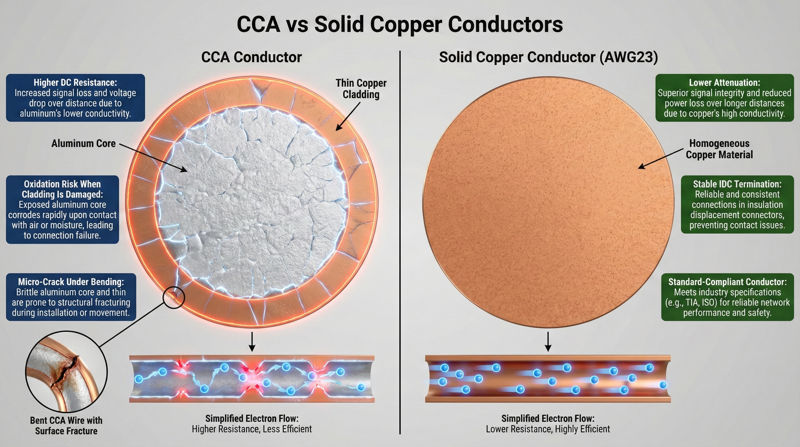
The main characteristics of CCA conductors are:
Cost Efficiency
Less copper content translates to significantly lower costs, making this an affordable solution for non-certified, budget-sensitive environments.Lightweight Properties
CCA conductors are less dense than pure copper, reducing physical strain on cable supports and management systems.General Usability
Performance over short distances is generally adequate for basic network links and patch cords.
Shielding Integrity
The S/FTP shielding effectiveness remains high, as the external noise immunity provided by the foil and braid is independent of the inner conductor material.
■ Limitations and Considerations of CCA Conductors
International standards require solid bare copper for all Category-rated cabling systems. Due to the use of CCA conductors, this cable is not applicable for standard field certification (e.g., Fluke tests) and will not achieve official CAT 6A certification.
Electrical Performance & Length
• DC Resistance: CCA has significantly higher DC resistance than copper.
• Attenuation: Higher electrical resistance results in increased insertion loss.
• Environmental Dependence: Performance is more susceptible to fluctuation based on temperature changes.
• Distance Constraints: Run lengths must be kept short to maintain signal integrity.
General Usage Recommendations:
Recommended for Patch cords and Channels up to 50 meters maximum.
Note: Not suitable for standard 90-meter permanent link horizontal cabling.
Power Implications (PoE)
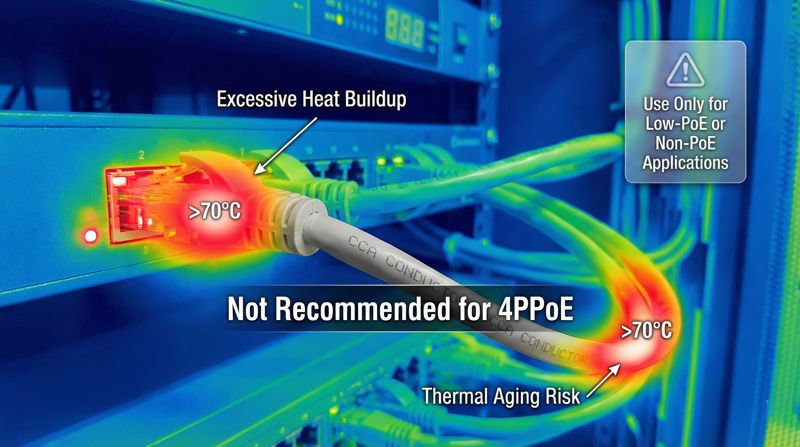
• Not recommended for IEEE 802.3bt (PoE++) or high-power applications.
• Bundled CCA cables may generate excessive heat, posing a risk to cable integrity and network devices.
• Long-term use under load may cause thermal aging of the LSZH jacket.
• Suitable for non-PoE or low-power (Type 1) applications only.
Mechanical Reliability
Aluminum/CCA conductors are more brittle and pliable than copper, leading to specific mechanical risks:
• IDC Contact: Punch-down contacts may deform the aluminum core over time, leading to loose connections.
• Micro-cracking: Care must be taken to avoid micro-cracks in conductors when bending the pairs.
• Oxidation: If the copper cladding is nicked during termination, the exposed aluminum may oxidize.
Termination Recommendations
To ensure connection reliability:
• Standard generic RJ45 (8P8C) plugs may not be suitable. Use plugs specifically designed for CCA or stranded wire to ensure a gas-tight termination.
• Avoid repeated re-termination to prevent conductor fatigue.
To increase reliability, the cable application
Contrary to popular opinion, the common RJ45 (8P8C) for general purpose cabling systems are not suitable for CCA conductors.
An appropriate passive 8P8C plug ensures a gas-tight termination of the wire.
Weighted tools and techniques.
■ Recommended Application Scenarios
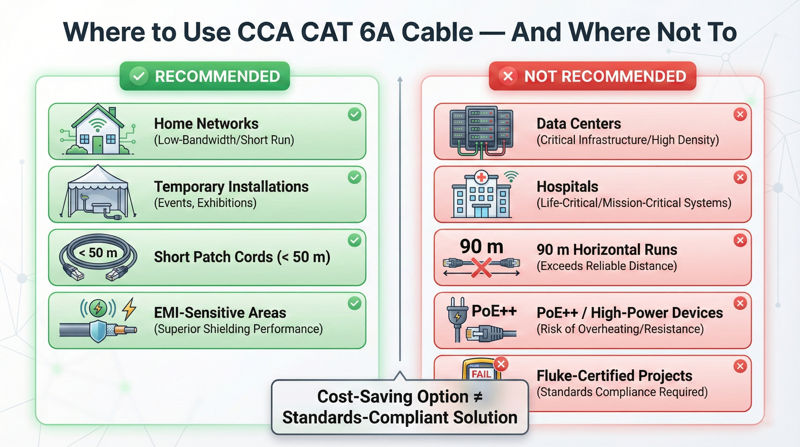
Appropriate Applications
• General-purpose patch cords (short runs).
• Consumer electronics and home networking.
• Non-PoE network communications.
• Small Home/Small Office (SOHO) environments.
• Temporary network setups.
• Connections in areas sensitive to EMI (due to S/FTP shielding).
Inappropriate Applications
• Standards-compliant horizontal structural cabling.
• High-power PoE applications (PoE+, PoE++ / Type 3 or 4).
• Critical infrastructure (Data Centers, Hospitals, Airports, Government).
• Long-distance runs (>50m).
• Any project strictly requiring Fluke Certification compliance.
■ Summary
The S/FTP CAT 6A LSZH Ethernet cable with CCA conductors is a cost-effective alternative for non-critical networks.
Installers and users must be aware that CCA conductors do not meet CAT 6A certification standards and require specific handling precautions.
This cable is best suited for scenarios where:
• Budget is the primary constraint.
• Cable run lengths are short (under 50m).
• There is no requirement for high-power PoE.
• Formal certification (Fluke Test) is not required.
Final Note: This product should not be used where strict adherence to TIA/ISO standards or guaranteed mission-critical stability is required.
Contact us for more information

michael@zion-communication.com
+86 13757188184