SFP vs SFP+ vs SFP28 vs QSFP+ vs QSFP28: 2026 Optical Transceiver Selection Guide
Author: James Publish Time: 26-01-2026 Origin: Site
SFP vs SFP+ vs SFP28 vs QSFP+ vs QSFP28: 2026 Optical Transceiver Selection Guide
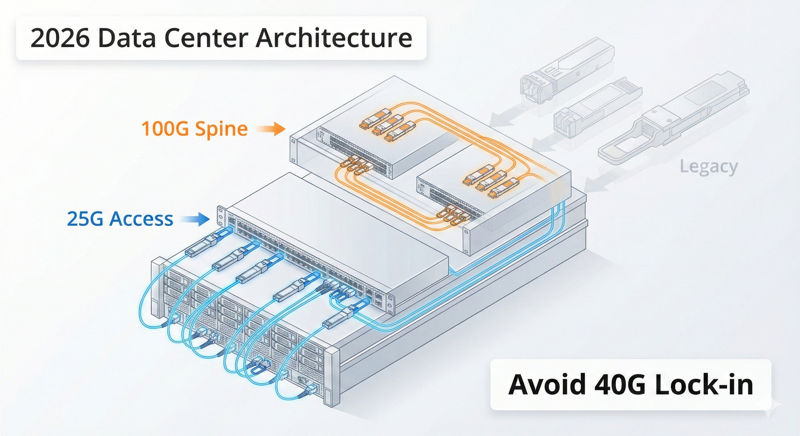
25G SFP28 is the new access/server baseline; deploy it for port density and long-term value.
100G QSFP28 is the mainstream spine/aggregation choice; design for 25G→100G migration.
Selection is driven by power, thermal limits, cabling, and O&M risk—not speed alone.
■ 1) What Transceiver Form Factors Mean (2026)
SFP-family and QSFP-family transceivers are hot-pluggable modules that convert electrical signals to optical signals (and back) for fiber links in switches, routers, servers, and transport platforms. In 2026, form factor selection is a combined decision across: lane architecture (1-lane vs 4-lane), port density, power/thermal headroom, cabling strategy, and upgrade roadmap.
■ 2) SFP / SFP+ / SFP28 / QSFP+ / QSFP28 Compared
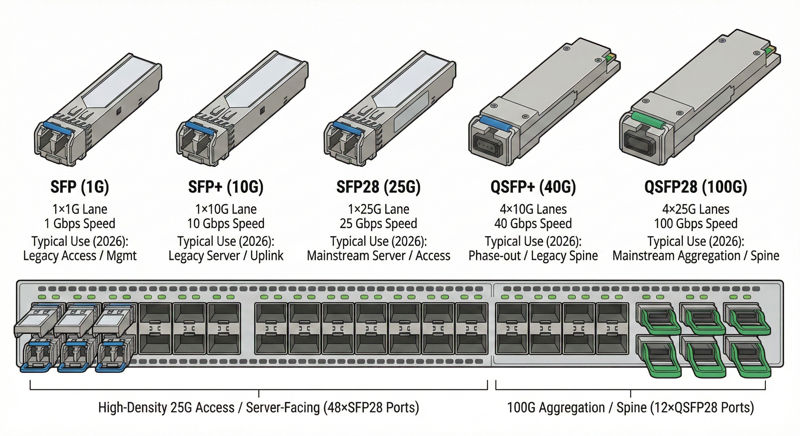
The biggest difference is not the name—it’s the lane speed and lane count. SFP variants are typically single-lane modules; QSFP variants are usually 4-lane modules designed for higher aggregate throughput.
| Form Factor | Typical Speed | Lane Model | 2026 Status | Best Fit | Practical Notes |
|---|---|---|---|---|---|
| SFP | 1G (legacy) | 1 lane | Obsolete in new builds | Legacy enterprise | Keep for maintenance/spares only. |
| SFP+ | 10G | 1 lane | Transitional | Brownfield upgrades | Often replaced by 25G for better scaling. |
| SFP28 | 25G | 1 lane | Mainstream | Access / server-facing | Best port density; strong 25G→100G alignment. |
| QSFP+ | 40G (4×10G) | 4 lanes | Declining | Legacy aggregation | Rarely recommended for new deployments. |
| QSFP28 | 100G (4×25G) | 4 lanes | Standard | Spine / aggregation | Supports breakout to 4×25G where platform allows. |
■ 3) Where Each Form Factor Fits
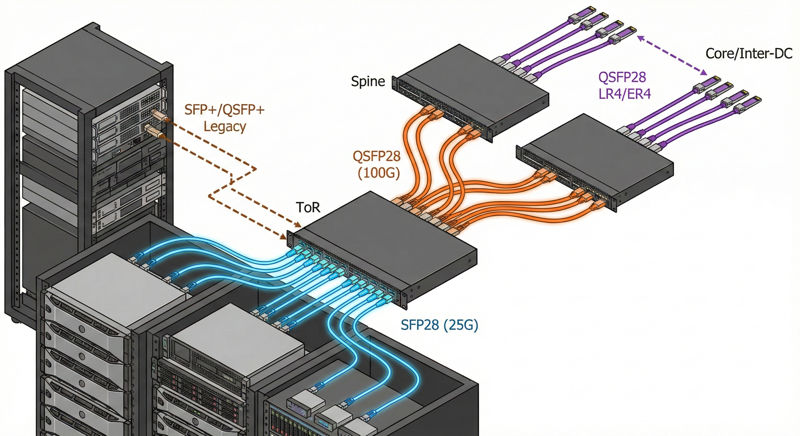
Use the table below to map each transceiver type to real deployment layers and common link patterns.
| Network Layer | Preferred (2026) | Typical Link Types | Why It Wins |
|---|---|---|---|
| Server / ToR Access | SFP28 (25G) | SR/LR; DAC/AOC in short reach | High density, strong scaling path, good cost per Gbps. |
| Aggregation | QSFP28 (100G) | SR4/LR4, CWDM4/PSM4 (platform-dependent) | Fewer links, simpler topology, efficient per bit. |
| Spine / Core | QSFP28 (100G) | LR4/ER4/ZR (distance-driven) | Mainstream backbone standard in 2026 networks. |
| Legacy Interop | SFP+ / QSFP+ | 10G SR/LR; 40G SR4/LR4 | Supports existing platforms and phased upgrades. |
■ 4) Decision Rules / Engineer’s Shortcut
Use the matrix below to decide quickly. This is optimized for 2026 default architectures: 25G access + 100G spine/aggregation.
| You Need… | Choose | Why | Avoid / Risk |
|---|---|---|---|
| New access/server links with high port density | SFP28 | Best density and scaling; aligns with 100G uplinks. | SFP+ locks you into 10G and earlier refresh cycles. |
| Mainstream spine/aggregation (east-west heavy) | QSFP28 | 100G baseline; reduces link count and operational complexity. | QSFP+ (40G) is declining; limited long-term value. |
| Phased upgrade from an existing 10G estate | SFP+ → SFP28 | Minimize disruption; migrate rack-by-rack. | Mixing optics without a sparing plan increases MTTR. |
| Breakout architecture (100G port → multiple 25G links) | QSFP28 breakout | Flexible port use; supports staged growth. | Platform-dependent; validate breakout support and cabling. |
■ 5) Cost Structure, Risk & Maintainability
Procurement decisions in 2026 should evaluate total lifecycle cost and operational risk, not just unit price. A lower-cost transceiver can still be expensive if it increases downtime, sparing complexity, or compatibility issues.
| Cost / Risk Driver | What to Check | Why It Matters |
|---|---|---|
| Compatibility | Switch vendor coding, DOM/DDM support, firmware behavior | Prevents link flaps, alarms, and unexpected disablements. |
| Thermal headroom | Operating temp range, airflow direction, port adjacency | Avoids instability in high-density racks. |
| Sparing strategy | Common SKU reuse, standardized reach (SR/LR), labeling | Reduces MTTR and inventory cost. |
| Testing & acceptance | Insertion loss budget, end-to-end link tests, burn-in | Improves deployment success and reduces rework. |
■ 6) 2026 Trends: What’s Changing
25G replaces 10G in new access/server deployments due to better density and lifecycle value.
100G is the baseline for spine/aggregation; 40G is increasingly transitional.
Power/thermal constraints drive selection as racks get denser and east-west traffic increases.
Migration planning is standard practice: designs often keep an upgrade path toward 400G platforms.
■ 7) FAQ (2026)
Is SFP+ still relevant in 2026?
Yes—mainly for existing 10G estates and phased upgrades. For new deployments, SFP28 is typically the better long-term choice.
Can SFP28 run in SFP+ ports?
In many platforms it can, but it may operate at 10G and compatibility depends on the switch and firmware.
Should I deploy QSFP+ (40G) in new builds?
Generally no. QSFP28 (100G) is the mainstream baseline for modern spine/aggregation layers in 2026.
What should procurement focus on beyond price?
Compatibility behavior, thermal performance, sparing standardization, and acceptance testing—these directly affect downtime risk and O&M cost.
■ 8) Conclusion & Next Steps
For 2026 networks, the most common, lowest-risk roadmap is SFP28 (25G) for access/server links and QSFP28 (100G) for aggregation/spine. Keep SFP+ and QSFP+ where interoperability is required, but avoid building new architectures around legacy speeds. For project success, treat optics as part of the system: cabling, thermal design, compatibility validation, and a clear sparing plan.