VHF Leaky Feeder Cable (75Ω) for Mine & Tunnel Communication
Author: Site Editor Publish Time: 05-03-2026 Origin: Site
VHF Leaky Feeder Cable (75 Ohm) for Mine & Tunnel Communication
Build continuous, maintainable VHF radio coverage in mines and tunnels where conventional antennas fail—using a distributed radiating coaxial cable engineered for harsh environments.
Leaky feeder cable works as a distributed antenna, delivering continuous VHF coverage along tunnels and mine drifts.
VHF offers strong diffraction + lower longitudinal loss, reducing amplifier count and improving system reliability.
Choose by impedance (75Ω), attenuation, coupling loss, jacket safety, and maintenance access—then design amplifier spacing.
■ 1) What is a VHF Leaky Feeder Cable?
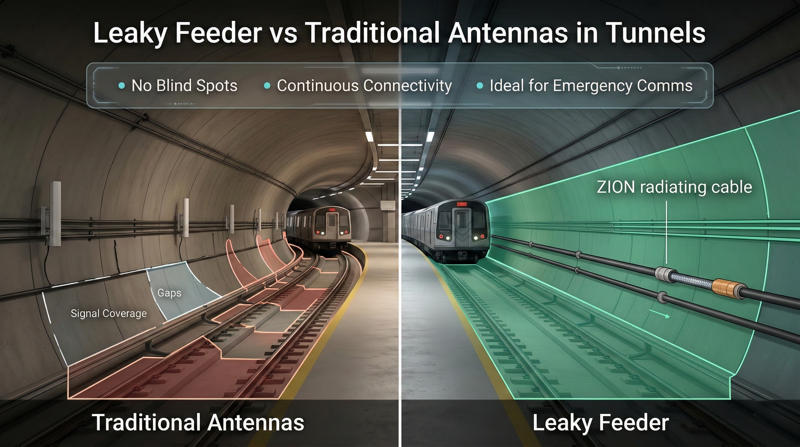
A VHF Leaky Feeder Cable (also called a radiating coaxial cable) is engineered to carry RF power and radiate/receive signals along its full length. Instead of relying on point antennas that create coverage gaps in curved or obstructed tunnels, a leaky feeder cable functions as a continuous linear antenna.
| Item | Conventional Antenna System | Leaky Feeder (Radiating Cable) System |
|---|---|---|
| Coverage model | Point coverage, gaps likely in bends/obstructions | Continuous coverage along the cable route |
| Maintenance | Multiple antennas and feeder runs to service | Single backbone path; modular amplifiers/couplers |
| Expansion | New antennas and RF planning per segment | Extend cable, add couplers/amplifiers |
| Risk profile | Dead zones can appear after layout changes | Coverage is route-based; easier to predict and audit |

■ 2) Why VHF for underground coverage?
VHF (30–300 MHz) is widely adopted for underground radio networks because its longer wavelength enables better diffraction in bends and robust performance in complex geometry. In many projects, VHF also reduces longitudinal RF loss, helping engineers control amplifier quantity and power budget.
| Engineering Factor | Why it matters underground | VHF leaky feeder impact |
|---|---|---|
| Diffraction / bend handling | Tunnels are rarely straight; bends create dead zones | Longer wavelength improves coverage stability |
| Longitudinal attenuation | Determines amplifier count and service complexity | Often supports longer spacing (site-dependent) |
| Radio ecosystem | Many legacy and professional radios operate in VHF | Simplifies integration with existing equipment |
| Safety and operations | Mission-critical voice reliability is non-negotiable | Route-based coverage reduces blind-spot risk |
■ 3) System architecture & maintainability
A leaky feeder network is not “just a cable”—it is a maintainable RF infrastructure. The design objective is simple: stable signal level along the route, with predictable maintenance points and minimal single-point failure risk.
Typical Components
Head-end base station / repeater: injects VHF RF into the feeder.
Radiating cable backbone: provides continuous coverage along the tunnel.
Bi-directional amplifiers: compensate cable attenuation (spacing depends on power budget).
Couplers / splitters / taps: enable branches and segmented coverage zones.
Terminations & grounding: reduce reflections and improve stability.
| Maintainability Item | What to check on site | Why it reduces risk |
|---|---|---|
| Amplifier access points | Clear maintenance space, labeling, spare power | Cuts downtime; faster troubleshooting |
| Connector / splice policy | Standardized connectors, controlled torque | Prevents VSWR spikes and intermittent faults |
| Grounding strategy | Bonding points, protective routing, lightning plan | Reduces EMI and protects equipment |
| Route documentation | As-built map, segment lengths, test records | Makes future expansion predictable |
■ 4) ZION cable design advantages
ZION Communication supplies VHF Leaky Feeder Cable (75 Ohm) engineered for underground and tunnel communication networks where mechanical reliability and RF stability must be maintained over years of operation.
What engineers care about (and what we build for)
Controlled slotting pattern: consistent coupling performance along the route to avoid “hot spots” and dead zones.
Low-loss coaxial structure: optimized conductor + dielectric selection to reduce attenuation and stabilize RF budget.
75Ω impedance design: compatible with common underground communication architectures where 75Ω components are specified.
Safety jacket options: LSZH and flame-retardant jackets for enclosed public infrastructure and mine environments.
OEM/ODM support: jacket, marking, packaging, and project-tailored configurations available.
■ 5) Applications & deployment scenarios
VHF leaky feeder systems are most valuable where the environment naturally destroys traditional RF coverage. The typical goal is continuous two-way radio connectivity for operations, safety, and emergency response.
| Scenario | Coverage objective | Engineering notes |
|---|---|---|
| Underground mining | Dispatch, safety calls, rescue coordination | Prioritize jacket durability, dust/moisture resistance, easy amplifier access |
| Metro / railway tunnels | Operations + maintenance + emergency comms | Fire safety materials (LSZH/FR) and documentation are critical |
| Utility corridors & underground facilities | No dead zones for security and service teams | Consider segmentation with couplers for different zones |
| Marine / offshore internal areas | Coverage through metal compartments | Corrosion resistance and robust routing constraints apply |

■ 6) Decision Rules / Engineer’s Shortcut
Use the rules below to select a VHF radiating cable quickly and reduce redesign risk during procurement. This is the fastest way to align engineering, integrator, and purchasing requirements.
| Decision question | If YES → choose / do this | If NO → choose / do this | Why it matters |
|---|---|---|---|
| Is your system specified as 75Ω? | Select 75Ω leaky feeder cable end-to-end (cable + passive parts) | Confirm network impedance before purchasing | Impedance mismatch increases reflections (VSWR) and reduces usable coverage |
| Are runs long with limited access? | Prioritize lower attenuation to reduce amplifier count | Standard attenuation may be acceptable | Fewer amplifiers = lower lifecycle maintenance and fewer failure points |
| Is this an enclosed public area (metro, tunnel)? | Specify LSZH / flame-retardant jacket | PE jacket may be acceptable (site dependent) | Fire safety, smoke toxicity, and compliance are decision thresholds |
| Do you need predictable coverage levels? | Choose cable with stable coupling loss and documented test approach | Pilot test with on-site measurements before full rollout | Coupling consistency controls real user experience (dead zones vs stable voice) |
■ 7) Cost structure & risk controls
For underground communication, the true cost is not only cable price per meter. The main drivers are amplifier quantity, installation labor, test/commissioning time, and downtime risk. A slightly better cable can reduce total lifecycle cost if it lowers amplifier count and stabilizes coverage.
| Cost / Risk Driver | What inflates cost | Control method (best practice) |
|---|---|---|
| Amplifier count | High attenuation / poor RF budget planning | Select lower-loss cable; calculate spacing; design access points |
| Connector integrity | Non-standard connectors, uncontrolled assembly | Standardize connectors; torque/inspection process; keep spares |
| Water ingress / corrosion | Improper sealing; unsuitable jacket | Use appropriate jacket; sealing kits; routing to avoid pooling |
| Commissioning time | No as-built map; no segment testing | Segment test records; labeled routes; acceptance checklist |
■ 8) Conclusion
In mines and tunnels, communication is a safety-critical utility. A VHF 75Ω leaky feeder cable provides predictable, continuous coverage by converting the route itself into a distributed antenna system. For project success, select by impedance matching, attenuation, coupling stability, jacket safety, and—most importantly—maintainability (amplifier access, connector policy, and documentation).
Actionable next step: Send ZION your target frequency band, route length, environment (mine/tunnel), preferred jacket (PE/LSZH/FR), and connector requirement. We will recommend a suitable VHF radiating cable configuration and procurement-ready datasheet.



 Fiber Optic Tools
Products 6 families
Solutions 6 markets
Resources Tools & docs
Certificate
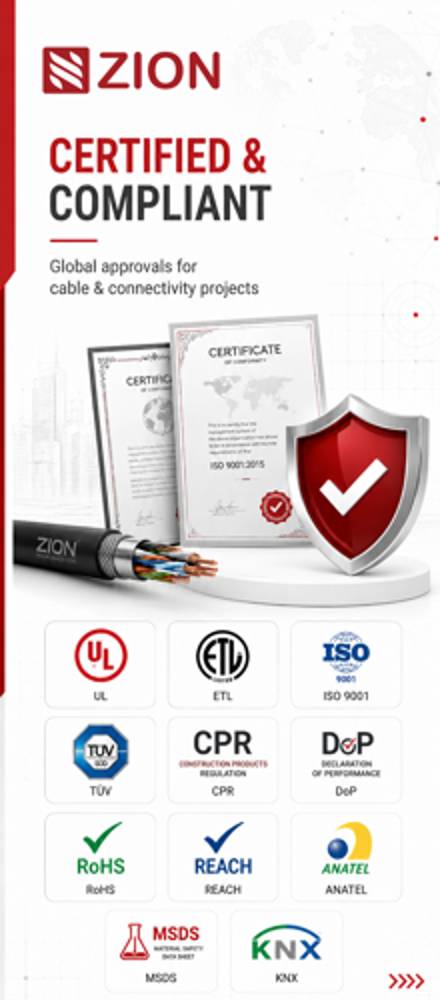
Certification and compliance references for project review, qualification and purchasing documentation.
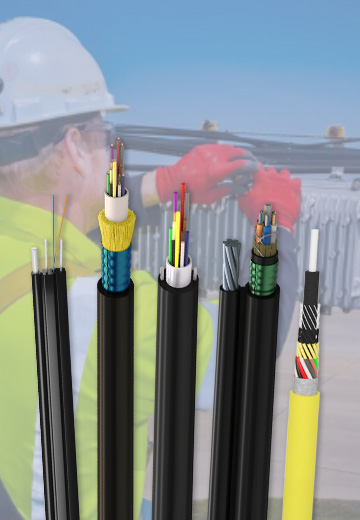 Fiber Optic CableAccess and backbone
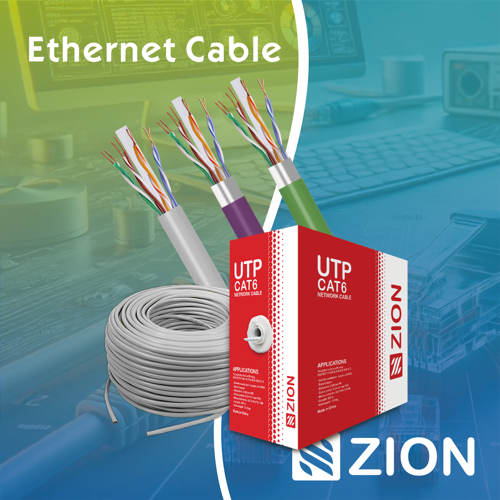 Ethernet CableCat5e to Cat8
 Coaxial CableRF and video signal
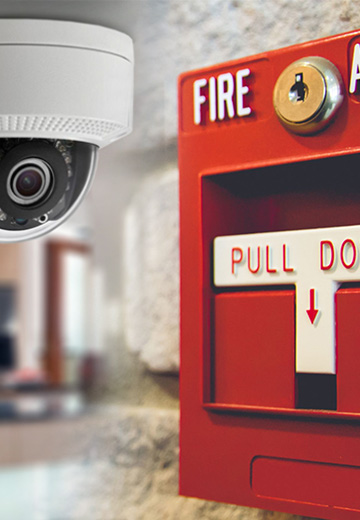 Fire, Security & AlarmSafety systems
 Voice, Audio & VideoSignal cabling
 Power & Control CableEnergy and control
Fiber optic cable systems
Outdoor, indoor, FTTH and distribution cable lines for access networks, backbone routes and campus deployments.
 Telecom & ISP NetworksFTTH, PON, ODN
  Data Center InfrastructureServer room cabling
  Building Low-Voltage SystemsBMS, AV, weak current
  Security & Fire ProtectionAlarm, CCTV, access
  Industrial Automation CablePLC, RS485, fieldbus
  Energy & Power InfrastructureSolar, battery, power
 Telecom & ISP Networks
For FTTH / PON access, outdoor fiber deployment, aerial routes, duct routes, direct burial routes, rural broadband and ODN planning.
Tools
Use calculators and planning tools for conduit capacity, PoE voltage drop and fiber optic link loss budget work.