Cat 7 Accessories Overview: Build a Reliable High-Speed Network
Author: Michael Publish Time: 01-07-2025 Origin: Site
■ Cat 7 Installation Accessories for Data Centers, Homes & Smart Networks
Within today's advanced high-speed networks, Cat 7 Ethernet cables constitute a large portion deployed in locations where bandwidth, minimal latency, and effective shielding are crucial — including data centers, enterprise wiring, and smart homes. Nevertheless, the strength of a Cat 7 cabling system is absolutely dependent on the weakest link therein. Indeed, for full system integrity and performance, it is key to utilize the right accessories compatible with Cat 7 to maintain the full integrity and performance.
This article looks at the elements vital to a Cat 7 network, going beyond the standard RJ45 connectors to include keystone jacks, wall readouts, patch panels, couplers, and more.
■ RJ45 Connectors for Cat 7
Understanding Shielding: A Cat 7 cable is usually terminated with a shielded RJ45 connector, also known as 8P8C connectors. Cat 7 standards included other alternatives in their specifications (like GG45 or TERA), but RJ45 remains practical and is widely used as it's compatible with a variety of network devices.

✔ Common Applications:
Made-for-measure assembly of patch cables of any kind.
Direct device connections (Microsoft computers, network switches, routers).
On-site terminations while work on retrofits is ongoing.
✔ Key Features:
Sheath coverage for S/FTP structure for cable shielded housing.
Gold-plated contacts for corrosion prevention with the required thickness of 50μ.
Tool-less and up to field termination choices are available.
Heavy-duty locking latch system ensures secure closure.
Installation Tips:
Use specific crimping or tool-less system depending on the connector type (i.e. modular Ethernet or DB9 connectors).
Be sure to use the connector that fits the average way cable (OD: e.g. 6.0-7.5mm).
Ensure foil shielding is properly bonded to the shell of the connector.
■ Keystone Jacks and Wall Plates for Cat 7
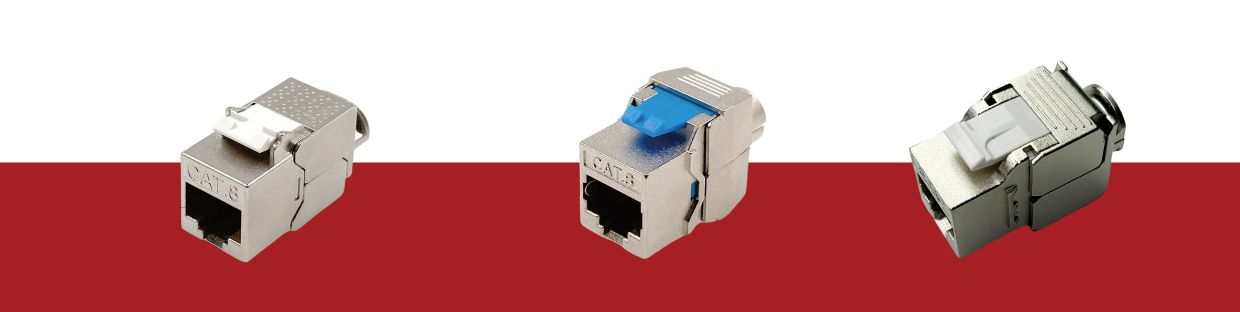
The keystones are available in various formats for different types of connectors. These are then connected to the cabling system by punching them down onto a patch panel following the wiring plan in the documentation. Keystone jacks are normally used in wall outlets, surface boxes, and panel patches in professional environments, making them extremely useful.
✔ Where to Use:
Shared offices desks (Cubicles).
Server rooms.
Board rooms.
Home networks with switches hubs or routers.
✔ Key Features:
Heavy shielded zinc alloy housing.
IDC or insulation displacement contact or tool-less terminals.
Snap-in design suitable for standard faceplate.
Wiring labels color-coded (TIA/EIA-568A/B).
✔ Wall Plate Configurations:
For instance, single to 4-port plates to let you experiment with different designs, which could also be of different sizes.
Can be found in standard 86mm, Decora, or UK for use in standard and unique installations.
Fireproof for the construction material of in-wall installation.

When understanding the wall plate installations, ensure to observe the difference between the rear-entry and the side-entry jacks for the depth and routing constraints.
■ Patch Panels: The Core Point of the Network Termination.
Patch panels are essential in rack-mounted systems, allowing technicians to easily re-route, label, and troubleshoot connections. An unshielded Cat 7 patch panel will compromise your entire network grounds and signal integrity.
✔ Best Use Cases:
Data of centers and server rooms.
To small and medium-sized enterprises.
Complete converged cabling of the building.
✔ Common Types:
24-port or 48-port patch panels.
Straight or angular shapes.
Keystones or empties in the modular frames.

✔ Key Features:
Heavy housing with grounding terminal.
19” rack-mount compatible (1U/2U).
Color-coded label for easy identification (non-reversible).
Cable management bar: Rear (optional) bar.
Ground bonding between the patch panel and rack should be installed to provide minimal signal interference.

■ Couplers, Inline Modules, and Joiners.
In situations where the wires are short or the ends are damaged, then Cat 7 couplers and inline connectors can be used. An active connection point whose main task is to connect two terminated cables.
✔ Common Use Cases:
Either short-term or long-term wiring extensions.
Repairing cable ruptures.
Adaptable connections for modular.
✔ Available Formats:
Female-to-female inline couplers.
Keystone-mounted couplers.
Through-wall adapters.

⚠️ Considerations:
You need to make sure that internal wires connected in the coupler can support up to 600MHz or 10Gbps.
Ensure ground continuity – select only concealed metal couplers.
Not recommended for priced service or repair in a single channel.

■ Modules, Plugs, and Termination Accessories.
For your installation to be complete, you might need to obtain some other key components that are specific to Cat 7.
Examples:
Field termination plugs… for the cable ends that are not rigidly connected.
Shielded jack modules for desk outlets or floor boxes
Cable boot covers that help relieve the strain.
Shield bonding clips to ensure foil continuity
Installation Tip:
Confirm always the cable OD (external diameter) and conductor gauge size (typically 23 AWG solid) with the right plug or module termination hardware before its use.
✅ Final Thoughts:
Speed and shielding strength are some of the advantages that can be availed through Cat 7, but you will only see its performance when it is a full unit. In essence, right flips, and jacks & panels complete your cable to perform its intended task without impairing its functionality.
Whether you're wiring a smart building, upgrading a data center, or future-proofing your home Ethernet, the longer run will certainly lead to fewer mistakes and better reliability in the long term.

michael@zion-communication.com
+86 13757188184