Cat6A Ethernet Couplers for Wi-Fi 7, 10G & Smart Buildings
Author: Will Publish Time: 08-01-2026 Origin: Site
Future-Proof Ethernet Couplers for 10G, Wi-Fi 7 & PoE++ in 2026
In 2026, a coupler is no longer a cheap accessory – it is a critical node that must carry 10G traffic, 90W PoE++ power and pass Fluke certification without becoming your weakest link.
Wi-Fi 7 APs and 10G switches require Cat6A-grade couplers – Cat5e instantly becomes a bottleneck.
PoE++ (90W) makes contact plating、thermal rise and DC resistance balance critical design parameters.
HelloSignal couplers (ZION brand) are engineered for 500 MHz, PoE++, Fluke DSX test and ESG compliance.
■1) Ethernet Couplers in 2026: Why They Matter
In 2026, copper cabling is doing more heavy lifting than ever. Wi-Fi 7 access points require 2.5G/5G/10G uplinks, while smart buildings rely on PoE++ cameras, sensors, LED lighting and automation – all delivered over twisted-pair Ethernet. In this landscape, an Ethernet coupler is no longer a disposable accessory; it is a critical point in the channel that must meet the same performance and safety expectations as the rest of the link.
A modern coupler must safely extend cable runs, maintain Cat6A-grade bandwidth, survive 90W PoE++ loads, and avoid adding return loss, crosstalk or thermal stress that could cause a 10G link to fail or fall back to 1G. For engineering teams and procurement departments, the question is no longer “Do we need a coupler?” but “Which coupler will not become our bottleneck or failure point?”
In Wi-Fi 7, 10G and PoE++ projects, certification tools like Fluke DSX rarely fail “because of the cable” alone. Instead, failures appear at connectors, patch panels and couplers that were not designed for 500 MHz and high-current PoE. Treat couplers as active design choices, not afterthoughts.
■2) Quick Decision Matrix for Fast Selection
Before diving into signal theory and standards, most engineers and buyers simply want a fast, low-risk choice. The matrix below summarizes typical application scenarios and the corresponding Ethernet coupler specification you should consider from HelloSignal (a ZION Communication brand).
| Application Scenario | Recommended Spec | Core Technical Priority | HelloSignal Recommended Model |
|---|---|---|---|
| Wi-Fi 7 AP backhaul / edge switches / 10G NAS storage | Cat6A Shielded Inline Coupler | 10Gbps symmetric throughput, 500 MHz return loss headroom | ZC-SB42-S-C6A |
| Smart lighting, building automation, PoE++ cameras and sensors | Cat6 Shielded Inline (180° layout) | Continuous 90W PoE++ power, EMI control, panel-friendly geometry | FTP CAT6 180° |
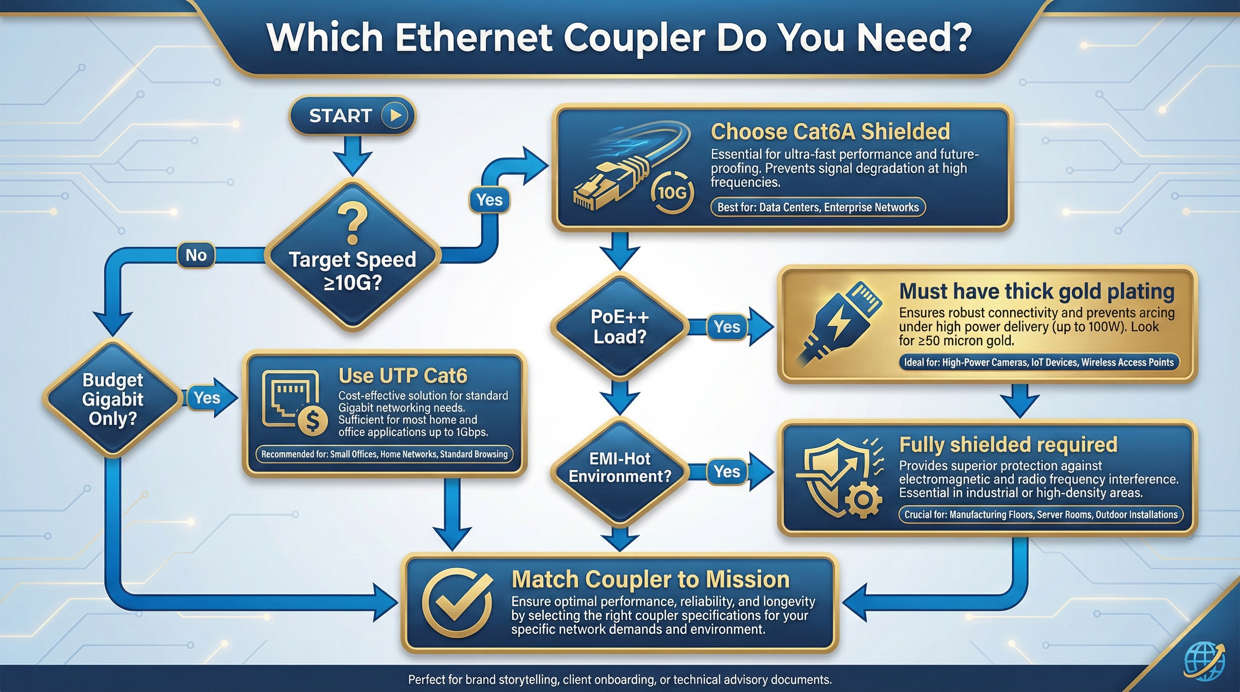
| Home / small office gigabit extension, SOHO routers and switches | Cat6 UTP Inline Coupler | Cost efficiency, simple installation, 1G performance | UTP CAT6 Inline |
If the link touches Wi-Fi 7, 10G switching or PoE++ loads, default to Cat6A/STP-grade couplers like ZC-SB42-S-C6A. Reserve unshielded Cat6 UTP couplers for non-critical, unmanaged gigabit extensions only.
■3) Signal Integrity & Performance Factors at 10G / 500 MHz
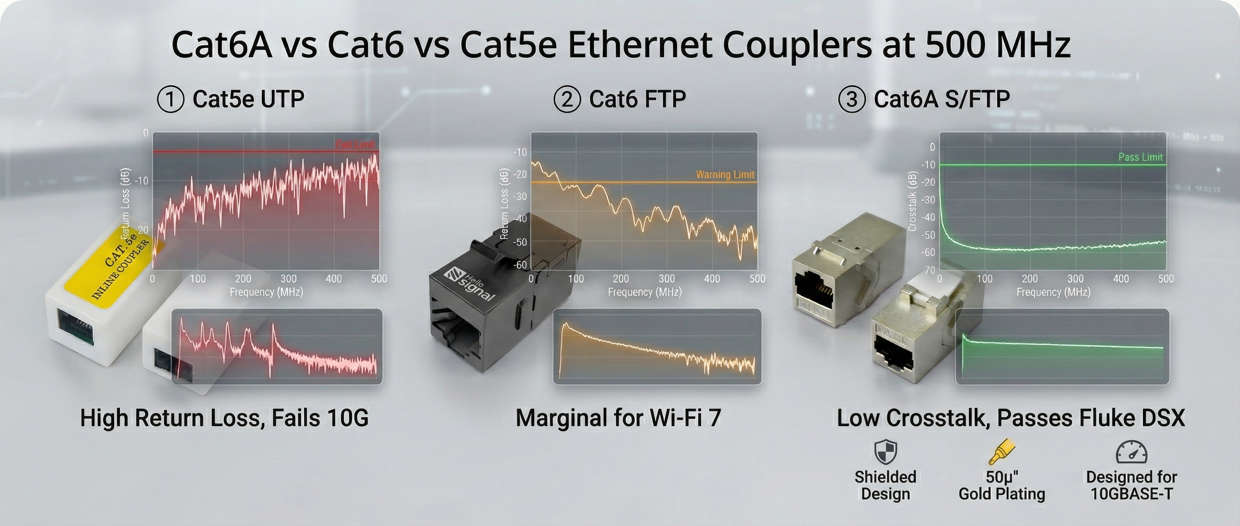
At 10G and Wi-Fi 7 backhaul speeds, “it passes link-light” is not enough. Modern copper channels operate up to 500 MHz (Cat6A), and Ethernet couplers must be treated as part of the high-frequency transmission line, not just mechanical joints.
| Performance Factor | What It Means | Why It Matters in 2026 | HelloSignal Design Approach |
|---|---|---|---|
| Return Loss | Signal reflected back toward the source due to impedance mismatch. | Poor return loss at 500 MHz reduces SNR and can cause 10G training failures. | Tuned internal geometry and contact layout to minimize reflections across the band. |
| NEXT / FEXT Crosstalk | Unwanted coupling of signals between twisted pairs. | Higher modulation schemes used in 10G are highly sensitive to crosstalk peaks. | Controlled pair mapping and, on STP models, 360° shielding to reduce pair-to-pair coupling. |
| Insertion Loss | Total attenuation introduced by the coupler in the channel. | Every extra connector consumes part of the loss budget – especially over long runs. | Low-loss metal paths and optimised contact structure; design assumes a single coupler per run. |
| DC Resistance Imbalance | Unequal resistance between conductors carrying PoE current. | Causes unequal heating and voltage drop, critical under PoE++ Type 4 loads. | Tight control of contact metallurgy and plating thickness to maintain pair balance. |
■4) PoE++ Power, Thermal Behaviour & Hot-Swap Safety
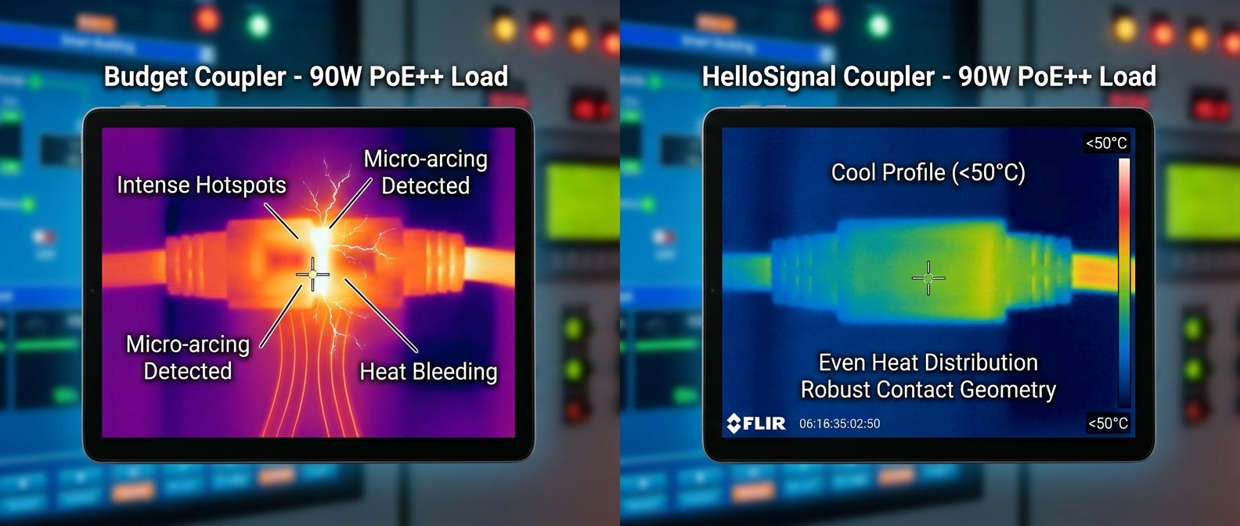
With IEEE 802.3bt PoE++ delivering up to 90 W over copper, the weakest metal contact in the path determines long-term reliability. Under high current, sub-optimal couplers suffer from local hot-spots, plated layer erosion and eventual carbonisation.
A frequently overlooked risk is hot-plugging: disconnecting and reconnecting connectors under active PoE++ load. Each event can generate micro-arcs that slowly damage the gold finish, raising contact resistance and temperature over time.
In real buildings, PoE++ circuits are rarely powered down just to repatch one camera or AP. Your couplers must survive occasional hot-swap operations without catastrophic plating damage. This is why HelloSignal specifies 50 µ" thick gold plating and robust contact geometry designed to minimise arcing and maintain low contact resistance after many maintenance cycles.
■5) Decision Rules / Engineer’s Shortcut
To keep projects on schedule, engineers and buyers need simple rules that can be applied directly to BOMs and on-site decisions. The table below summarises practical “if-this-then-that” shortcuts for Ethernet coupler selection in 2026.
| Condition | Decision Rule | Rationale | Recommended Class |
|---|---|---|---|
| Link speed target ≥ 10G or Wi-Fi 7 AP uplink | Always use Cat6A shielded couplers only. | Cat5e / Cat6 parts will limit throughput or fail certification at 500 MHz. | Cat6A STP inline (e.g. ZC-SB42-S-C6A) |
| PoE++ Type 3 / Type 4 (60–90 W) present in the channel | Select couplers with documented PoE++ capability and thick gold plating. | Reduces risk of overheating, arcing damage and long-term resistance drift. | Shielded Cat6/Cat6A, 50 µ" gold contacts |
| Industrial or EMI-dense environment (5G, VFD drives, heavy machinery) | Default to fully shielded couplers and cables. | Maintains SNR by controlling external noise coupling. | STP couplers with 360° shield continuity |
| Total available channel loss margin is small | Limit to one coupler per channel; redesign if more are required. | Each additional joint consumes part of the insertion loss budget. | Single high-quality inline coupler only |
| Project requires EU / NA compliance and ESG reporting | Use RoHS/REACH-compliant, branded interconnects with traceable documentation. | Reduces audit risk and supports sustainability commitments. | HelloSignal couplers (ZION Communication) |
■6) HelloSignal Coupler Lineup (ZION Communication Brand)
HelloSignal is ZION Communication’s brand dedicated to structured cabling components – including RJ45 plugs, keystone jacks and inline couplers. All HelloSignal couplers are designed with multi-gigabit networks, PoE++ power and global compliance (RoHS/REACH, recyclable packaging) in mind.
6.1 Cat6A Shielded Inline Coupler
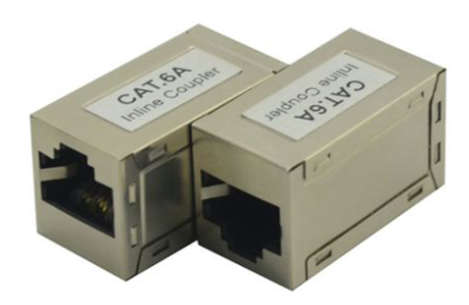
Best for: Wi-Fi 7 AP uplinks, 10G switches, PoE++ surveillance and high-density edge compute.
10GBASE-T ready, Cat6A, up to 500 MHz operation.
Fully shielded housing for 360° EMI protection and stable return loss.
50 µ" gold-plated contacts to withstand repeated PoE++ hot-plug cycles.
Designed to pass Fluke DSX Channel and Permanent Link tests when used in a compliant link.
RoHS/REACH compliant, with environmentally responsible packaging.
Product link: https://hello-signal.com/pt/product/in-line-coupler-zc-sb42-s-c6a/
6.2 FTP Cat6 RJ45-RJ45 180° Inline Coupler
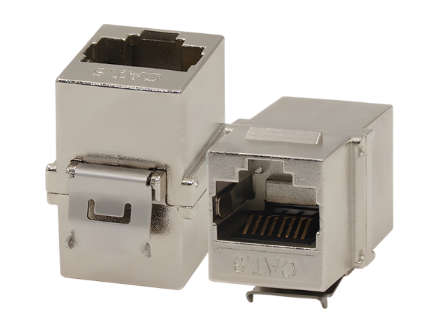
Best for: Patch panels, rack enclosures and equipment rooms where space is tight but shielded performance is required.
FTP Cat6 specification suitable for 1G and short multi-gig runs.
180° aligned contact layout optimised for controlled return loss.
Shielded construction to protect against industrial and in-building EMI.
PoE+/PoE++ capable with controlled thermal behaviour.
Product link: https://hello-signal.com/product/ftp-cat6-rj45-rj45-180-degree-inline-coupler/
6.3 UTP Cat6 RJ45-RJ45 Inline Coupler
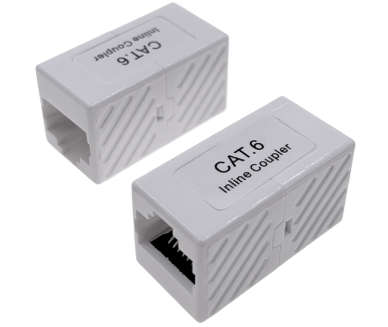
Best for: Home and small office network extensions where 1G performance and simple installation are the top priorities.
UTP Cat6 performance suitable for gigabit broadband and SOHO routers.
Compact, easy-to-install form factor for fast field work.
PoE and PoE+ compatible for typical IP camera and VoIP usage.
Product link: https://hello-signal.com/product/utp-cat6-rj45-rj45-inline-coupler-4/
■7) FAQ for Installers & Procurement Teams
Q1. Will an Ethernet coupler increase my network or gaming latency?
No. A properly designed coupler adds a delay in the sub-nanosecond range, which is undetectable to applications. Latency issues in gaming or cloud applications are dominated by WAN routing and server distance, not by passive connectors.
Q2. Can I run PoE++ (up to 90 W) through a coupler?
Yes – provided the coupler is designed and rated for PoE++. HelloSignal couplers use robust contact materials, controlled DC resistance and thick gold plating to operate safely under IEEE 802.3bt Type 3/4 loads when integrated in a compliant channel.
Q3. Is it safe to unplug and re-plug couplers under PoE++ load?
Hot-swapping under load always creates tiny arcs, which can slowly damage poor-quality contacts. HelloSignal mitigates this by using 50 µ" gold plating and a contact geometry designed to minimise arcing and maintain low contact resistance after repeated maintenance operations. Even so, the safest practice is to de-energise ports when convenient.
Q4. Will a coupler pass 10G certification on a Fluke DSX?
A Cat6A-grade coupler such as ZC-SB42-S-C6A is designed to meet the limits of Fluke DSX Channel and Permanent Link tests, provided the overall cabling, patch cords and terminations also conform to Cat6A and are within their respective loss budgets.
Q5. How many couplers can I safely use in a single channel?
As a rule of thumb, plan for a maximum of one inline coupler per channel. Two may pass in short, low-loss channels, but three or more will typically break the insertion loss and return loss budgets, especially for 10G links.
Q6. Do I really need shielded couplers for enterprise and industrial sites?
In most 2026 enterprise, smart building and industrial environments, yes. 5G base stations, VFD motor drives, LED drivers and dense Wi-Fi deployments make EMI a real concern. Shielded couplers and cables provide a controlled, predictable path with better immunity and certification margins.
■8) Conclusion & Next Steps
In 2026, Ethernet couplers must handle far more than basic connectivity. They are expected to sustain 10G throughput, support Wi-Fi 7 backhaul, carry PoE++ loads and comply with increasingly strict ESG and regulatory requirements. A low-cost, unverified coupler can silently turn into the weakest point of your infrastructure – causing speed drops, certification failures or hard-to-trace field issues.
By designing couplers specifically for multi-gigabit performance, PoE++ thermal stability and long-term reliability, HelloSignal (ZION Communication) offers a safer, higher-margin choice for engineers and procurement teams. Standardise your bill of materials on known, test-proven couplers and reduce the risk of callbacks, rework and site-wide debugging.
Share your project requirements (target speed, PoE class, environment, standards) and our team will help you map the right HelloSignal coupler and Ethernet cable portfolio – including samples for lab verification and Fluke DSX testing.