Cat6A Permanent Link vs Channel Test: What Buyers Should Know
Author: Site Editor Publish Time: 09-01-2026 Origin: Site
Cat6A Permanent Link vs Channel Test: What Buyers Should Know
A practical buyer’s guide to understanding Cat6A permanent link testing, channel testing, patch cord influence, field acceptance and common cabling project risks.
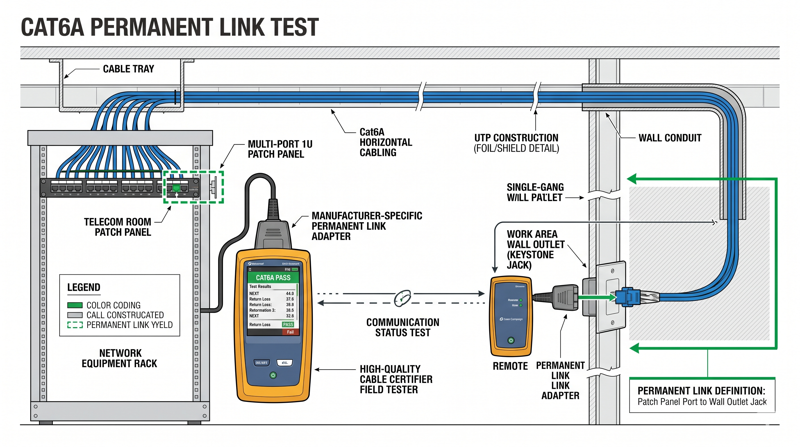
Permanent link test checks the fixed installed cabling between patch panel and work area outlet.
Channel test checks the complete working link including patch cords and equipment cords.
For Cat6A projects, buyers should confirm the required test type before installation, not after acceptance problems appear.
■ Quick Answer
In a Cat6A structured cabling project, permanent link testing and channel testing are used for different acceptance purposes. A permanent link test focuses on the fixed cabling infrastructure, while a channel test verifies the complete working connection after patch cords are included.
For buyers, this difference matters because a project may pass one test and still have problems in real use if the wrong patch cords, poor terminations, excessive length or bad installation practices are introduced later.
Use permanent link testing to verify installed infrastructure quality. Use channel testing to verify the final working link with actual patch cords and equipment connection path.
■ What Is a Cat6A Permanent Link Test?
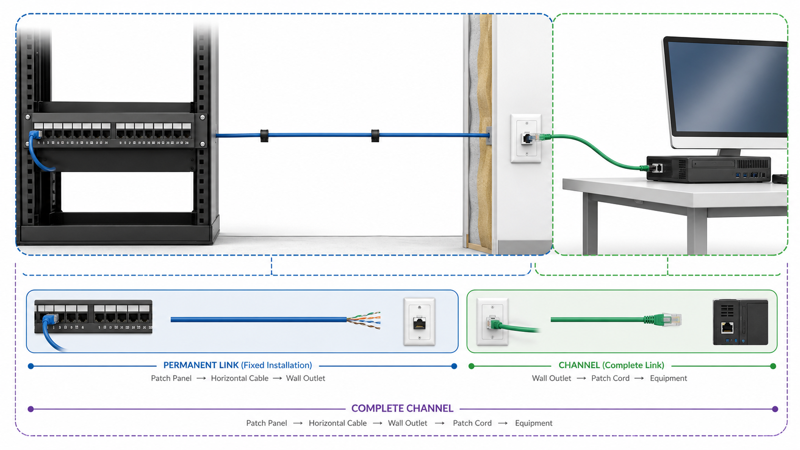
A Cat6A permanent link test checks the fixed installed cabling path, typically from the patch panel in the telecom room to the work area outlet. It does not include the normal equipment patch cords used to connect the switch or end device.
What It Checks
Horizontal cable, patch panel termination, keystone jack termination and fixed route quality.
Why It Is Used
It verifies whether the installed building cabling infrastructure meets the required performance level.
Buyer Value
It helps separate infrastructure quality from later patch cord or equipment-related problems.
■ What Is a Cat6A Channel Test?
A Cat6A channel test checks the complete end-to-end connection used in real operation. It includes the switch-side patch cord, patch panel, horizontal cable, work area outlet and work area patch cord.
| Channel Component | Included in Channel Test? | Buyer Concern |
|---|---|---|
| Switch-side patch cord | Yes | Poor patch cords can reduce final performance margin. |
| Patch panel and horizontal cable | Yes | Termination quality and cable route still matter. |
| Work area outlet | Yes | Keystone quality affects end-to-end performance. |
| Work area patch cord | Yes | Length, category and connector quality must match the system. |
■ Permanent Link vs Channel Test
The two tests are not competitors. They answer different questions. Permanent link testing asks, “Is the fixed cabling infrastructure good?” Channel testing asks, “Does the complete working link perform correctly?”
| Item | Permanent Link Test | Channel Test | Buyer Decision |
|---|---|---|---|
| Purpose | Verify fixed installed cabling | Verify complete operational link | Use both when project acceptance and final operation both matter. |
| Includes patch cords? | No | Yes | Patch cord quality can change final channel result. |
| Typical acceptance stage | After fixed cabling installation | After patching and final setup | Define acceptance stage in project documents. |
| Best for | Contractor handover and infrastructure QA | Real-use verification and troubleshooting | Select based on project responsibility boundary. |
| Common misunderstanding | “If permanent link passes, everything will work.” | “If channel fails, all installed cable is bad.” | Use test results to isolate the problem source. |
■ Key Test Parameters Buyers Should Understand
Buyers do not need to become test engineers, but understanding the main test terms helps when reviewing reports or discussing failures with contractors and suppliers.
| Parameter | Simple Meaning | Why It Matters | Common Cause of Problem |
|---|---|---|---|
| Wiremap | Checks pair connection and pinout correctness | Detects miswires, opens, shorts and split pairs. | Wrong termination or mixed wiring schemes. |
| Insertion Loss | Signal loss through the cable path | Long or poor-quality links lose more signal. | Excessive length, poor conductor quality or bad patch cords. |
| NEXT | Near-end crosstalk between pairs | Important for stable high-speed transmission. | Untwisted pairs near termination or poor connector quality. |
| Return Loss | Signal reflection caused by impedance mismatch | Poor return loss can cause unstable links. | Bad termination, cable damage or inconsistent components. |
| ACR-F / PS Parameters | Combined performance margin indicators | Help evaluate multi-pair performance under load. | Poor installation quality or mixed-grade components. |
■ Why Cat6A Permanent Link or Channel Tests Fail
Cat6A has higher performance requirements than lower-category cabling systems. Small installation mistakes that may not affect a basic link can become visible during Cat6A certification testing.
Poor Termination
Too much untwisting, wrong pair order or poor contact can affect NEXT and return loss.
Mixed Components
Using Cat6A cable with lower-grade patch cords, connectors or jacks can reduce channel performance.
Excessive Length
Over-length permanent links or long patch cords can increase insertion loss.
Bend and Pulling Stress
Sharp bends, over-tight cable ties or excessive pulling tension can damage cable geometry.
Shielding and Grounding Issues
For shielded Cat6A systems, grounding continuity and proper termination are important.
Wrong Test Setup
Incorrect test adapter, wrong test limit or poor tester calibration can lead to confusing results.
■ What Buyers Should Confirm Before Ordering
Before buying Cat6A cable, patch panels, keystone jacks and patch cords for a project, buyers should define the expected test scope and acceptance method. This prevents disputes between supplier, installer and end customer.
| Buyer Checkpoint | What to Confirm | Why It Matters |
|---|---|---|
| Test Type | Permanent link, channel or both | Defines what will be accepted and who is responsible. |
| Component Category | Cat6A cable, Cat6A patch panel, Cat6A keystone and Cat6A patch cord | Mixed lower-grade parts can reduce final system performance. |
| Length Plan | Fixed link length and patch cord length | Prevents over-length channel failures. |
| Shielding Type | UTP, F/UTP, U/FTP, S/FTP and grounding plan | Shielded systems need compatible components and correct installation. |
| Report Requirement | Test report format, project labeling and acceptance record | Makes handover clearer for contractors, buyers and end users. |
■ Risk Levels for Cat6A Testing
The risk level depends on project complexity, speed requirement, cable route, component matching and acceptance criteria.
Short Cat6A link, matched Cat6A components, proper termination and clear permanent link test requirement.
Long route, mixed patch cords, dense cabinet, shielded system or unclear acceptance boundary.
Over-length channel, poor termination, low-grade components, excessive bending or no test report requirement.
■ Decision Rules / Engineer’s Shortcut
For Cat6A projects, test selection should follow the project stage and responsibility boundary.
| Project Situation | Recommended Test | Reason | Buyer Action |
|---|---|---|---|
| New building fixed cabling | Permanent link test | Verifies installed infrastructure quality. | Request test report before project handover. |
| Final network commissioning | Channel test | Checks real working link with patch cords. | Use actual patch cords planned for operation. |
| Contractor acceptance dispute | Permanent link first, then channel if needed | Separates fixed cabling issue from patch cord issue. | Compare reports and isolate failure source. |
| High-density data room | Both, depending on project requirement | Cat6A performance margin can be affected by installation details. | Control bend radius, routing and patch cord quality. |
| OEM supply order | Factory QA plus project-side test | Factory product test is not the same as installed link certification. | Confirm product standard and field test responsibility separately. |
Permanent link test = fixed infrastructure quality. Channel test = real working connection quality. For Cat6A projects, define the required test before purchasing and installation.
■ FAQ
What is a Cat6A permanent link test?
It tests the fixed cabling path, usually from patch panel to work area outlet, excluding normal equipment patch cords.
What is a Cat6A channel test?
It tests the complete operational link, including patch cords, patch panel, horizontal cable, outlet and work area cord.
Which test should buyers request?
For fixed cabling acceptance, request permanent link testing. For final operational verification, request channel testing.
Can a permanent link pass but channel fail?
Yes. Poor patch cords, excessive patch cord length or mismatched components can make the final channel fail.
Why is Cat6A testing more sensitive?
Cat6A supports higher performance applications, so termination quality, cable geometry, length and component matching become more important.
What should be included in a test report?
A useful report should include link ID, test type, category limit, pass/fail result, length and key performance parameters.
Need Cat6A Cabling Components for Your Project?
ZION Communication can support Cat6A bulk cable, patch cords, patch panels, keystone jacks and customized copper cabling solutions for structured cabling, data center, office and OEM projects.