Cat6e vs Cat6a: How to Choose the Right Ethernet Cable for Wi-Fi 7, PoE++ and 10GbE
Author: Site Editor Publish Time: 15-01-2026 Origin: Site
Cat6e vs Cat6a: How to Choose the Right Cable for Wi-Fi 7, PoE++ and 10GbE
This guide explains the real difference between Cat6e vs Cat6a, why only Cat6a is standardized, and how project owners, engineers and buyers can avoid expensive recabling in the next 5–10 years.
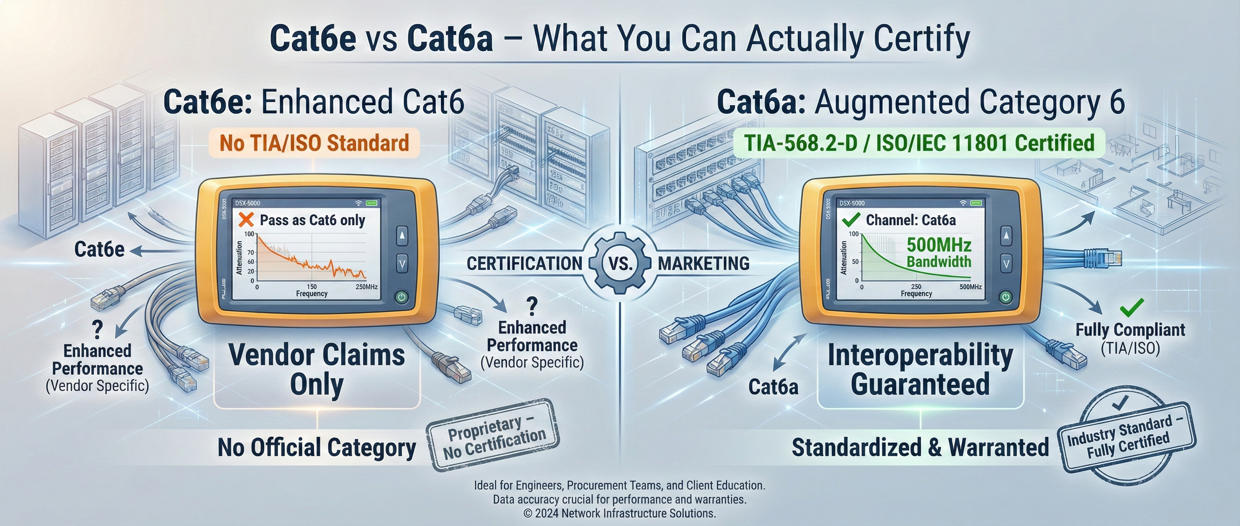
Cat6e is not a TIA / ISO standard — it is only a marketing term; test equipment will only certify it as Cat6.
Cat6a is the only standardized choice for 10GbE up to 100 m, Wi-Fi 7 AP uplinks and PoE++ 90 W in 2026 structured cabling.
For new builds and major upgrades, the safe design rule is: “If in doubt, go Cat6a UTP as baseline.”
■ 1) Why Cat6e vs Cat6a Matters in 2026
From 2024 onward, core trends like Wi-Fi 7 (802.11be), PoE++ 90 W, smart building systems and high-density edge switches are pushing Cat6 infrastructure to its limits. When new projects compare cat6e vs cat6a, the decision directly affects:
Whether 10GbE can be supported across full 100 m horizontal links.
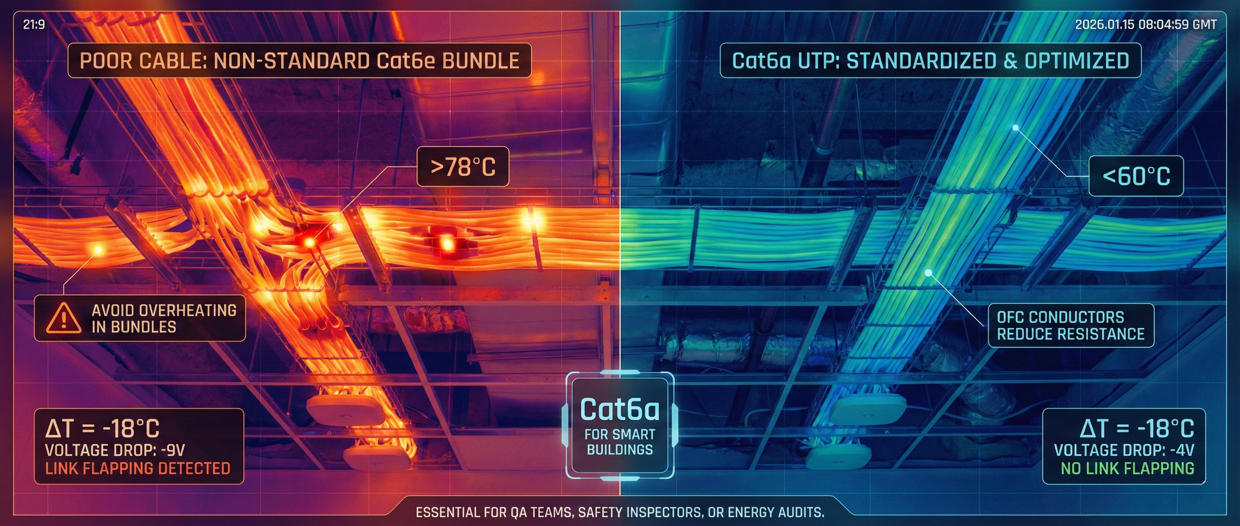
Whether PoE++ loads will cause excessive heating and voltage drop.
Whether your cabling can be certified and warranted for 10–15 years.
Whether you will face costly re-cabling just to support the next Wi-Fi upgrade cycle.
For consultants, system integrators and end-user IT, the key question is no longer “Can we save a little on cable?” but rather “Will this cabling survive two or three equipment refresh cycles?”.
Many tenders still write “Cat6e” into the specification. On site, installers discover that the cable cannot be tested as anything above Cat6. The result: links failing 10GbE certification, rework, and arguments over who pays for replacement with Cat6a.
■ 2) What Exactly Is Cat6e?
Cat6e = Enhanced Cat6 Marketing, Not an Official Standard
“Cat6e” is commonly promoted as “enhanced Cat6”, suggesting higher bandwidth or better shielding. However:
There is no Cat6e category in TIA-568.2-D or ISO/IEC 11801.
Each manufacturer defines its own “Cat6e” performance limits.
Field testers cannot certify a channel as “Cat6e” — only as Cat6 or Cat6a.
In practice, cat6e vs cat6a is a comparison between non-standard enhanced Cat6 and fully standardized Cat6a.
Any “Cat6e” cable you buy will always certify only as Cat6 in the field. You cannot prove it performs as advertised, and interoperability depends entirely on the vendor’s own claims.
■ 3) Cat6a: Standardized Cabling for 10GbE
Cat6a Was Designed for 10GbE and Beyond
Cat6a (“augmented Cat6”) is defined in TIA-568 and ISO/IEC as the reference copper medium for 10GBASE-T:
Up to 500 MHz bandwidth (stated and verified).
10GbE support up to 100 m including patch cords and consolidation points.
Controlled alien crosstalk performance in high-density bundles.
Designed to handle PoE++ 90 W with acceptable temperature rise when properly installed.
For most 2026 projects, Cat6a UTP becomes the “default” copper category for horizontal cabling, especially when comparing cat6e vs cat6a for new buildings, campuses and healthcare or industrial sites.
■ 4) Technical Comparison: Cat6e vs Cat6a
The table below summarizes the main differences engineers should consider when evaluating cat6e vs cat6a in real projects.
| Parameter | Cat6e (Enhanced Cat6) | Cat6a (Augmented Cat6) |
|---|---|---|
| Standardization | Not defined by TIA/ISO, vendor-specific | Defined in TIA-568.2-D / ISO/IEC 11801 |
| Typical Bandwidth | 500–600 MHz (not guaranteed) | 500 MHz (guaranteed by standard) |
| 10GbE Support | Usually 10GbE up to 30–55 m (best case) | 10GbE up to 100 m (full channel) |
| Alien Crosstalk | No common ANEXT limits, vendor-specific | ANEXT limits specified and tested |
| PoE Capability | Generally PoE / PoE+, some claim up to 60 W | Designed for PoE++ (up to 90 W) with proper installation |
| Certification in Field | Tests only as Cat6, not “Cat6e” | Tests and labels as Cat6a channel/link |
| Recommended Lifecycle | ~5–7 years (limited 10GbE) | ~10–15 years (multiple equipment refreshes) |
■ 5) PoE, Wi-Fi 7 and Application Scenarios
How cat6e vs cat6a Impacts Real Deployments
Before choosing between cat6e vs cat6a, align cable selection with target applications: Wi-Fi 7 access points, cameras, industrial controllers, LED lighting and future 10GbE edge switches.
| Environment / Application | Typical Requirements | Cat6e Suitability | Cat6a Suitability |
|---|---|---|---|
| Small office / basic LAN | 1GbE, few PoE+ devices, low density | Acceptable, but not future-proof | Recommended baseline for new installs |
| Enterprise office / campus | Wi-Fi 6E / 7, 2.5–10GbE uplinks, PoE+ | Limited, may restrict AP upgrades | Strongly recommended for 10+ year lifecycle |
| Data center / MDF / IDF | 10GbE at full distance, high density bundles | Not recommended | Preferred standard if fiber is not used |
| Industrial / manufacturing | EMI, PoE++ loads, harsh environment | Generally not suitable | Cat6a (often shielded) recommended |
| Hospital / healthcare | Critical uptime, high density, long lifecycle | Risky choice, difficult to justify | Standard choice for new builds |
| Smart building / PoE lighting | PoE++ 90 W, many cables in tight bundles | Heat rise and voltage drop may be an issue | Cat6a UTP is the safer long-term option |
■ 6) Decision Rules / Engineer’s Shortcut
To speed up specification and on-site decision-making, use the following shortcut when comparing cat6e vs cat6a.
| Design Question | If Answer is YES → | Recommended Choice | Notes |
|---|---|---|---|
| Will any link carry 10GbE beyond 30–40 m? | Yes | Cat6a | Cat6e may work only in best-case lab conditions. |
| Do you plan for Wi-Fi 6E / 7 APs in the next 5 years? | Yes | Cat6a | AP uplinks will likely move to 2.5–10GbE and higher PoE power. |
| Will many cables run in tight bundles with PoE++ 90 W? | Yes | Cat6a | Cat6a handles heat rise and resistance better than non-standard Cat6e. |
| Do you need formal channel certification and warranty? | Yes | Cat6a only | Cat6e cannot be certified as a category, only as Cat6. |
| Is this a short retrofit (< 30–40 m) with tight budget? | Yes | Cat6e or high-performance Cat6 | Acceptable where 10GbE is limited and lifecycle requirements are modest. |
If the cable will be hidden above ceilings, inside walls or under raised floors, specify Cat6a UTP as the minimum. Use Cat6e only for short patch runs or very cost-sensitive retrofits where 10GbE is not critical.
■ 7) Installation & Cost Considerations
Cable Size, Pathways and Labor
Cat6a cables are typically thicker than Cat6/Cat6e, which affects conduit fill, tray capacity and bend radius. Modern “slim” Cat6a UTP constructions help reduce OD while still meeting Cat6a performance.
Expect slightly larger minimum bend radius with Cat6a.
Plan pathway capacity with 20–30% spare for future adds.
Use quality connectors rated specifically for Cat6a.
Material vs Lifecycle Cost
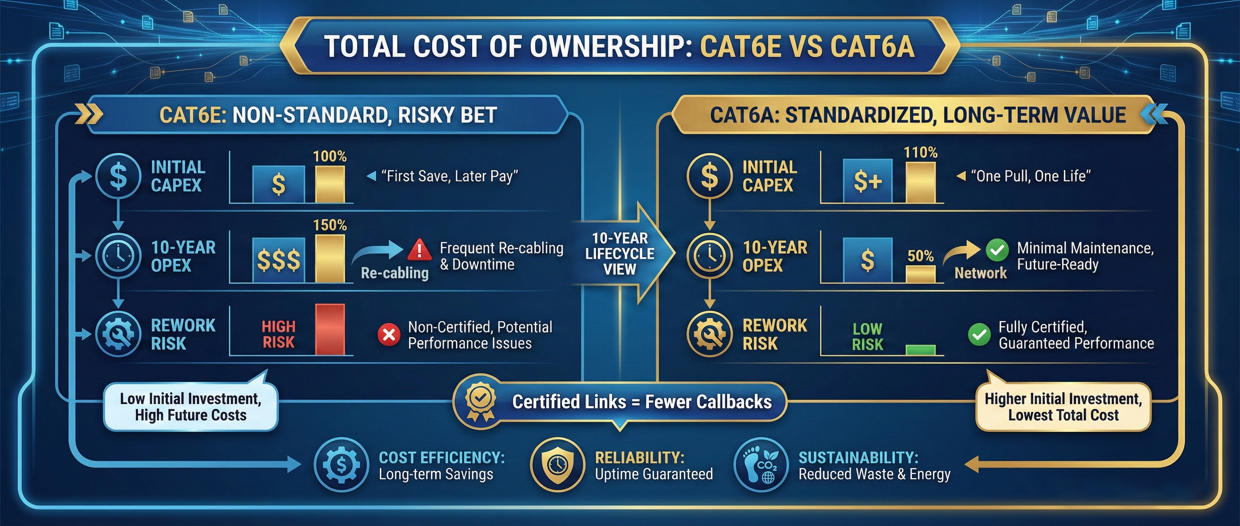
The raw cable price difference between cat6e vs cat6a is usually modest compared to labor, testing and patching hardware. Over a 10–15 year life, the total cost of ownership almost always favors Cat6a because it postpones or eliminates the next recabling cycle.
| Item | Cat6e-based Design | Cat6a-based Design |
|---|---|---|
| Material Cost (per link) | Lower cable cost, similar hardware | Slightly higher cable cost |
| Labor & Testing | Similar installation effort, may require rework if 10GbE fails | Similar installation effort, fewer surprises in testing |
| 10-Year Upgrade Flexibility | May need recabling for 10GbE or PoE++ | Generally no recabling required |
| Total Cost of Ownership | Appears lower at day one, can become higher after first major upgrade | More predictable and often lower TCO over project life |
■ 8) Conclusion & Final Recommendation
Conclusion
When you put marketing aside and look at standards, testing and lifecycle cost, the cat6e vs cat6a debate becomes clear:
Cat6e is only an enhanced Cat6 label. It cannot be certified as a separate category and performance depends entirely on each manufacturer.
Cat6a is the only copper cabling category standardized for 10GbE up to 100 m with specified alien crosstalk and PoE++ capabilities.
For most 2026 projects, especially with Wi-Fi 7, smart building and PoE++ requirements, Cat6a UTP should be considered the minimum baseline.
In other words: if you are investing to open ceilings and pull new cable, the safe engineering choice is to install Cat6a once and keep it for the next 10–15 years, instead of saving a little now with Cat6e and paying much more later during upgrades.
Share your project type, link lengths, PoE requirements and emission environment with ZION COMMUNICATION. Our team can help you choose the right Cat6a UTP / shielded Ethernet cable, patch panels and connectivity for a robust, standards-compliant solution.