Drop Wire Clamps for FTTH & Aerial Fiber Cable – Plastic & Steel Options
Author: James Publish Time: 02-07-2025 Origin: Site
■ Drop Wire Clamp in FTTH Deployment: An Ultimate Guide, Varieties, and Options
In the current age of telecommunication, FTTH (Fibre to the Home) is truly the best for quick broadband connectivity. The drop wire clamp's presence is often taken for granted, despite the weight it carries in any FTTH infrastructure. This small but essential device ensures the fiber drop cables' security and stability when suspendly mounted and incorporated into buildings.
No matter who you are—a network installer, telecom engineer, or a product buyer—understanding the operation of drop wire clamps and taking an appropriate one can do away with premature failure of your fiber network and improve the repairability.
■ What are the drop wire clamps?
A drop wire clamp is a hardware component that doubles as a drop cable clamp and an FTTH cable clamp. It enables the support and secure mounting of aerial drop fiber optic cables. These clamps work to:
Ground the cable at telecommunication poles or building entrances.
Relieve strain on the connectors,
Stay clear of sagging or breakage due to high winds or gravity.
The aerial FTTH deployments cannot do without drop wire clamps. This is especially between the final distribution point and each subscriber's new address.
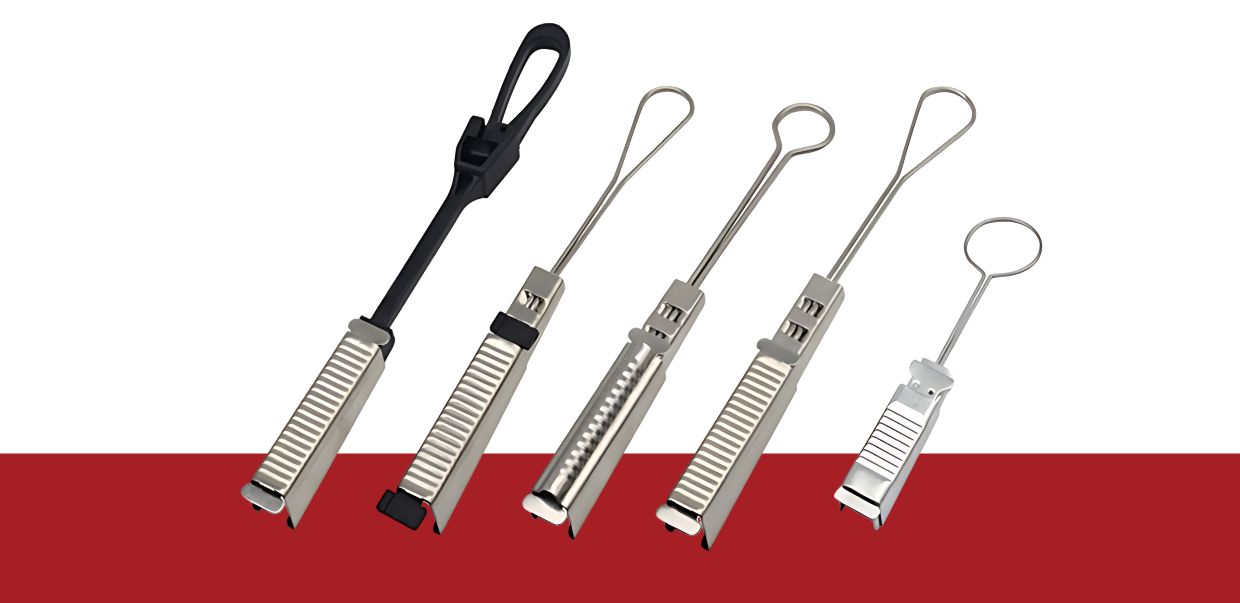
■ Structure of a drop wire clamp
A schematic of a drop wire clamp consists of:
The clamp body: Made of either stainless steel, galvanized steel, or reinforced plastic, which happens to be the portion on which the cable sits, and also where the mechanical strength lies.
The wedge or Jaw mechanism: A device that exerts pressure to grasp on the cable strongly. Some come self-tied.
Bail wire or hook: A loop or hook which leads to an anchor on the suspension point.
The groove or channel: Made to support either flat or round cables with a stable inclination.
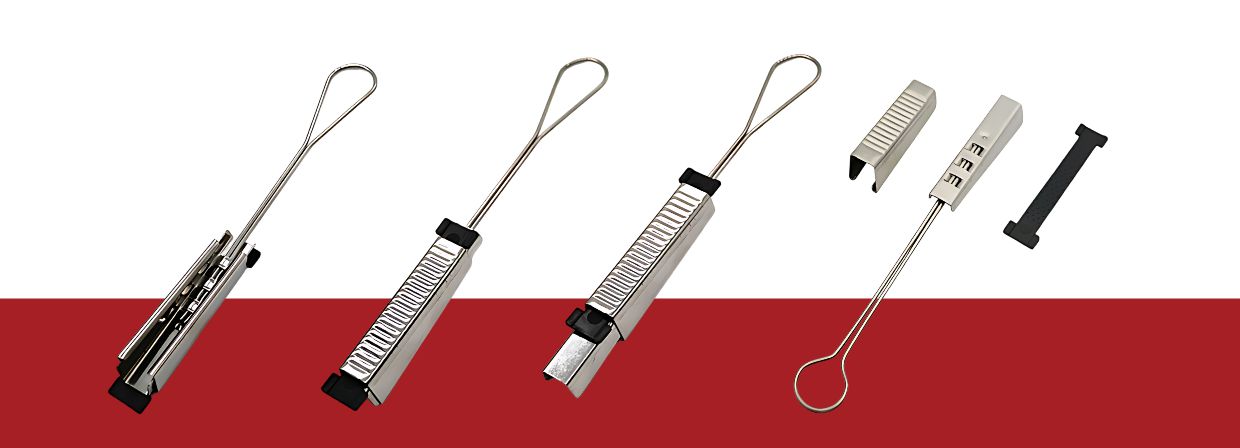
■ Varieties of the drop wire clamp used in the FTTH installations
With every installation case demanding performance, a variety of drop wire clamps prototypes have been constructed. The next section lists the commonly employed fiber optic designs:
Type | Pic | Material | Compatible Cable | Key Features | Typical Use Case |
Stainless Steel Drop Wire Clamp |  | 304 / 201 Stainless Steel | Flat or round drop cables | High tensile strength, corrosion-resistant, | Outdoor FTTH pole-to-building installation |
Plastic Drop Wire Clamp (FTTH Clamp) |  | UV-resistant Nylon or ABS | Flat drop cables (e.g., 2.0x3.0mm or 2.0x5.2mm) | Lightweight, easy to install, cost-effective | Indoor/outdoor last-mile FTTH installations |
Figure-8 Cable Drop Clamp |  | Galvanized Steel or Stainless Steel | Figure-8 cable with messenger wire | Designed to hold both cable and messenger; | Aerial FTTH spans with integrated support wire |
Round Cable Drop Clamp |  | Stainless Steel or Plastic | Round fiber optic drop cables (e.g., G657A1/A2) | Ideal for small diameter round drop cables | Pole-to-building installations, adaptable |
Wedge Type Drop Clamp |  | Aluminum or Steel + Plastic wedge | Flat or round cable | Automatic self-tightening | Heavy-duty FTTH or telecom drops |
Hook Type Drop Clamp |  | Stainless Steel with open hook | Flat drop cable | Quick hook-on installation, | Temporary or rapid deployment FTTH installs |
■ Installation Manual: How to Use Drop Wire Clamps
The drop wire clamp installation is generally hassle-free and in most cases tool-free:
The Cable Needs to be Inserted: Feed the cable into the clamp pursuant to its groove or jaw.
The Wedge Needs to be Locked: If the clamp is of a wedge-type, drive in the self-locking wedge until it is tightly secured.
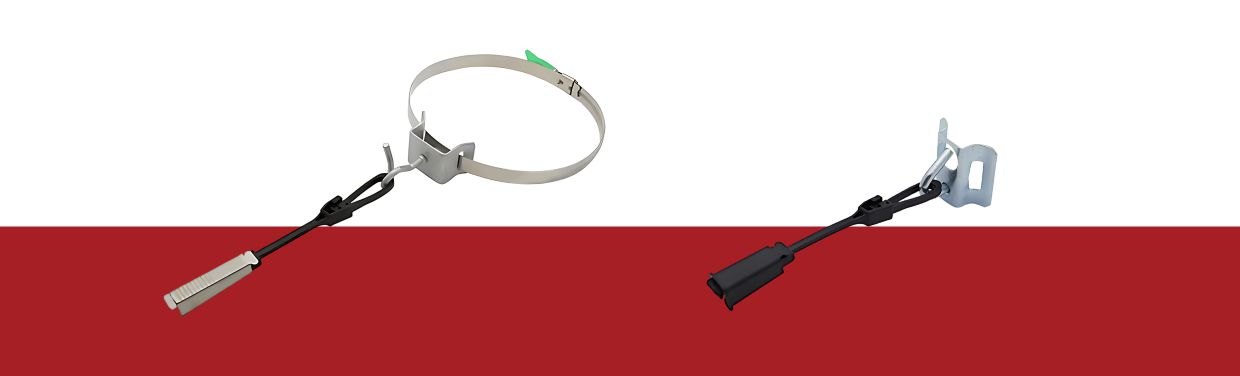
The Clamp is to be Attached: Take the bail wire or hook and connect it carefully to a suspension bracket or pole anchor.
The Slack is to be Adjusted: Make it sure that you leave an extra loop for service capability and strain relief.
Tip: You should prevent exceeding the limit of the clamp or placing it too near to the connectors. Otherwise, the fibers running through the cables would be damaged.
■ The Uses of Drop Wire Clamps
These are now extensively encountered in:
FTTH optical network installations
Facilitations for telephone lines and cable on aerial stretches
Telecommunication access networks at the outdoor
Cable routing in the building-to-building way
Rural and suburban fiber deployments
They are fitted into what?
Utility poles
Wall-mounted brackets
Service entry points on homes or offices
■ The Gooditracte of Drop Wire Clamps
Simple Assembly – No assembly parts included in the majority of cases.
Weather Resistant – Stainless steel alloys and thermoplastics with UV protection contain durable use in the open.
Cable Security – Limits the chance of cable fatigue fatigue, disconnect, and cold bend.
Broad Compatibility – Drop cables: Flat, round, and more complex shapes are all okay.
Economical – A solution with the least amount of input carries with them the highest amounts of network dependability.
■ How to Choose the Right Drop Wire Clamp?
When arranging a clamp for your fiber installation, here are a few factors to inform your choice:
Factor | Recommendation |
Cable Type | Match clamp groove with cable shape (flat or round) and size |
Installation Environment | Use stainless steel or galvanized models for outdoor/humid regions |
Span Length | Use stronger wedge or figure-8 types for long spans |
Load Requirement | Confirm tensile strength ratings for safety |
Ease of Installation | Choose hook or plastic models for quick drop connections |
■ Final Thoughts
Even though minuscule in size, the drop wire clamp is one of optic fiber networks' most potent weapons. It is one of the measures that guarantees that your drop cables are properly held, that they have the required tension strength, and that they are not exposed to harsh weather elements or mechanical stresses. In this scenario, selecting the right clamp has the impact of simplifying network maintenance and increasing network stability.
Discover the different types of drop wire clamps that suit your project demands to assure that the fiber installation can be utilized in future.

James is a technical manager and associate at Zion Communication.
Specializes in Optical Fiber communications, FTTH Solutions,
Fiber optic cables, ADSS cable, and ODN networks.
james@zion-communication.com
+86 13777460328