Fusion Splicing vs. Pre-Terminated Fiber Optic Cable: Which is Better?
Author: James Publish Time: 15-07-2025 Origin: Site
■ Connector vs. Splicing: Two Main Types of Fiber Optic Termination Explained
Termination of fiber optics is indeed one of the most critical aspects of an optical network that requires connecting an optical fiber to an interface. The second aspect of fiber optic installation is proper identification of the various kinds of fiber optic terminations. This knowledge would enable one to know which of the networks: enterprise data center, FTTH access point, or backbone telecom line fibers ones are suitable for optimal performance and reliability.
Termination of fiber optic cable may be done in two main ways: through connector termination or fo cable splicing (more commonly known as fo cable splicing). Each method adapts to the stated environment and performance. For making the decision, these factors, such as cost and efficiency, signal loss, as well as installation flexibility, are to be weighed.
■ Connector Termination
Connector termination is one of the most renowned optical fiber termination types, involving use of factory or field-installed connectors that allow easy mating with or unmating of other fiber links. These connectors have been made so that coordination of the flexible light cores is achieved. Therefore, the fiber losses and reflections are reduced.
Common Connector Types
The most widely used fiber optic connectors are:
LC (Lucent Connector) – extensively applied in data centers with high-density areas
SC (Subscriber Connector) – commonly used on the enterprise and telecom networks
FC (Ferrule Connector) – most suited for locations that face high frequency of vibration
Every connector may be factory- or field-installed based on the type of cable and the size of the project.
Termination Techniques
Epoxy and Polish Termination
Epoxy is introduced through fibers using the adhesive onto the connector with manual polishing of the tool and film. However, the process is quite lengthy. Considering this, it could be low-cost for high-volume terminations.
Rapid-Patch or Pre-Polished Termination
Quick connect (QC) deployments include a pre-terminated fiber stub only inside the connector. The technicians on the field only have to cleave and insert the fiber into the connector's body to finish the task. The method provides quick service and is suitable for installation in the field, although the unit cost is expensive. First, make sure that your connection is intact by either cutting splice machine or using a visual fault locator.
Pre-Terminated Fiber Optic Cables
When the speed of action is of utmost importance, plug and play solutions are excellent to have. Fiber optic cables, which are terminated in a controlled factory environment and tested for performance prior to shipment, come ready for instant installation. They avoid the necessity of external field termination and splicing via machines. Hence they can be used effectively in:
data centers
short indoor links
temporaries on the move or relocations
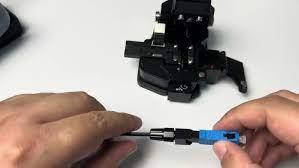
■ Splicing Termination
Fo cable splicing, also known as cable splicing or fo cable splicing, is joining two ends of fiber cable together to create a closed optical path. This technique is critically importative in long-distance light transmission, whether if it is in podcast, microwave, transmission line, or broadcasting purposes.
There are two major splicing techniques: First one is mechanical splicing and the other one is fusion splicing.
Mechanical Splicing
Mechanical splicing utilizes factor components (alignment sleeves, matching gel) to temporarily or semi-permanently put two end fibers into alignment. It does not yet tie the two densely packed fibers together, but from the view of axonal transmission of electromagnetical impulses, it comes a long way.
Advantages:
Nothing to enjoy a splicing machine
Ideal for an emergency field repair
Very simple and fast to process
Limitations:
The decrease in insertion loss is slightly higher compared to that of the fusion joining
Not capable of high-performance, long-distance communications
Fusion Splicing
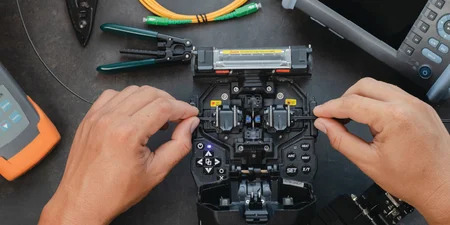
When the arc is produced by a splicing machine on high-voltage, it irreversibly fuses the fiber ends in fusion splicing. This method is characterized by the lowest levels of insertion loss and reflectance in all the types of fiber optic termination, hence it is the norm for most outdoor and backbone networks.
Steps involved:
Strip and clean fiber ends
Precisely cleave the fibers
Use a splicing machine to align and arc-fuse the fibers
Protect the splice with a heat-shrink sleeve or housing
Applications:
Intercontinental telecommunications
Outdoor installations for plants
Manufacturing of fiber optic components
Tip: Fusion splicing is of great help when you have to join two different types of fiber cables or running repairs of damaged cable in remote places, where performance is of utmost importance.
■ Comparing Connector Termination and Splicing
Feature | Connector Termination | Splicing Termination |
Tool Requirement | Polishing kits or factory-terminated | Splicing machine required for fusion |
Installation Time | Fast (especially pre-polished) | Slower and more technical |
Cost | Lower initial cost | Higher equipment and labor cost |
Performance | Slightly higher loss | Lowest loss (fusion splicing) |
Use Case | Patch panels, cross-connects, modular designs | Long-haul, permanent backbone, cable repair |
Flexibility | Removable and reusable | Permanent once fused |
■ FAQ: Fiber Termination & Splicing
Q1: What is the best method for terminating fiber optic cable in the field? In this instance, if performance and durability are prioritized, fusion splicing is applied using a splicing machine as the best option. Pre-terminated fiber optic cables and quick-connectors help for an exact connection in the swift installations, while the installation of the sleeves is much faster.
Q2: Can I have multiple connectors and also do splicing for one project? Use of a connector for long trunk cables and the termination with connectors or pre-terminated assemblies for flexibility is indeed common.
Q3: When should I consider avoiding mechanical splicing? In high-vibration or varying temperature applications where there is a risk of moisture getting into causing connectors to misalign, then use of mechanical splicing should be avoided.
■ Final Thoughts
Integrated optical other terminations are essential for the overall effectiveness and economy of fiber optic system. The connector termination, cable splicing, or pre-terminated fiber optics cable should be determined according to:
Network design intricacies
The area of installation
Performance aims cannot be neglected as insertion loss tolerances will be required to meet
In the available tools such as splicing machines and polishing kits
Restoration of the time and the budget help
To conclude, each of these kinds of termination is very important in modern optical networks. Selection of the most appropriate technology — or a well-planned combination of the two — will ensure a solid, scalable, and sustainable level of connectivity.

James is a technical manager and associate at Zion Communication.
Specializes in Optical Fiber communications, FTTH Solutions,
Fiber optic cables, ADSS cable, and ODN networks.
james@zion-communication.com
+86 13777460328