IDF Edge Node Guide: Smart Building Network Architecture with Cat6A & Fiber
Author: Will Publish Time: 16-01-2026 Origin: Site
From IDF Room to Edge Node: 2026 Structured Cabling Guide for Smart Buildings
By 2026, IDF rooms are no longer passive wiring closets—they are floor-level edge nodes that aggregate Wi-Fi 7, PoE++ devices, and AI sensor data. This guide explains how to design IDF edge nodes using ZION Communication’s high-performance copper and fiber solutions.
By 2026, IDF rooms act as edge nodes for AI sensors, Wi-Fi 7, and PoE++ devices.
Cat6A LSZH copper and OS2 / G.657.A2 fiber from ZION form the backbone of smart building IDFs.
Design for edge computing, high density, and future growth—not only today’s port count.
■ 1) What Is an IDF Room in 2026?
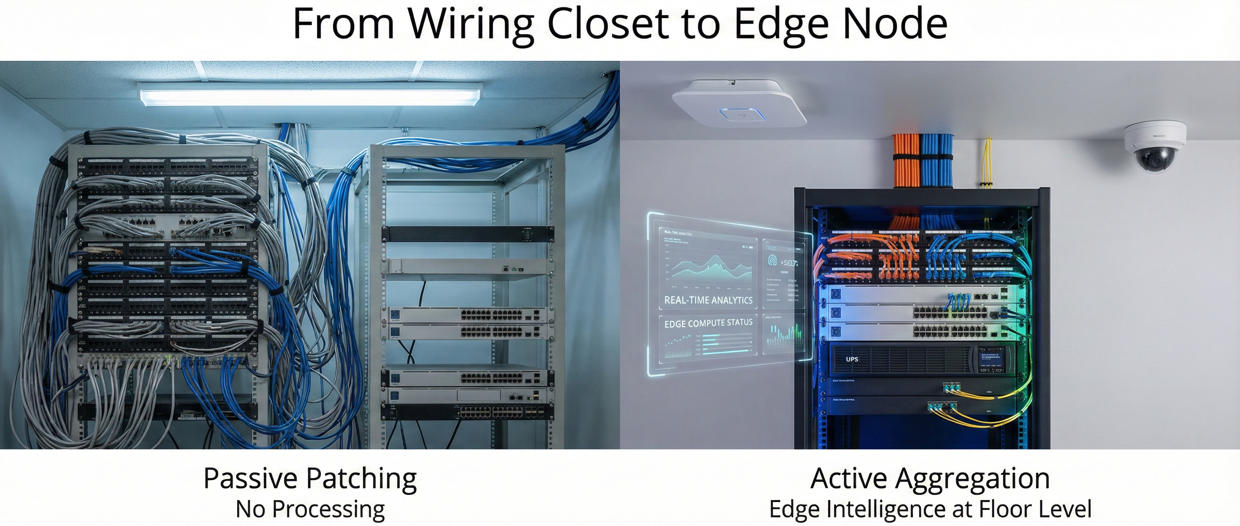
An Intermediate Distribution Frame (IDF) has traditionally been a floor-level telecommunications room that distributes copper and fiber cabling between the Main Distribution Frame (MDF) and end devices. By 2026, this role has evolved significantly. With the rise of smart building network architecture 2026, Wi-Fi 7, and AI-driven IoT, the IDF is now a floor-level edge node that aggregates, powers, and secures high-density connected devices.
Instead of acting only as a passive cross-connect, the IDF now:
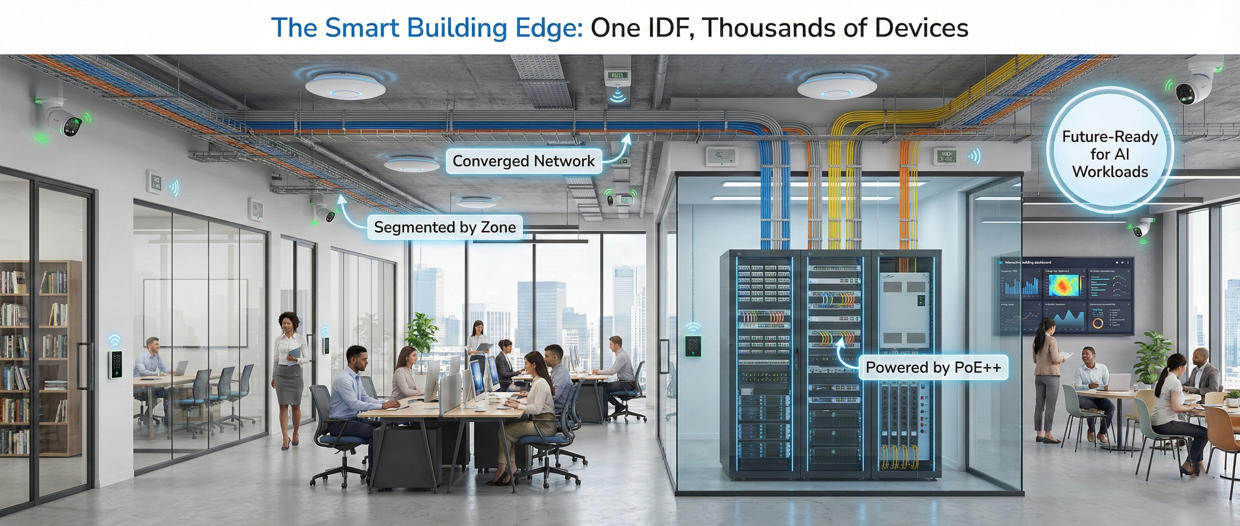
Hosts PoE++ switches for Wi-Fi 7 access points, cameras, access control readers, and sensors.
Terminates Cat6A LSZH copper to user outlets and edge devices within 100 m reach.
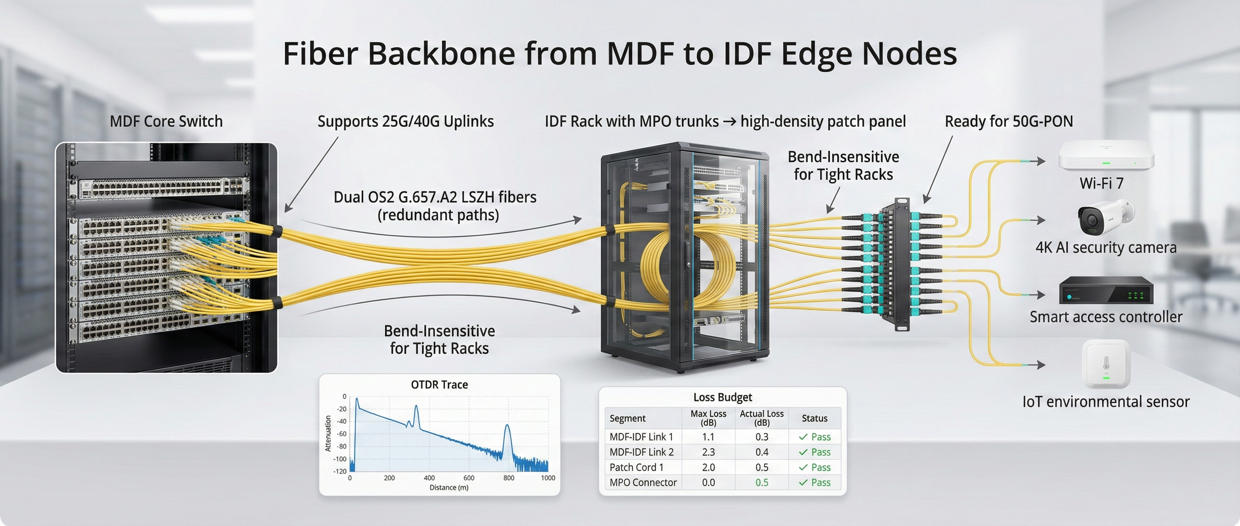
Connects to the MDF via OS2 / G.657.A2 fiber backbones, often with multiple redundant paths.
Supports edge-level telemetry, segmentation, and sometimes light analytics or anomaly detection.
| Layer | Role | Typical Location | Cabling Focus | 2026 View |
|---|---|---|---|---|
| MDF | Building / campus core, provider handoff | Central comms room | Fiber-heavy, core routing/switching | “Cloud gateway” for the building |
| Traditional IDF | Distribution / cross-connect | Per floor / per zone | Copper-heavy to outlets, some fiber | Mostly passive, limited processing |
| 2026 IDF Edge Node | Edge aggregation, PoE++, early analytics | Every high-density floor or cluster | Cat6A LSZH copper + OS2/G.657.A2 fiber | Floor-level “mini edge data center” |
■ 2) From Wiring Closet to Edge Node: Why It Matters
In high-density smart buildings, latency and reliability are critical. Video analytics, occupancy tracking, access control, and environmental sensors all generate real-time data. Sending everything back to the core or cloud introduces latency and extra bandwidth cost. That is why the IDF must be viewed as an edge node, not just a patching area.
Key Drivers for the Edge-IDF Transition
Wi-Fi 7 access points with 10G uplinks and PoE++ power draw.
AI cameras and sensors generating constant high-bitrate streams.
Smart Building Network Architecture 2026 combining IT, OT, and BMS on one converged infrastructure.
Regulatory and security requirements pushing segmentation closer to devices.
■ 3) Core Components of a 2026 IDF Edge Node
A 2026-ready IDF edge node combines structured cabling, active network infrastructure, power, and environmental management. ZION Communication focuses on the physical layer: Cat6A copper, OS2/G.657.A2 fiber, high-density patch panels, and LSZH/FR jackets, ensuring the IDF is ready for high power and high bandwidth.
3.1 Structured Cabling Layer (Powered by ZION)
ZION Cat6A UTP & FTP LSZH Series – 10GBase-T up to 100 m, optimized for PoE++ deployment for Wi-Fi 7 and edge devices.
ZION OS2 Single-mode Indoor/Outdoor Fiber – building backbone between MDF and IDF edge nodes.
ZION G.657.A2 Bend-Insensitive Fiber – tight spaces, small bend radii, and high-density patching inside racks.
High-density patch panels & keystones – 24/48/96-port designs for compact but scalable IDF layouts.
3.2 Active Network & Power Layer
Managed and stackable switches with 1G/2.5G/10G uplinks.
PoE+/PoE++ switches sized for cameras, APs, and building systems.
UPS and intelligent PDUs with monitoring for PoE loads.
| Layer | Typical Function | ZION-Recommended Product Type | Design Notes (2026) |
|---|---|---|---|
| Horizontal Copper | Outlet to IDF switch | Cat6A UTP/FTP LSZH | Use for Wi-Fi 7 APs, cameras, IoT; size for PoE++ power and heat. |
| Backbone Fiber | IDF ↔ MDF / other IDFs | OS2 / G.657.A2 Single-mode Fiber | Multiple fibers per path; design for redundancy and future 25G/40G. |
| Patching & Connectivity | Rack-level management | High-density patch panels, keystones, couplers | Keep labeling, color codes, and dressing consistent across floors. |
■ 4) Smart Building & AI / IoT Use Cases
IDF edge nodes sit at the intersection of IT, OT, and building automation. A single floor may host hundreds or thousands of endpoints. Using ZION’s high-density structured cabling solutions ensures that your design is physically ready for the logical services you need to deploy.
4.1 Typical Edge-IDF Application Scenarios
| Application | Typical Devices / Density | Cabling Choice | Edge-IDF Design Note |
|---|---|---|---|
| Wi-Fi 7 Coverage | 1 AP / 60–80 m² | ZION Cat6A LSZH + PoE++ | Plan for 10G uplinks and high PoE power draw per AP. |
| AI Video Analytics | 4K cameras around critical zones | Cat6A FTP + fiber uplinks | Consider shielded cabling for EMI and PoE++ for night vision units. |
| Access Control & Occupancy | Badge readers, door controllers, people counters | Cat6A UTP / structured zones | Group ports by security zone and VLAN to simplify maintenance. |
| BMS & Environmental Sensors | Temperature, humidity, CO₂, energy meters | Mixed copper + fiber backhaul | Edge node aggregates all data for local logic and cloud sync. |
■ 5) Decision Rules / Engineer’s Shortcut
This section gives a fast path for engineers and purchasing teams to make structured decisions when designing IDF edge nodes with ZION cabling products.
5.1 Quick Selection Matrix
| Design Question | If Answer Is... | Recommended Choice | Reason / Shortcut Rule |
|---|---|---|---|
| Floor area ≤ 800 m² and low IoT density? | Yes | 1 shared IDF edge node | Single IDF may be enough; still design for future doubling of ports. |
| Wi-Fi 7 and 4K cameras on same floor? | Yes | ZION Cat6A FTP LSZH + PoE++ switches | Use shielded cabling to control EMI and temperature under PoE++ load. |
| Multiple tenants / security zones per floor? | Yes | Separate patching blocks & color-coded ZION patch cords | Logical segmentation is easier when physical layout clearly separates tenants. |
| Distance MDF ↔ IDF > 100 m? | Yes | OS2 / G.657.A2 ZION fiber backbone | Copper backbones are no longer recommended beyond 100 m limits. |
■ 6) ZION Cabling Solutions for IDF Edge Nodes
ZION Communication offers an integrated portfolio covering copper, fiber, and connectivity hardware for edge-IDF deployments. This section summarizes how our products map to typical 2026 design requirements.
6.1 Copper: Cat6A for PoE++ and High-Density Access
Cat6A UTP LSZH series – general office, smart building, and low-EMI environments.
Cat6A FTP LSZH series – environments with higher EMI, PoE++ cameras, industrial floors.
Optimized for PoE++ deployment for Wi-Fi 7, edge switches, and IoT devices.
6.2 Fiber: OS2 & G.657.A2 for Smart Building Backbones
OS2 single-mode tight-buffer or loose-tube for MDF ↔ IDF links.
G.657.A2 bend-insensitive variants for high-density racks and tight bends.
Supports high-density structured cabling solutions and future 25G/40G links.
6.3 Patch Panels, Connectivity & Accessories
High-density fiber and copper patch panels (24/48/96 ports).
Keystone jacks, couplers, and field termination options.
Cable managers, trays, and labeling systems for clean documentation.
■ 7) Conclusion: Build IDF Edge Nodes That Last to 2030+
As buildings become smarter and networks more distributed, the IDF room has transformed into a strategic edge node. It aggregates thousands of copper and fiber links, powers PoE++ devices, and often hosts the first line of analytics and security policies. Designing this space correctly is no longer optional—it is a prerequisite for reliable, scalable, and secure operation.
For engineering teams and project owners, the most robust path forward is clear:
Adopt Cat6A LSZH as your horizontal cabling baseline for all new builds and major upgrades.
Use OS2 / G.657.A2 fiber for all MDF–IDF and IDF–IDF backbones.
Plan every IDF as a floor-level edge node, with additional capacity for AI, analytics, and future smart-building services.
ZION Communication’s high-performance structured cabling portfolio is designed specifically to support Smart Building Network Architecture 2026, high-density structured cabling solutions, and PoE++ deployment for Wi-Fi 7 and beyond.
Share your floor layout, estimated device count, and performance goals. Our team can help you select the right combination of Cat6A copper, OS2 / G.657.A2 fiber, and high-density connectivity to make your IDF rooms edge-ready for 2026 and beyond.