KNX Cable & Connector Guide 2025
Author: Site Editor Publish Time: 08-12-2025 Origin: Site
KNX is the World’s most popular open-standard for building automation.
Multi-vendor support drives tough standards for cabling & connectivity to ensure:
Robust & reliable communication, free from interference
Reliable bus power supply over long bus line lengths
Interoperability between devices from different brands
Long-term maintainability across technology generations
Security support for KNX Secure installations
In a KNX installation, the use of non-certified cabling is one of the leading causes of bus failure, telegram loss, and installation problems.
High-quality KNX bus cabling is essential to reliability.
■ KNX TP1 Bus Cable — Structure, Colors, Shielding & Technical Specs
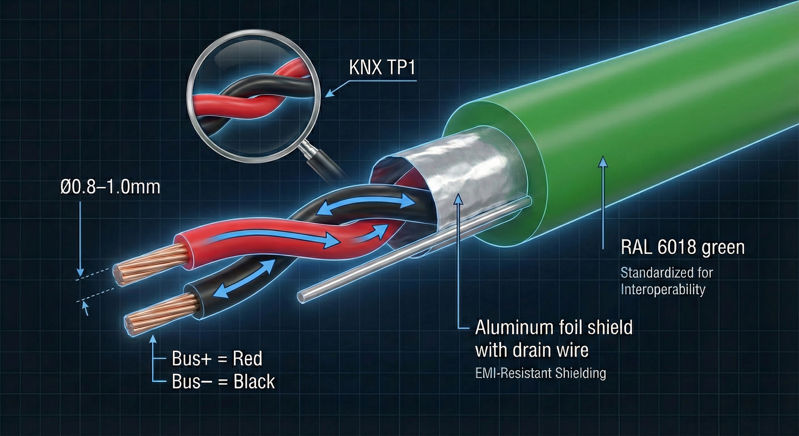
TP1 (Twisted Pair 1) is the standard cable for KNX installations. Its core build and conductor colors are standardized for easy integration.
https://www.zion-communication.com/KNX-Cable-pl3189640.html
KNX Cable Structure
Standard KNX TP1 cabling includes:
Solid copper conductor (Standard Ø 0.8mm)
1 or 2 twisted pairs
Aluminum foil screen and drain wire
Standard green RAL 6018 outer sheath for easy identification in the field
Standard KNX wire colors:
Red = Bus + (positive)
Black = Bus – (negative)
Yellow / White = Auxiliary / Reserve pair
Standard colors reduce installation mistakes, particularly when tracking down problems.
EMC Considerations — Shielding, Drain Wires & Noise Immunity
Today’s buildings and electrical environments are more electrically noisy (LED power supplies, inverters, and HVAC units).
To ensure KNX performance:
Shielding & Grounding (Drain-Wire Rules)
Ensure the shield implies no ground loops. If grounding is required by the topology, connect the drain wire at one end only (typically the distribution board end).
Double grounding creates ground loops and injects electromagnetic noise into the KNX bus.
Maintain cable twists as close to the terminals as possible to preserve noise immunity.
Cable Routing Best Practices
Avoid long parallel runs with 230/400V power and dimmer lines.
Cross power runs at 90° where necessary.
Use shielded TP1 cables in high EMC areas.

■ Professional Installation Rules
IEC Standard Cable Separation Distances (IEC 60364)
To improve KNX installation safety & minimize disturbances:
Hold a minimum of 4mm distance to 230/400V power cables
Or use segregated trunking with insulating barriers
Avoid running KNX cables around switching loads (e.g., motors)
Always follow separation distances for long-term reliability.
Installer Mistakes To Avoid
❌ Mixing twisted-pair halves of stranded data cables for separate bus runs
→ Keep Red and Black wires together as a bus pair.
❌ Floating or double grounding of shields
→ Follow drain-wire standards to avoid electromagnetic noise.
❌ Routing cables too close to LED drivers and dimmers
→ Maintain separation distances or use shielded TP1 cables.
❌ Excessive stripping of cable sheath or untwisting of pairs

■ KNX Connectors — Types, Advantages, Colors & Applications
KNX connectors are standardized to guarantee compatibility with third-party manufacturers.
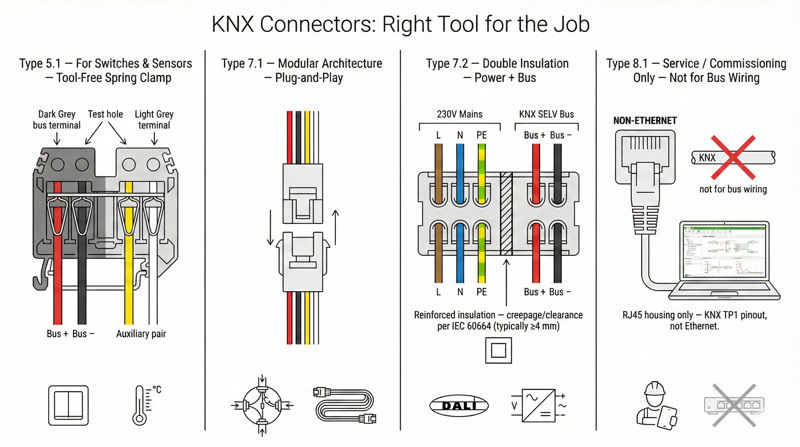
Type 5.1 Connector — Common KNX Terminal (WAGO 243 Design)
Commonly found in:
Switches
Motion Detectors (PIR)
Actuators
Binary inputs
Thermostats & Temperature Sensors
Technical Specifications
2 pins and a spring clamp. No screw locking
Accommodates solid wires of 0.6mm to 0.8mm
Permits 2 or more wires to attach
Multi-meter ready: Embedded testing slots allow for voltage checks without removing wires
Standard color orientation:
Red = Bus + (positive)
Black = Bus – (negative)
Yellow/White = Auxiliary/Reserve pair
Installer Tip
The housing color often indicates the function for fast recognition:
Dark Grey Shell → Bus pair (Red and Black)
Light Grey Shell → Auxiliary pair (Yellow and White)
Ensure wires are fully inserted to guarantee reliable contact.
Type 7.1 Connector — Plug/Socket For In-The-Field Wiring
Used for structured cabling:
Ceiling voids
Raised floor spaces
Modular Architecture
Features:
Quick installation & removal
Mechanical latch
Durable for in-field installation
Type 7.2 Connector — KNX + Mains Connector
Used for integrated devices having:
230 Volts mains supply
KNX communication
Features:
Double insulation of circuits
Individually optimized creepage/clearance
Combined LV + SELV routing
Commonly found in:
Lighting appliances
Modular integrated electrical devices
RJ45 (Type 8.1) — Special Use Only
Not used for KNX TP1 bus communication.
Primary Uses:
KNX IP Interface & IP Routing (Backbone)
In-the-field diagnostics / PC connection
■ Certification — Why the KNX Logo Matters
The sale of ‘KNX’ products is dotted with labels and names like:
‘KNX Compatible’ or ‘KNX-style cable’
‘Suitable for KNX’
A KNX Logo means full certification and assurances of:
KNX TP1 performance/specifics and immunity
Reliable inter-operational and Interconnectivity
Compliant installation rules
Tender readiness
Minimal problems when integrating products from different manufacturers
KNX Logo = Advanced Assurance for Specifiers and Integrators
■ Future Trends (2025 & Beyond)
KNX Secure & Cable Performance
KNX Secure requirements (prevention of replay attacks, sabotage, and eavesdropping) increase the demand for high-integrity cabling.
Reduced screen noise
Low-likelihood of telegram disturbance
Robust telegram protection delivered
High-performance TP1 cabling is the physical foundation for KNX Secure networks.
CPR Performance Characteristics (Europe)
In the EU, building wire and cable products need Construction Product Regulation (CPR). Possible classifications include:
Class Eca – for basic residential usage
Class Dca – for medium fire risk environments
Class Cca – for strict safety commercial applications
Increasing Class levels apply for:
Schools
Hospitality buildings
Public Use Buildings
Transport Hubs/Stations, etc.
For the European market, standard CPR classification applies.

■ Choosing the Right KNX Cable & Connector – Application Matrix
Residential Applications:
Standard Green TP1 cable
Type 5.1 connectors
Commercial/Structured Cabling
Shielded TP1 cable
Type 7.1 connectors
Lighting / Power + KNX Combined
Type 7.2 connector
Electrically Noisy Environments
Shielded TP1 cable, connected to the KNX power supply terminal
Seeking Certification For Manufacturers:
Keep to KNX Connector and electrical specs
Provide documentation as KNX Safety Standard
■ Conclusion
Your KNX Installation depends upon robust cabling and connections:
Certified KNX cabling
Standard Conductor colors
Further drain wire & earthing rules
IEC separation distance guidelines
Integrated, compatible connectors, ensure:
Strong, shielded communications
Quick installation – and upgrade
Reliable interoperation by maintained standards
Ready for KNX Secure & Next-Gen
High-Quality KNX cabling isn’t optional for reliable Automation.
Contact us for more information

michael@zion-communication.com
+86 13757188184