RF Corrugated Coax Cable Guide: Types, Sizes, PIM & 5G Applications
Author: James Publish Time: 26-11-2025 Origin: Site
■ RF Corrugated Coax Cable? Complete Beginner’s & Professional Guide
RF Corrugated Coax cable is one of the most essential RF transmission cables used in the modern RF infrastructure, such as 4G/5G base stations, DAS, broadcast networks, and microwave transmission links. With much lower attenuation, increased RF loading capacity, better PIM performance, and superior mechanical properties compared with standard braided and temporary rigid smooth-wall coax cables, RF Corrugated Coax cables are the best choice for outdoor cables and high-power RF sites.
This complete beginner’s & professional guide will explain everything you need to know about RF Corrugated Coax cables – its working principle, construction, types, sizes, performance parameters, use cases in modern 5G applications, and how to select RF Corrugated Coax cables yourself.
■ What Is RF Corrugated Coax Cable
An RF Corrugated Coaxial Cable (often called "Hardline" or "Feeder Cable") is a heavy-duty transmission line designed for low signal loss and harsh outdoor environments. Its defining feature is the corrugated (wave-shaped) solid metallic outer conductor, typically made of copper or aluminum.
Vs. Braided Coax (e.g., RG series): Braided cables use a woven mesh shield. While flexible, they suffer from higher signal loss and lower shielding effectiveness.
Vs. Smooth-Wall Semi-Rigid Coax: Smooth-wall copper tubes offer great electrical performance but are rigid and difficult to install.
The Solution: RF Corrugated Coaxial Cable combines the best of both worlds. The corrugation allows the solid metal tube to bend effectively while maintaining the superior electrical shielding and low loss of a solid tube design.
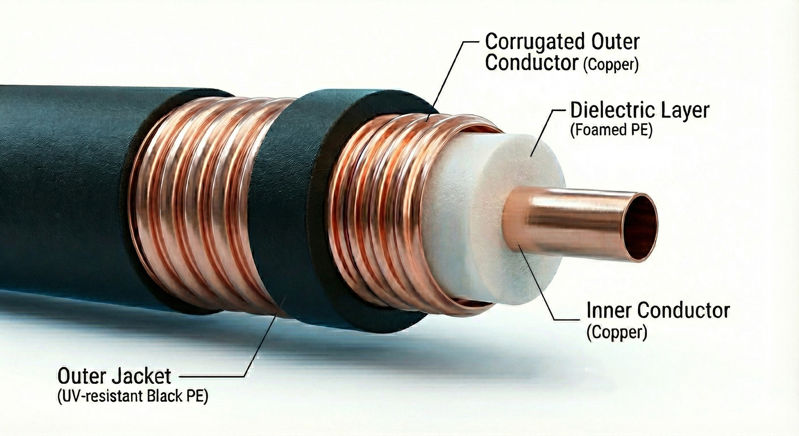
■ Basic Structure of RF Corrugated Coax Cable
RF Corrugated Coax cables usually feature the following core elements:
Inner conductor
Usually solid copper or copper-clad aluminum. Mainly responsible for carrying the RF current.Dielectric insulation
Typically physical foam polyethylene (Foamed PE). This maintains the spacing between conductors to ensure 50-ohm impedance and controls signal velocity.
The corrugated outer conductor
Usually a Corrugated copper or aluminum tube made of copper or aluminum, practically serves as the shielding layer and the return current path.
Outer jacket
Usually UV-resistant Black PE for outdoor use, or Low-Smoke Zero Halogen (LSZH) for indoor fire safety. It protects against moisture, chemicals, and physical damage.
Due to the concentric cable design, RF Corrugated Coax cables provide excellent shielding, low signal leakage, and stable impedance.
■ How RF Corrugated Coax Cable Works
The cable functions as a waveguide for electromagnetic energy. The signal propagates through the dielectric layer between the inner and outer conductors.
Dielectric allows:
Stable characteristic impedance
Controlled signal velocity
High signal quality with minimum reflection
Designed corrugated outer conductors provide more uniform current distribution at high frequencies and excellent RF current heat dissipation at high RF load conditions.
■ Key Differences Between Corrugated and Conventional Coax Cables
Compared with braided and semi-rigid coax cables, RF Corrugated Coax cables provide:
Low attenuation
Very small signal losses over long distances.High power handling capacity
High-power RF transmission required in base stations.Strong mechanical properties
Excellent resistance to crush, vibration, wind load, and temperature variations.Excellent flexibility
Easier to handle and work with compared with regular smooth-wall coax cable with the same diameter.Long service life
Can be relied on for outdoor applications for years.Superior protection against external interference
Lower RF leakage.

■ Typical RF Corrugated Coax Cable Sizes
RF Corrugated Coax cables’ design mainly features their outer diameter size. Standard size and options may include:
1/4 inch
Mainly used for RF jumper connections, short-distance indoor applications, and compact installations.3/8 inch
Mainly used in indoor DAS systems and mobile applications with and without shift change.1/2 inch
One of the most standard RF Cable sizes used in 4G/5G base station applications and indoor coverage applications.7/8 inch
Mainly used for feeders and base station RF transmissions.1-1/4 inch
Very high power transmission with very low attenuation.1-5/8 inch
Commonly used in macro base stations, broadcast stations, and long-distance outdoor feeder applications.
In general:
Larger diameter RF cables = better low-attenuation, more power handling.
Smaller diameter = easier to work with.
■ Main Types of RF Corrugated Coax Cables
General RF Corrugated Coax cable
Most standard applications for base station and other RF deployments.Super flexible RF Corrugated Coax cable
Features a spiral deep corrugation for maximum flexibility (Jumpers/Patch Cords).Low-loss RF Corrugated Coax cable
Specially made to high-quality standard conductors and materials to minimize attenuation.Aluminum RF Corrugated Coax cable
Mainly uses aluminum as the outer conductor to reduce cost and weight while preserving the high-quality RF performance.
■ Key Performance Specifications Explained
While selecting an RF Corrugated Coax cable for installation, make sure to check the following specifications:
Impedance
Usually, 50 Ohm for telecom and microwave applications.Attenuation
Measured in dB [decibel] per 100m or 100ft. Indicates the amount of signal lost during transmission.VSWR
Voltage standing wave ratio – a measure of cable actual impedance matching quality to terminal impedance.Power handling capacity
Keys to the maximum RF power capacity the cable can handle at a specific frequency.Low Passive Intermodulation [PIM]
One of the most important RF performance characteristics in modern 4G and 5G deployments.
Passive intermodulation refers to intermodulation that occurs due to presence metallic material junctions, such as RF connectors, weld seams, etc. The result of high PIMs may be uplink noise rise, reduced coverage, reduced data rates, unreliable calls, and many more.
With the in-weld corrugated outer conductor and quality RF connectors, RF Corrugated Coax cables can achieve very low PIM levels, such as:
-155 dBc
-160 dBc
Or lower for some special types.
Low PIM severity is considered one of the most important specifications in modern 5G and 4G deployments.
Operating temperature
Usually -40°C to +70°C or higher for outdoor applications.Minimum bending radius
Usually for installations and measurements.Outer jacket insulation
Typically Extruded PE for outdoor applications or low-smoke, zero halogen for indoors.
■ Typical Applications of RF Corrugated Coax Cable
Main applications of RF Corrugated Coax cables are:
4G and 5G cellular base stations
DAS systems and requirements
Broadcasting radio and TV networks
Microwave RF transmission systems
Emergency RF communication systems
Defense applications and special RF communications
■ RF Corrugated Coax Cable in Modern 5G Architecture
Due to the recent introduction of Remote Radio Unit [RRU] and Fiber To The Antenna [FTTA] architecture in modern 5G deployments, long-distance RF transmission inside base stations is mainly done using fiber optical cables instead of traditional long RF feeders.
While fiber communications dominate base stations and long-distance data transfer connectivity, RF Corrugated Coax cables are still irreplaceable in various last distance RF transmission applications such as:
Jumper connections between RRU and antennas
Feeder links between base stations and antennas
Head-end RF connection in DAS systems
Massive MIMO, many-RF antennas setups.
In these applications, high-quality super flexible 1/4" RF jumpers cables connecting a diverse group of antennas are installed to do the job due to their:
Low signal attenuation
Good PIM handling
Excellent mechanical reliability and performance
Easy to work with in complicated antenna setups and service paths.
Therefore, while long-distance connections between antenna sites and base stations have been replaced using FTTA/fiber architecture, RF Corrugated Coax cables remain absolutely necessary at short-distance applications in RRU and antenna installations, as well as in head-end connections in DAS systems.

■ Advantages of RF Corrugated Coax Cable
Some of the advantages of RF Corrugated Coax cables include:
Low attenuation
High power handling capacity
Excellent shielding effectiveness
High mechanical performance and reliability
Exceptional low-PIM performance
Years of service life
Compatible with a wide range of RF connectors, such as 4.3-10, 7/16, N-type, etc.
■ How to Choose the Right RF Corrugated Coax Cable
To select the right RF Corrugated Coax cables in your application, the following important factors must be considered:
Distance
The longer the transmission distance, the bigger copper RF cable is needed to minimize attenuation.Signal Frequency
Higher frequencies, smaller distances, and wider capacity will require more attenuation.Power Level
Higher RF power levels will need thicker RF cables.Installation Environment
Environmental conditions (UV resistance, voltage, moisture, etc.)Flexibility
High-radius bending installations require every type of RF Corrugated Coax cables.Budget and weight limits for your installation site
■ Quick Size Selection Reference (for Article Use)
Application Scenario | Recommended Size & Type |
RRU to Antenna Jumpers (5G) | 1/4" Super Flexible, 1/2" Super Flexible |
Indoor DAS Systems | 3/8", 1/2" Standard RF |
Macro Base Station Feeders | 7/8", 1-1/4", 1-5/8" |
Long-Distance Low-Loss Transmission | 7/8" Low-Loss RF |
Lightweight / Cost-Sensitive Projects | Aluminum RF Types |
■ Common Installation Considerations
Must not exceed minimum bending radius.
Use appropriate cable force while pulling/handling the cable.
Must use adequate RF connectors at each end with impedance matching.
Must secure grounding and lightning protection.
Use waterproof sealing on the RF connectors if necessary.
Avoid stress concentration points during installation.
Proper RF cable installation must be taken seriously to provide the anticipated performance.

■ RF Corrugated Coax Cable vs Fiber Optic Cable
Despite being used in modern telecommunications systems, the two are used for completely different tasks:
RF Corrugated Coax Cable
At mid or base stations, transmits analog RF power from base stations to antennas (or vice versa).While the fiber optical cable
Mainly transmits digital communication over long-distance from base stations and data point to fiber backbones and telecommunications networks.
While fiber cables dominate long-distance deep fiber connections, transmission, and communication, according to recent 5G deployment plans, RF Corrugated Coax cables are currently used at antenna end and various applications as RRU junction cables.
■ Expected Future Development Trend
Despite FTTA/fiber architecture has deeply penetrated fiber communications and 5G technology, RF Corrugated Coax cables will remain absolutely necessary in the following applications:
Work and signal connections in modern 4G networks
Antenna and RRU, indoor DAS needs, and areas
Broadcasting stations and microwave installation.
The expected developments in RF Corrugated Coax cables will mainly be:
Low-attenuation conductive materials
Small bending radius design
Low cost and weight applications using aluminum construction and coatings.
Low-PIM capacity for future 5G installations and applications.
■ Conclusion
RF Corrugated Coax cable is a special type of high-performance RF cable designed for high power, low attenuation, low PIM, and outdoor applications. The simple wave-shaped corrugated outer conductor is designed to provide the same current uniform distribution, exceptional RF properties of copper tube-based RF cables, and outdoor physical flexibility.
Despite FTTA applications and installation, RF Corrugated Coax cables will remain necessary in RF/Antenna junctions, RRU, and antenna ends, DAS, and many more.
Using this knowledge about RF Corrugated Coax cable construction, sizes, types, main features, and real-life applications in modern 5G installations, you will be able to select the appropriate RF Corrugated Coax cables for your installation projects.
Contact us for more information

michael@zion-communication.com
+86 13757188184