RF Corrugated Coaxial Cable: The Complete Guide to Structure, Types, and Applications
Author: Michael Publish Time: 26-11-2025 Origin: Site
■ RF Corrugated Coaxial Cable: Structure, Working Principle and Applications
In modern-day wireless communication networks, the needs for stable signal transmission, low loss, and long-term outdoor performance in 4G/5G base stations, DAS networks, broadcasting stations, or microwave backhaul networks – all become mission-critical. Among all RF transmission options, RF Corrugated Coaxial Cables are the most suitable solution to meet demands for high power, low loss, and outdoor applications.
This comprehensive guide explores the structure, working principles, key advantages, and applications of RF Corrugated Coaxial Cables, explaining why they remain the backbone of modern RF engineering.
■ What Is RF Corrugated Coaxial Cable
RF corrugated coaxial cables are high-quality RF transmission cables optimized for low loss, high performance, and outdoor applications. Compared to traditional braided cables, the RF corrugated coaxial cable has a corrugated outer metallic conductor for enhanced flexibility and excellent shielding.
Common applications include:
Cellular base stations (2G / 3G / 4G / 5G)
Distributed Antenna Systems (DAS)
Broadcasting systems
Microwave wireless backhaul connections
Tunnels, subways, and public buildings
Compared to traditional coaxial cables, RF corrugated coaxial cables offer:
Significantly low attenuation values
Support higher transmission power
Better Passive Intermodulation (PIM) performance
Higher mechanical durability
■ Structure of RF Corrugated Coaxial Cable
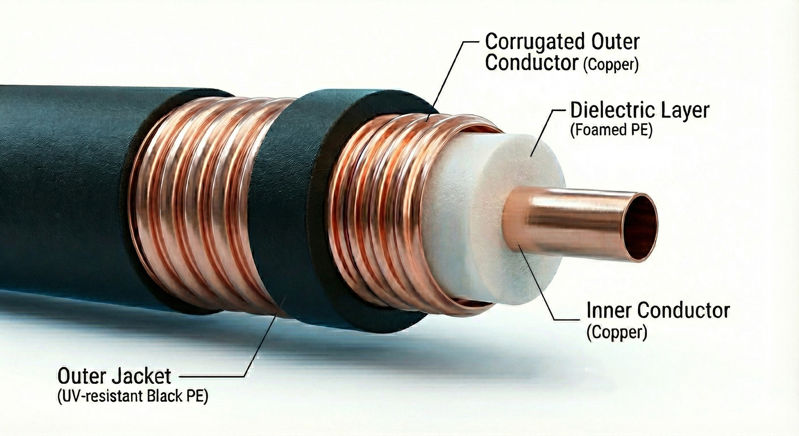
The exact construction of a standard RF corrugated coaxial cable typically includes (from inner to outer):
Inner Conductor
Generally made of solid copper or copper-clad aluminum, the inner conductor carries the RF electrical signal. The copper conductor has high conductivity to reduce resistive losses.
Dielectric Insulation
It uses traditional foam Polyethylene (FPE) or solid Polyethylene (PE), to precisely maintain 50-ohm characteristic impedance and low inner losses while providing strong mechanical support.
Outer Corrugated Conductor
Made of corrugated copper/aluminum, the outer conductor acts as RF shield and return path. The corrugated structure supports:
Cable flexibility
Signal shielding
Extended fatigue lifetimes
Outer Jacket
Typically black PE, specially treated to protect against:
UV rays
Rain and moisture
Harsh chemicals and temperatures
Such multilayer cable construction ensures high electrical performance with good outdoor durability.
■ Working Principle of RF Corrugated Coaxial Cable
RF Corrugated coaxial cables work on RF signal transmission through coaxial electrodynamics:
Signal travels down the inner conductor
Outer conductor acts as the RF shield and return path
Dielectric insulation maintains characteristic impedance
Electromagnetic (EM) field is completely enclosed inside, thus not radiating:
Low losses
Minimal external interference
Phase stability
The transmission by transverse electromagnetic (TEM) structure enables better long-distance transmission with low distortion and loss.

■ Key Performance Advantages
Super Low Attenuation
By design, RF corrugated coaxial cables have higher conductor diameter, supporting:
Very low loss (especially for long-distance applications)
High-quality dielectric insulation
low loss transmission for feeder runs
High Power Transmission
The robust inner and outer conductor allows safe transmission of medium power (high power – for broadcasting)
Best PIM Performance
PIM is critical for any 4G/5G wireless system. RF corrugated coaxial cables have excellent design features to meet -155dBc or lower.
Excellent Shielding Effectiveness
Unique continuous metallic conductor design:
Strong EMI shielding against external interference
Minimal signal loss
Higher immunity from external noise sources
Outstanding Mechanical Durability
Excellent bending characteristics
Vibration resistance and higher tensile robust design
Long-term outdoor (up to 20 years) performance in extreme weather
■ Common Sizes and Types
Common sizes of RF corrugated coaxial cables include:
¼ inch RF corrugated coaxial cables (Superflex jumpers for antenna connections or short distances)
⅜ inch RF corrugated coaxial cables (Compact feeder cables for base station cabinets)
½ inch RF corrugated coaxial cables (Mainstream used for 4G/5G base stations)
⅞ inch RF corrugated coaxial cables (Larger diameter low loss RF connections for long-distance transmission needs)
1-¼ inch (or larger) RF corrugated coaxial cables (High-power broadcast feeders)
Other common types include:
Traditional RF corrugated coaxial cables
Superflex RF corrugated coaxial cables jumpers
Air-dielectrics RF corrugated coaxial cables
PIM optimized corrugated coaxial cables

■ Main Applications of RF Corrugated Coaxial Cable
4G / 5G Base Station
Used in BBU and RRU and the antenna systems for RF signal connection. Short distance Superflex jumpers for the “last meters” near the antennas. Large diameter feeders for extended vertical drops.
DAS Systems
To provide stable indoor RF connectivity in:
Airports
Shopping malls
Large Stadiums and Arenas
Subways, tunnels, and public buildings
Broadcasting/TV Transmitters
High power RF broadcasting with extremely low loss and long-term performance.
Microwave Wireless Backhaul Connection
Stable RF signal between microwave radios and the antennas.
Tunnels, Rail Transit, and other Critical Infrastructure
Applications and locations requiring EMI immune and fire-resistant transmission.

■ RF Corrugated Coaxial Cable vs Ordinary Braided Coax Cable
Item | RF Corrugated Coax | Braided Coax |
Attenuation | Very low | Higher |
Power Capacity | High | Medium |
PIM Performance | Excellent | Limited |
Shielding | Continuous metal | Braided mesh |
Outdoor Durability | Excellent | Moderate |
Service Life | 10–20 years | 3–8 years |
Typical Application | Base stations, DAS | Short indoor RF links |
■ How to Select the Right RF Corrugated Coaxial Cable
If you are in the market to select the RF corrugated coaxial cable for your specific application, below are key factors to consider:
Operation frequency (700MHz-6GHz for 4G / 5G)
Distance and allowable attenuation
Power requirements
Common environmental conditions (e.g. UV, moisture, temperature)
PIM requirement to support modern wireless systems
Compatible connectors (DIN, 4.3-10, 7/16DIN, etc., depending on the application)
Leading manufacturers often provide electrical and mechanical performance datasheets to help right-size the RF connections.
■ Conclusion
The RF corrugated coaxial cable is the central RF transmission cable for modern-day RF networks. RF corrugated coaxial cables with ultra-low attenuation, high power, excellent PIM, and outstanding mechanical properties, are critical components of 4G/5G base stations, DAS networks, broadcasting, and microwave equipment.
With the rapid adoption of wireless systems for larger bandwidth, operation frequencies, and stricter PIM requirements; high-quality RF coaxial cables will still remain critical components of the RF engineering systems.
Contact us for more information

michael@zion-communication.com
+86 13757188184