RF Corrugated (Hardline) Coax Cable vs Braided (Soft/RG series)Coax Cable: Technical Comparison Guide
Author: Michael Publish Time: 09-12-2025 Origin: Site
■ RF Corrugated Coax Cable vs Braided Coax Cable
In modern RF transmission systems such as 4G/5G base stations, distributed antenna systems, broadcast transmission networks, and microwave communication networks, the coaxial cable is the number one game changer determining the quality, reliability, and TCO of the transmission system.
RF Corrugated Coax Cables and Braided Coax Cables are the two types of coax cables in widespread use. While both are used for RF signal transmission, the two differ greatly both in terms of structural design and engineering capabilities, including mechanical durability, lifespan, electrical properties, and use cases.
This brief comparison guide offers you an easy-to-understand technical difference between these two coax cables, together with relevant lattice tables to assist your selection of RF cables for your installation projects.
■ What Is RF Corrugated Coax Cable
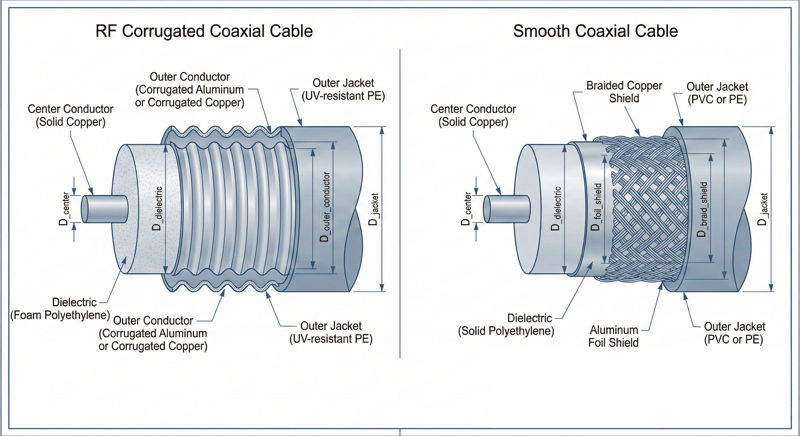
RF Corrugated Coax Cable is a type of low-loss, high-power RF transmission coax cable, primarily used for outdoor and high-power RF applications. RF Corrugated Coax Cable has its outer conductor made of a corrugated solid copper or aluminum corrugated tubing which displays superior flexibility and crush resistance.
Key Features
Metal corrugated outer conductor
Ultra-low attenuation
Excellent PIM performance
Very high power handling capabilities
Designed for outdoor (harsh) environments
Typical Application Scenarios
4G / 5G base transceiver stations
Cellular tower / Rooftop site installations
DAS main feeder cable runs
Broadcast / Microwave transmission networks
■ What Is Braided (Smooth Jacket) Coax Cable
Braided Coax Cable (often referred to as standard "Smooth Coax") is the most common type of coaxial cable. Unlike the solid corrugated tube of hardline cables, its outer conductor is made of braided metal strands and foil, covered by a smooth PVC or PE jacket.
Key Features
Flexible Braided Shielding: Excellent flexibility for routing through tight spaces.
Lightweight Design: Much lighter than corrugated hardline cables.
Easy Termination: Connectors are simple to crimp or compress.
Cost-Effective: Significantly lower cost for short runs.
Typical Application Scenarios
CCTV / Security installations
Indoor RF jumper cables (connecting equipment)
Satellite TV and CATV wiring
Short-distance Wi-Fi or Radio patch cords
■ Structural Differences (With Integrated Table)
Component | ||
Inner Conductor | Solid / stranded copper | Solid / stranded copper |
Dielectric | Foam PE or solid PE | Solid PE or foam PE |
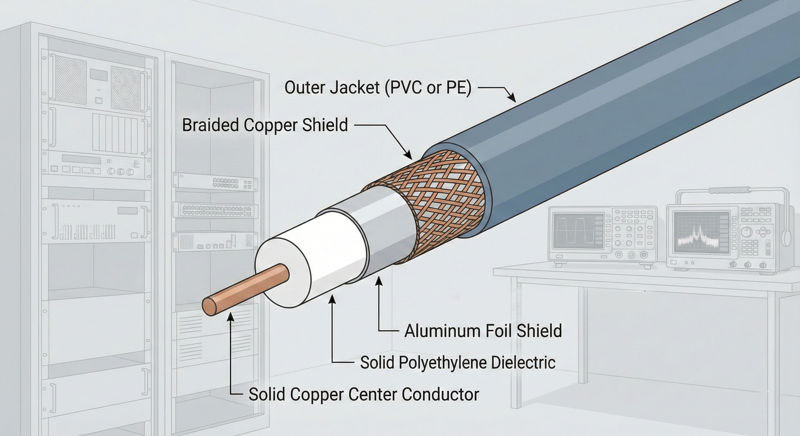
Outer Conductor | Corrugated copper / aluminum tube | Braided copper or smooth metal shield |
Outer Jacket | UV-resistant PE | PVC / PE |
Mechanical Strength | Very high | Medium |
■ Electrical Performance Differences (With Integrated Table)
Performance Parameter | RF Corrugated Coax | Braided (Smooth) Coax |
Signal Attenuation | Very Low (Best for long runs) | Medium / High (Best for short runs) |
Power Handling | Very High (kW class) | Low – Medium (Watts class) |
PIM Performance | Excellent (≤ -160 dBc typical) | Poor / Unstable (Not optimized for PIM) |
Shielding Effectiveness | 100% (Solid Metal Tube) | 60% - 95% (Braid gaps exist) |
VSWR Stability | Excellent | Good |
■ Mechanical Performance Differences (With Integrated Table)
Parameter | RF Corrugated Coax | Braided Coax |
Minimum Bending Radius | Larger but controlled | Smaller, very flexible |
Tensile Strength | Extremely high | Medium |
Crush Resistance | >1000 N (typical) | Low |
Wind & Vibration Resistance | Excellent | Limited |
Typical Service Life | 10–20 years outdoor | Mainly indoor |
■ Typical Product Specification Comparison (Integrated)
RF Corrugated Coax Cable (Typical 1/2" & 7/8")
Parameter | 1/2" Corrugated Coax | 7/8" Corrugated Coax |
Impedance | 50 Ω | 50 Ω |
Frequency Range | DC–6 GHz | DC–6 GHz |
Attenuation @ 2 GHz | ≤ 0.23 dB/m | ≤ 0.12 dB/m |
PIM | ≤ -160 dBc | ≤ -160 dBc |
Power Handling | High | Very High |
Minimum Bending Radius | 125 mm | 250 mm |
Jacket | UV-resistant PE | UV-resistant PE |
Operating Temperature | -40 ℃ ~ +85 ℃ | -40 ℃ ~ +85 ℃ |
Typical Application | 4G/5G BTS feeder | High-power base stations |
■ Braided Coax Cable (Typical RG59 & RG6)
Parameter | RG59 | RG6 |
Impedance | 75 Ω (Video Standard) | 75 Ω (Video Standard) |
Shield Type | Braided + Foil | Braided + Foil |
Frequency Range | ≤ 1 GHz | ≤ 3 GHz |
Attenuation | High | Medium (Lower than RG59) |
Jacket | PVC / PE | PVC / PE |
Power Handling | Low | Medium |
Primary Use | Analog CCTV, Baseband Video | Satellite TV, CATV, Broadband |
Installation | Indoor | Indoor / Limited Outdoor |
■ Application Differences (With Direct Engineering Use)
RF Corrugated Coax Cable is primarily used in installations involving:
4G / 5G base station main feeder systems
Cell tower or rooftop RRU connection runs
DAS main feeder cable runs
Microwave transmission systems / Broadcast systems
Braided Coax Cable is primarily used in installations involving:
CCTV / Security installations
Indoor RF jumpers
Laboratory RF experiments
Consumer/market RF technology
■ How to Choose the Right Coax Cable
Choose RF Corrugated Coax Cable in installations that involve:
Outdoor rated installation requirements
Very high RF transmission power (over 250W)
Long-distance transmission runs
Ultra-low PIM requirements for 4G/5G installations
High-reliability installations (minimal downtime)
Choose Braided Coax Cable in all installations that involve:
Indoor RF signal transmission installations or applications
Short-distance runs
Low power RF installations
Easy and fast installation systems
Low-budget RF installations
Contact us for more information

michael@zion-communication.com
+86 13757188184