Rack Cabinet Buying Guide: What Importers Should Confirm Before Ordering
Author: Site Editor Publish Time: 27-04-2026 Origin: Site
Rack Cabinet Buying Guide: What Importers Should Confirm Before Ordering
Importing rack cabinets is not only a product selection issue. Buyers must confirm cabinet size, packaging, carton size, pallet method, freight plan, HS code reference, accessories, and installation requirements before placing an order.
Do not confirm only the cabinet U height; confirm width, depth, mounting depth, load capacity, door type, and accessories.
For import orders, carton size, gross weight, pallet method, and container loading quantity directly affect landed cost.
HS code should be treated as a customs reference, not a fixed universal answer; final classification should be checked by the importer or local broker.
■ Direct Answer: What Should Importers Confirm Before Ordering Rack Cabinets?
Before importing rack cabinets, buyers should confirm the cabinet size, rack unit height, external width and depth, usable mounting depth, static loading capacity, door structure, side panel design, ventilation, grounding, accessories, packaging method, carton size, gross weight, pallet requirement, container loading quantity, HS code reference, and required import documents.
A rack cabinet may look like a simple metal enclosure, but for importers it is also a logistics product. Incorrect packing, missing carton data, or unclear accessories can increase freight cost, cause transport damage, delay customs clearance, or create installation problems after delivery.
Do not buy a rack cabinet only by model name or unit price. Confirm the full delivery condition: product specification + packing data + freight plan + customs data + accessory list.
| Confirmation Item | Why It Matters | What to Ask Before Ordering |
|---|---|---|
| Rack height | Determines equipment capacity | 6U, 9U, 12U, 18U, 22U, 42U, or customized? |
| Width and depth | Affects equipment fit, cabling, airflow, and freight volume | 600 mm / 800 mm width? 450 / 600 / 800 / 1000 / 1200 mm depth? |
| Mounting depth | More important than external depth for equipment installation | What is the adjustable rail range? |
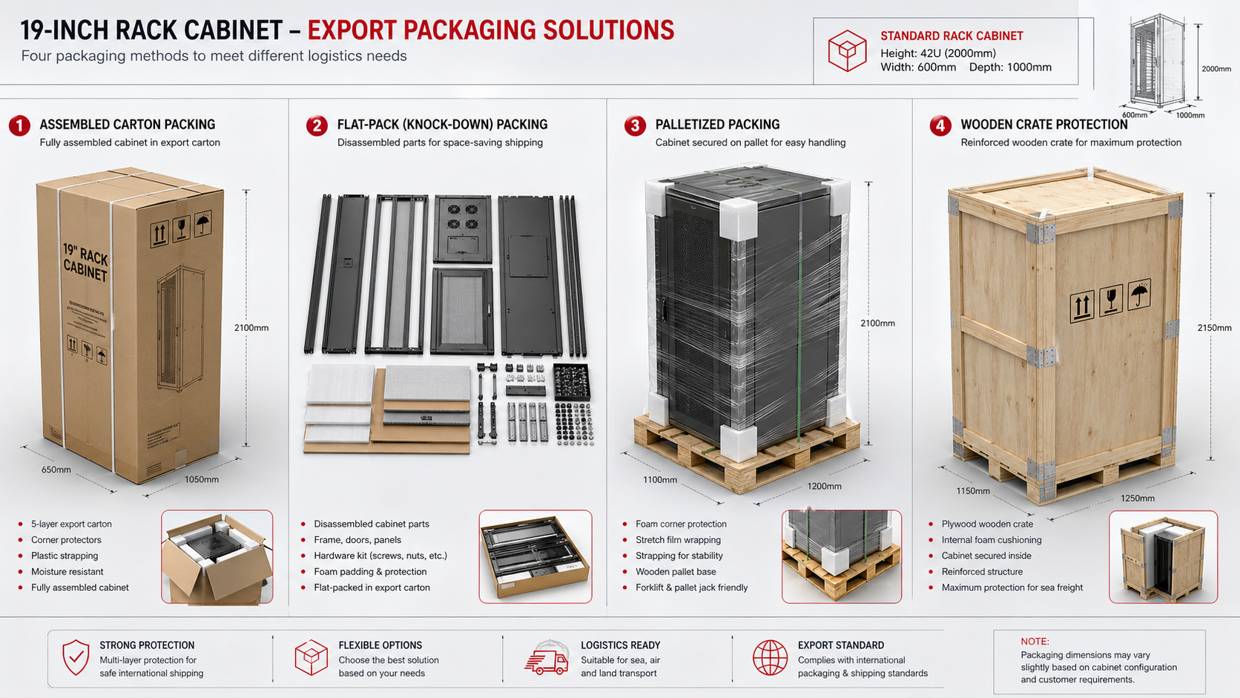
| Packaging | Controls damage risk and CBM | Assembled, flat-pack, carton, pallet, or wooden crate? |
| Carton size and gross weight | Required for freight quotation and warehouse planning | Length × width × height, net weight, gross weight |
| HS code reference | Needed for import duty pre-check | Confirm with local customs broker before shipment |
■ What Is a Rack Cabinet?
A rack cabinet is a metal enclosure used to install and protect network, server, telecom, security, audio-video, and industrial control equipment. It normally includes vertical mounting rails, front and rear doors, side panels, top or bottom cable entries, ventilation openings, grounding points, locks, and optional accessories such as shelves, fan trays, PDUs, cable managers, and casters.
For importers, rack cabinets are different from small network accessories because they are large-volume products. The order is affected by steel structure, packaging strength, carton size, pallet method, CBM, destination handling, and customs documents.
A technically correct rack cabinet can still become a project problem if the buyer did not confirm packaging, carton size, accessory list, or loading method before shipment.
■ Confirm Size and Mounting Depth Before Discussing Price
Many buyers ask for a rack cabinet price before confirming the full specification. This often leads to inaccurate quotation because size affects steel consumption, production structure, packaging method, carton size, and shipping cost.
External depth is not equal to usable mounting depth. A cabinet with 600 mm external depth does not mean the equipment can use all 600 mm. Space may be occupied by the front door, rear door, cable bending radius, fan unit, vertical rails, and frame structure.
| Size Factor | Common Options | Buying Note |
|---|---|---|
| Height | 6U, 9U, 12U, 18U, 22U, 27U, 32U, 42U | More U space means larger cabinet and higher shipping volume. |
| Width | 600 mm, 800 mm | 800 mm width provides more side space for cable management. |
| Depth | 450 mm, 600 mm, 800 mm, 1000 mm, 1200 mm | Deeper cabinets are usually required for servers, UPS, and high-density cabling. |
| Mounting depth | Depends on adjustable rail range | Confirm the distance between front and rear mounting rails. |
| Load capacity | Light, medium, heavy-duty | Must match equipment weight, especially servers, UPS, and battery units. |
For switches, patch panels, routers, and CCTV/network distribution points, a wall-mounted network cabinet may be enough. For servers, UPS, telecom rooms, and high-density cable management, choose a floor-standing cabinet with sufficient depth and load capacity.

■ Choose Rack Cabinet by Application, Not Only by Price
Different rack cabinets serve different project environments. A low-cost cabinet may work for a small office network, but it may not be suitable for a data room, telecom project, industrial site, or security system with high cable density.
| Application | Recommended Cabinet Type | Key Confirmation Points |
|---|---|---|
| Small office network | Wall-mounted network cabinet | 6U–12U, glass door, fan option, shelf, cable entry |
| CCTV / security system | Wall-mounted or floor-standing cabinet | Patch panel space, lockable door, cable routing, PDU |
| Data room | Floor-standing network cabinet | 600 / 800 mm width, airflow, cable manager, grounding |
| Server installation | Deep server cabinet | 1000 / 1200 mm depth, heavy-duty frame, perforated doors |
| Distributor stock | Standardized cabinet range | Popular sizes, optimized packing, container loading quantity |
■ Packaging Method: The Hidden Cost Driver in Rack Cabinet Import
Packaging is one of the most important parts of rack cabinet import. A cabinet may be technically correct but still arrive damaged if the packaging is not suitable for long-distance transport, LCL handling, warehouse stacking, or local delivery.
| Packaging Method | Best For | Advantages | Risks |
|---|---|---|---|
| Assembled carton packing | Small and medium orders | Easy for end users, less assembly work | Higher CBM and freight cost |
| Flat-pack / knock-down packing | Distributor or container orders | Saves space and reduces freight cost | Requires assembly and parts control |
| Carton + foam protection | Standard export orders | Cost-effective for regular shipments | Needs strong corner protection |
| Carton + pallet | LCL shipment and warehouse handling | Better forklift handling and lower impact risk | Increases packing cost and pallet height |
| Wooden crate | High-value or fragile shipments | Strong protection | Higher cost and possible destination treatment requirements |
For rack cabinets, packaging should be confirmed together with the product price. A low unit price may become expensive if the carton size is too large, the cabinet is packed inefficiently, or the damage rate is high.

■ Freight Planning: Carton Size, CBM, Pallet, and Loading Quantity
Carton size is not just a logistics detail. It is a commercial cost factor. For bulky products such as rack cabinets, freight cost may influence the real landed cost more than small differences in cabinet unit price.
| Data to Request | Why It Is Needed | Importer’s Use |
|---|---|---|
| Product size | Confirms project installation space | Site layout and equipment planning |
| Carton size | Calculates CBM and freight cost | Forwarder quotation and warehouse planning |
| Gross weight | Required for freight and customs documents | Shipping documents and unloading planning |
| Quantity per pallet | Determines handling method | Forklift, warehouse, and delivery arrangement |
| Quantity per container | Controls freight cost per unit | 20GP / 40HQ cost comparison |
For full container orders, loading efficiency is usually the priority. For LCL shipments, packaging strength and handling protection become more important because the goods may be moved several times before final delivery.
■ Common Transport Risks for Rack Cabinets
Rack cabinets are usually made of steel panels, frames, doors, rails, locks, hinges, and accessories. During international transport, the most common risks include deformation, corner damage, scratched surfaces, broken glass doors, bent mounting rails, damaged locks, and missing accessories.
| Damage Point | Possible Cause | Prevention |
|---|---|---|
| Bent cabinet frame | Weak carton or heavy stacking | Reinforced carton, corner protection, pallet option |
| Scratched surface | Insufficient internal protection | Foam, protective film, separate accessory packing |
| Broken glass door | Impact during handling | Stronger front protection or safer door option |
| Missing accessories | Mixed packing or unclear list | Accessory checklist and labeled parts bag |
| Carton collapse | Low carton strength or humidity | Export-grade carton and palletized protection |
If the shipment is LCL, if the cabinet has a glass door, or if the delivery route includes long inland transport, stronger packaging is usually cheaper than damage claims and project delays.
■ HS Code and Customs Data: Do Not Rely on Guesswork
Importers often ask for HS code together with carton size because both are required for landed cost estimation. However, HS code should not be treated as a fixed marketing field. The final classification may depend on destination country rules, cabinet material, product function, electrical components, accessories, and whether the product is imported assembled or unassembled.
A supplier can provide product description, material information, packing list data, and HS code reference. The importer or local customs broker should verify the final import classification before shipment.
| Customs Data | Why It Matters | What to Prepare |
|---|---|---|
| Product description | Supports customs classification | Network rack cabinet, server rack cabinet, wall-mounted cabinet |
| Material | May affect classification and duty | Steel frame, glass door, plastic or metal accessories |
| Function | Clarifies product use | Housing network, server, telecom, or security equipment |
| Electrical parts | Fan or PDU may affect import review | Voltage, plug type, electrical accessory list |
| Packing condition | Assembled or unassembled status may be checked | Packing list, carton data, product photos |
Do not copy an HS code from another market without checking. The same product description may require different national tariff digits or customs interpretation in different destination countries.
■ Accessories Checklist: Avoid Missing Parts at Installation
Rack cabinet orders often include accessories. If the buyer confirms only the cabinet body, the project may still face installation delays because shelves, fans, PDUs, screws, casters, feet, or cable managers are missing.
| Accessory | Function | Buying Note |
|---|---|---|
| Fixed shelf | Supports non-rack equipment | Confirm depth and load capacity |
| Fan unit | Improves ventilation | Confirm voltage, plug type, and installation position |
| PDU | Power distribution | Confirm socket type, plug, current rating, and cable length |
| Cable manager | Organizes patch cords | Important for network cabinets and patch panels |
| Cage nuts and screws | Equipment mounting | Confirm quantity and spare parts |
| Grounding kit | Safety and bonding | Important for telecom rooms and data cabinets |
■ RFQ Checklist for Rack Cabinet Importers
A clear RFQ helps the supplier provide accurate product price, packing data, carton size, lead time, and freight planning information. It also reduces repeated communication and prevents assumptions.
| RFQ Item | Example Requirement | Why It Should Be Clear |
|---|---|---|
| Cabinet type | Wall-mounted / floor-standing / server rack | Determines structure and packaging |
| Size | 42U, 600W × 1000D mm | Affects price, CBM, and equipment compatibility |
| Door type | Glass / perforated / mesh / steel | Affects airflow, security, and shipping risk |
| Accessories | Fan, PDU, shelf, cable manager, cage nuts | Prevents missing installation parts |
| Packaging | Assembled carton / flat-pack / pallet | Controls freight cost and damage risk |
| Destination and trade term | FOB, CIF, DDP; destination port or warehouse | Needed for logistics planning and landed cost comparison |
Focus on standard size, safe packaging, accessory completeness, and destination handling.
Focus on flat-pack option, carton optimization, loading quantity, and distributor stock planning.
Focus on installation readiness, accessories, labeling, packing photos, and schedule risk.
■ FAQ: Rack Cabinet Import and Buying Questions
1. What information should importers confirm before ordering rack cabinets?
Importers should confirm cabinet size, rack height, width, depth, mounting depth, loading capacity, door type, side panel structure, accessories, packaging method, carton size, gross weight, container loading quantity, HS code reference, and required import documents.
2. Why is carton size important for rack cabinet orders?
Carton size determines CBM, freight cost, container loading quantity, warehouse space, and handling method. For bulky products such as rack cabinets, carton size can significantly affect landed cost.
3. Should rack cabinets be shipped assembled or flat-pack?
Assembled cabinets reduce site assembly work but occupy more space. Flat-pack cabinets can reduce freight volume but require assembly capability and better parts control. Importers should choose based on order quantity, destination labor cost, and project delivery method.
4. Is pallet packing necessary for rack cabinets?
Pallet packing is recommended for LCL shipments, heavy cabinets, fragile door designs, or shipments with multiple handling points. For full container orders, carton packing or optimized flat-pack packing may improve loading efficiency.
5. Can one HS code be used for all rack cabinets?
No. HS code should be confirmed by the importer or customs broker according to destination country rules, product material, function, accessories, electrical components, and packing condition. Suppliers may provide a reference, but final classification should be verified locally.
6. What accessories should be confirmed before shipment?
Common accessories include shelves, fans, PDUs, cable managers, cage nuts, screws, keys, casters, leveling feet, brush cable entries, and grounding kits. They should be listed clearly in the quotation and packing list.
■ Conclusion: Buy the Cabinet and the Delivery Condition Together
For rack cabinet importers, a good purchase decision is not limited to cabinet size or unit price. The correct approach is to confirm the complete order condition: product dimensions, mounting depth, load capacity, accessories, packaging, carton size, gross weight, pallet method, loading plan, HS code reference, and import documents.
When specifications and logistics data are clear before ordering, importers can reduce freight surprises, avoid damage claims, improve customs preparation, and deliver projects more smoothly.