Why CAT7A UTP Is Usually the Wrong Choice
Author: Site Editor Publish Time: 24-04-2026 Origin: Site
Why CAT7A UTP Is Usually the Wrong Choice
If a project truly needs CAT7A-style performance, buyers should usually specify S/FTP construction, compatible hardware, and test requirements—not simply write “CAT7A UTP” on the RFQ. In most real projects, “CAT7A UTP” creates ambiguity rather than clarity. It can lead to structure mismatch, connector mismatch, test disputes, and unnecessary procurement risk. For many 10G installations, CAT6A U/UTP or F/UTP is a more practical and better-defined choice.
“CAT7A UTP” is usually an incomplete or misleading specification rather than a clean engineering requirement.
If the project really needs CAT7A-style cabling, S/FTP is usually the more technically consistent construction.
For most standard 10G RJ45 projects, CAT6A is often the clearer, lower-risk, and more practical choice.
■ Why this topic matters
In many inquiries, buyers use category names as shorthand: CAT6, CAT6A, CAT7, CAT7A. But when a request says “CAT7A UTP”, the wording often mixes two different engineering ideas. “CAT7A” usually suggests a higher-frequency, shielded cabling discussion, while “UTP” means unshielded twisted pair. That mismatch matters because the installed channel—not just the cable jacket print—determines whether the project will meet performance, compatibility, and acceptance requirements.
For procurement teams, this is a risk-control issue. If the category name is clear but the structure is wrong, the project may face quotation confusion, connector mismatch, unnecessary cost, or field test disputes. A better RFQ should define the construction, application, connector compatibility, and test expectations, not only the category name.
■ What “CAT7A UTP” actually means
The phrase CAT7A UTP is usually problematic because it combines a high-category label with an unshielded structure. In real B2B quoting, that can mean one of three things: the buyer wants a premium-sounding cable name, the project spec is incomplete, or the supplier and buyer are using different assumptions about what the cable should be.
| RFQ wording | What it may actually mean | Main risk |
|---|---|---|
| CAT7A UTP | Buyer wants a high category name but unshielded cable construction | Structure may not match expected system behavior |
| CAT7A S/FTP | Buyer wants shielded CAT7A-style cable | Still needs hardware and test alignment |
| CAT6A U/UTP | Buyer wants standard 10G unshielded cabling | Less EMI protection in noisy environments |
| CAT6A F/UTP | Buyer wants 10G with moderate shielding | Needs shielded component planning |
■ Why CAT7A is usually discussed with S/FTP
In practical engineering language, CAT7 and CAT7A are commonly associated with shielded high-frequency cabling systems. The structure typically discussed is S/FTP: four twisted pairs, each individually foil-shielded, plus an overall braided screen. That construction supports stronger pair isolation and better external EMI control than UTP.
This is exactly why “CAT7A UTP” feels inconsistent. If the buyer truly needs the reason people move toward CAT7A—higher headroom, cleaner pair isolation, and better noise control—then removing the shielding undermines much of that logic.
| Structure element | Typical role | Why buyers care |
|---|---|---|
| Twisted pairs | Balanced signal transmission | Basic data integrity and pair performance |
| Individual pair foil | Reduces pair-to-pair interference | Useful for tighter crosstalk control |
| Overall braid / screen | Helps block external EMI | Important near electrical noise sources |
| Drain / grounding path | Supports shield continuity | Shielding only works as a system |
| Outer jacket | Mechanical and environmental protection | Must match LSZH, PVC, PE, CPR or site needs |
■ Why “CAT7A UTP” can mislead buyers
The biggest problem is not vocabulary. It is decision quality. A category name alone does not define the real cable system. If the RFQ only says “CAT7A UTP,” the supplier may not know whether to prioritize shield structure, RJ45 compatibility, project budget, or general LAN use. That ambiguity can create rework later.
| Misleading point | What may happen in the project | Operational impact |
|---|---|---|
| Structure mismatch | Buyer expects CAT7A logic but requests unshielded construction | Supplier quotes something that may not match expectations |
| Connector mismatch | Cable is “upgraded” but connector/channel planning is unclear | System compatibility becomes uncertain |
| Test mismatch | Project team and installer do not align on acceptance limits | Field disputes and re-testing risk |
| Cost mismatch | Buyer pays for a higher label without system-level benefit | Overspending or poor value for the application |
If the project really needs CAT7A-style performance, do not stop at “CAT7A.” Confirm the construction, connector type, shield continuity, application environment, and test target. If the project only needs dependable 10G Ethernet over standard RJ45 infrastructure, start with CAT6A and then review EMI and installation conditions.
■ CAT7A UTP vs CAT7A S/FTP vs CAT6A
For most procurement decisions, the real question is not “Which category sounds higher?” but “Which structured cabling approach best matches the link requirement, site conditions, and hardware ecosystem?”
| Option | Typical logic | Advantages | Limitations |
|---|---|---|---|
| CAT6A U/UTP | Standard 10G Ethernet in controlled environments | Widely available, RJ45-friendly, cost-effective | Less EMI protection than shielded options |
| CAT6A F/UTP | 10G with moderate shielding needs | Good balance of shielding and practicality | Needs shield-aware component planning |
| CAT7A S/FTP | Higher-frequency shielded system discussion | Strong pair isolation and EMI control | Higher cost and stricter system alignment |
| CAT7A UTP | Often an incomplete or misleading request | May look simpler on paper | Usually the wrong specification logic for a CAT7A project |
■ What buyers should check in the RFQ instead of only the category name
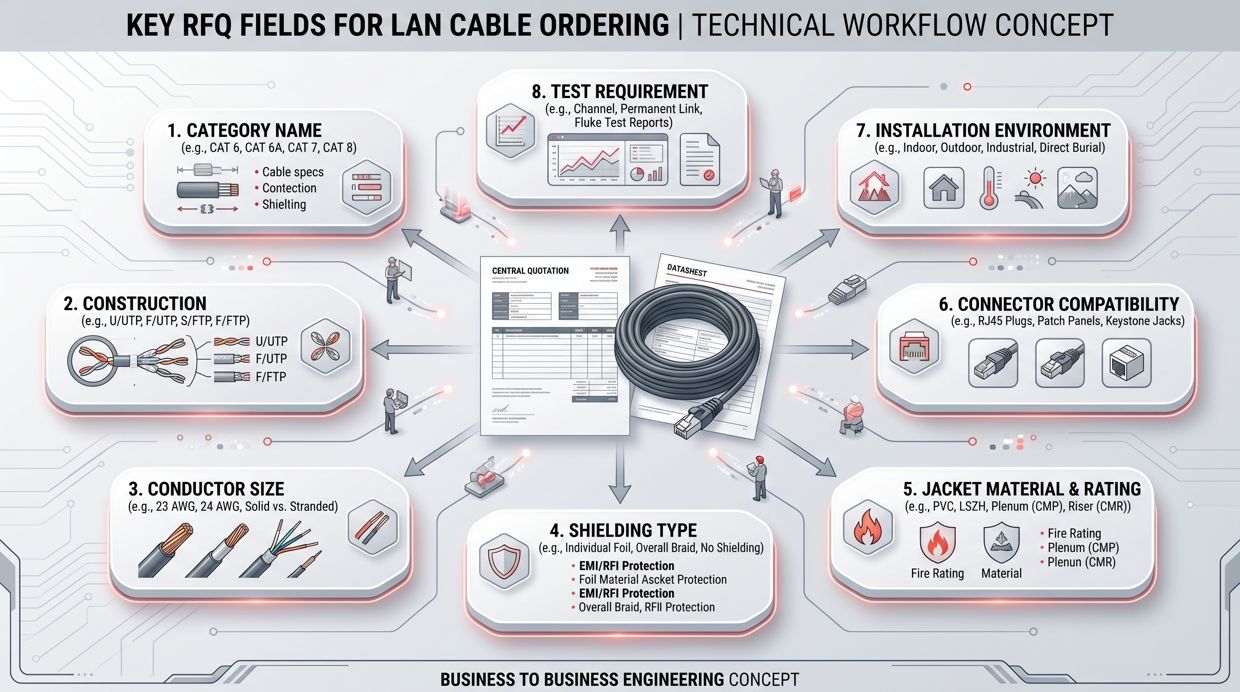
A good RFQ defines the cable as part of a complete link decision. That means the buyer should specify not only category, but also the structure and the actual installation objective.
| RFQ field | What to define | Why it matters |
|---|---|---|
| Category / target | CAT6A, CAT7A, etc. | Sets the performance direction |
| Construction | U/UTP, F/UTP, U/FTP, F/FTP, S/FTP | Defines shielding and pair isolation |
| Conductor | Solid or stranded, AWG, copper quality | Affects application and transmission stability |
| Jacket | PVC, LSZH, PE, CPR/fire class | Must match site compliance and route type |
| Hardware compatibility | Patch panel, keystone jack, plug type | The channel matters more than the cable alone |
| Environment | Office, data center, industrial, mixed tray | Determines whether shielding is worth it |
| Test requirement | Permanent link / channel target | Reduces acceptance and warranty disputes |
Please quote CAT7A S/FTP 4-pair solid copper LAN cable, 23AWG, LSZH jacket, suitable for shielded structured cabling installation. Please confirm shielding construction, compatible hardware, available test reports, and packing length. If the project is standard 10G Ethernet over RJ45, please also advise whether CAT6A U/UTP or F/UTP would be a more practical solution.
■ When to choose CAT6A or CAT7A S/FTP
Most projects do not need the highest-looking category label. They need a cabling system that is technically justified, commercially reasonable, and easy to maintain. Use the following simplified decision rules as an engineering shortcut.
| Project condition | Recommended direction | Why |
|---|---|---|
| Standard office 10G Ethernet | CAT6A U/UTP or CAT6A F/UTP | Clear, practical, and easy to match with common hardware |
| Noisy electrical environment | CAT6A F/UTP or CAT7A S/FTP | Shielding becomes more valuable |
| Consultant explicitly requires CAT7A-style cabling | CAT7A S/FTP | Better aligned with project intent than CAT7A UTP |
| Budget-sensitive project with standard LAN use | CAT6A first | Avoids over-specification |
| Buyer asks for CAT7A UTP only because it “sounds better” | Re-check the actual requirement | Higher label without full system logic usually creates risk |
If you need normal 10G RJ45 cabling, start with CAT6A.
If the environment has EMI, dense trays, or mixed routing near power, consider shielded solutions.
If the consultant or end user truly specifies CAT7A-style performance, do not use “CAT7A UTP” as a shortcut—move to CAT7A S/FTP and define the system clearly.
■ FAQ
■ Conclusion
The phrase CAT7A UTP is usually the wrong choice because it combines a higher-performance category label with a cable structure that often does not match the real engineering intent. If the project only needs reliable 10G Ethernet, CAT6A is often the cleaner and lower-risk option. If the project truly requires CAT7A-style logic, CAT7A S/FTP is usually the more consistent direction.
For procurement teams and engineers, the safest approach is simple: do not buy by category name alone. Check the construction, connector ecosystem, environment, and acceptance target before you quote, approve, or install.



 Fiber Optic Tools
Products 6 families
Solutions 6 markets
Resources Tools & docs
Certificate
Certification and compliance references for project review, qualification and purchasing documentation.

 Fiber Optic CableAccess and backbone
 Ethernet CableCat5e to Cat8
 Coaxial CableRF and video signal
 Fire, Security & AlarmSafety systems
 Voice, Audio & VideoSignal cabling
 Power & Control CableEnergy and control
Fiber optic cable systems
Outdoor, indoor, FTTH and distribution cable lines for access networks, backbone routes and campus deployments.
 Telecom & ISP NetworksFTTH, PON, ODN
  Data Center InfrastructureServer room cabling
  Building Low-Voltage SystemsBMS, AV, weak current
  Security & Fire ProtectionAlarm, CCTV, access
  Industrial Automation CablePLC, RS485, fieldbus
  Energy & Power InfrastructureSolar, battery, power
 Telecom & ISP Networks
For FTTH / PON access, outdoor fiber deployment, aerial routes, duct routes, direct burial routes, rural broadband and ODN planning.
Tools
Use calculators and planning tools for conduit capacity, PoE voltage drop and fiber optic link loss budget work.