Why Structured Cabling Is Essential for AI Data Centers
Author: Site Editor Publish Time: 22-01-2026 Origin: Site
Why Structured Cabling Systems Are Essential for AI-Driven Data Centers in 2026
AI clusters, 800G/1.6T roadmaps, and high-density leaf–spine fabrics are pushing fiber counts into the thousands. In 2026, structured cabling is no longer “nice to have”—it’s the foundation for predictable upgrades, lower TCO, and safer operations.
AI density changes the math: thousands of fibers demand trunks, panels, and repeatable pathways—not ad-hoc point-to-point runs.
Lower risk & faster MACs: structured cabling turns moves/adds/changes into patch-cord work, reducing downtime probability.
TCO wins over CAPEX: improved airflow, simpler troubleshooting, and upgrade readiness reduce lifecycle cost.
■ 1) What structured cabling means in a 2026 data center
A structured cabling system is a standards-aligned connectivity architecture that separates the permanent link (trunks between panels/enclosures) from the equipment connections (short patch cords to servers, switches, and storage). The permanent infrastructure remains stable for years, while endpoints can be reconfigured quickly as the environment evolves.
■ 2) What changed in 2026: AI fabrics, density, and energy
AI-driven data centers use leaf–spine architectures, GPU clusters, and high-bandwidth interconnects that multiply fiber counts. As speeds scale from 400G to 800G and beyond, cable management becomes a reliability and energy-efficiency issue—not just a neatness issue.
| 2026 Driver | What it changes | Cabling implication |
|---|---|---|
| AI / GPU clusters | Higher port density, more fiber links | Use modular panels + MPO/MTP trunks to avoid chaos |
| 800G / 1.6T roadmap | Optics and connectors change faster | Keep permanent links stable; change patching as needed |
| Energy / ESG pressure | Cooling becomes a dominant OPEX line | Reduce airflow blockage via clean pathways and cable density control |
| Continuous expansion | Frequent adds/moves/changes (MACs) | Patch-cord work > reinstalling long runs |

■ 3) Structured cabling vs point-to-point: operational reality
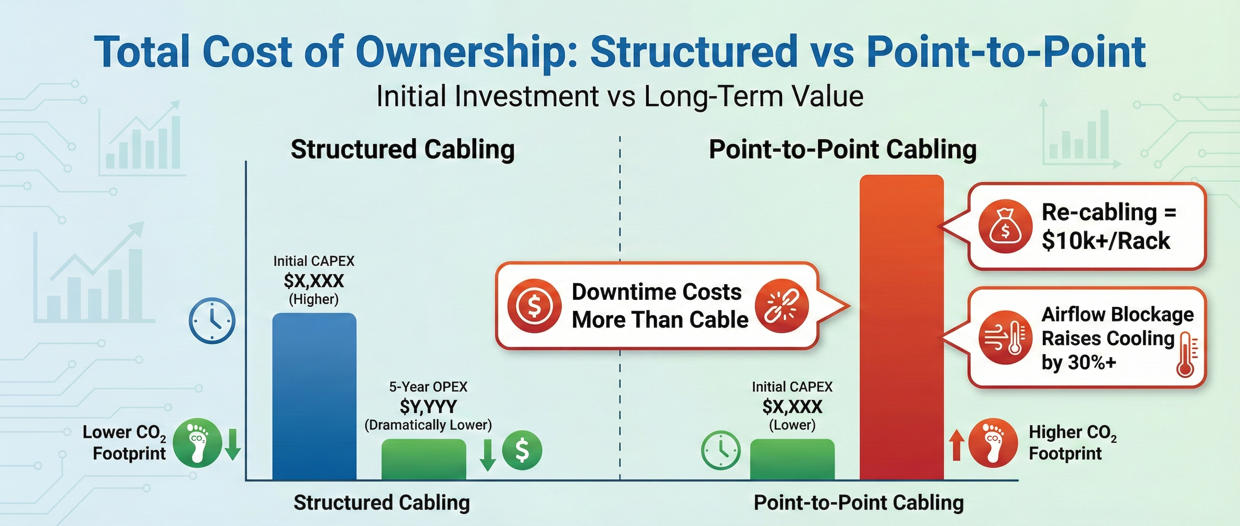
Point-to-point cabling looks inexpensive and fast at day one, but becomes ly during upgrades. Technicians often over-length cables “just in case,” creating congestion that blocks airflow and complicates maintenance. Structured cabling prevents this by enforcing short patching, defined pathways, and stable trunk infrastructure.
Why point-to-point breaks down at AI scale
Cable growth without governance increases rack congestion and technician time.
Airflow obstruction can increase cooling demand—directly impacting OPEX.
Upgrade friction (new links, re-routing, labeling) increases downtime probability.
■ 4) Procurement decision matrix (TCO, risk, scalability)
In 2026, procurement decisions must optimize for lifecycle performance—not just initial material cost. Use this matrix to evaluate total cost of ownership (TCO), operational risk, and upgrade readiness.
| Decision Factor | Structured Cabling | Point-to-Point |
|---|---|---|
| Initial material cost | Higher (panels, trunks, enclosures) | Lower (direct links) |
| Planning requirement | High upfront, standards-based | Low at start |
| Speed at scale | Fast once designed (pre-terminated trunks) | Slows as density grows |
| Scalability (400G → 800G → 1.6T) | Excellent; infrastructure supports multiple generations | Poor; often re-cabling is required |
| Moves/Adds/Changes (MACs) | Patch-cord changes, minimal disruption | New cable runs, higher downtime risk |
| Cooling / energy efficiency | Cleaner airflow, supports ESG goals | Airflow blockage increases cooling demand |
| Operational risk | Lower via labeling + standardized admin | Higher; harder tracing and error-prone |
| Long-term maintenance cost | Predictable and lower | Rises rapidly with complexity |
■ 5) Decision Rules / Engineer’s Shortcut
Use the rules below as a fast screening tool. If you match any of these conditions, structured cabling is the safer default for 2026 projects.
| If your project has… | Choose this | Why |
|---|---|---|
| AI / GPU cluster rollout | Structured fiber trunks + modular panels | High density needs repeatable pathways and fast reconfiguration |
| Upgrade roadmap (400G → 800G → 1.6T) | Structured cabling | Keep permanent links stable; change patching/optics as needed |
| Frequent MACs (moves/adds/changes) | Structured cabling | Patch cords avoid reinstalling long runs and reduce downtime risk |
| Cooling / ESG targets | Structured cabling | Cleaner cable paths protect airflow and lower cooling demand |
| Small, static room with rare changes | Point-to-point (limited) | Only viable if density is low and upgrade frequency is near zero |
■ 6) Design blueprint: fiber + copper channels that scale
A scalable structured cabling design balances fiber trunks for high-speed fabrics and copper trunks for management and PoE-based auxiliary systems. The best practice is to standardize trunk routes, reserve pathway capacity, and keep patching short and well-administered.
Typical applications by channel type
| Channel / Component | Where it’s used | Why it matters |
|---|---|---|
| Fiber trunks (MTP/MPO / LC) | Leaf–spine, GPU fabrics, high-speed interconnects | High density and fast upgrades with modular patching |
| High-density patch panels | Network racks, distribution zones | Standardized administration reduces errors and downtime |
| Copper trunks | OOB management, control networks, auxiliary systems | Faster deployment; consistent terminations |
| Short patch cords | Server/switch to panel, panel to panel cross-connect | Fast MACs; keeps pathways clean for airflow and serviceability |
■ 7) How ZION COMMUNICATION supports structured cabling projects
For AI-driven data centers, cabling is a lifecycle asset. ZION COMMUNICATION supports projects with structured cabling components and manufacturing capabilities designed to help teams deploy faster, upgrade easier, and maintain clean, standards-aligned infrastructure.
What to prepare when requesting a structured cabling quote
Data hall layout and pathway constraints (rack rows, overhead/underfloor)
Port counts by zone (server racks, network racks, storage)
Target speeds now and next upgrade cycle (e.g., 400G/800G readiness)
Preferred fiber type/connector ecosystem (LC, MPO/MTP, etc.)
Labeling/admin requirements and testing expectations
■ 8) Conclusion & next steps
In 2026, AI workloads and high-speed fabrics make cabling density a first-class constraint. A structured cabling system transforms cabling from a repeated installation task into durable infrastructure—reducing downtime risk, improving airflow and serviceability, and lowering total cost of ownership.
Actionable next step: If your roadmap includes AI expansion, higher-speed uplifts, or frequent MACs, standardize your structured cabling architecture now (panels + trunks + short patching), then scale port density without losing operational control.