Nested Anti-Resonant Nodeless Hollow-Core Fiber (NANF) | Ultra-Low-Latency Optical Fiber Guide
Author: James Publish Time: 30-12-2025 Origin: Site
■ Introduction: Why Hollow-Core Fiber Matters Now
With optical communication systems approaching fundamental limits, conventional solid-core optical fibers increasingly limit system performance in latency, nonlinearity effects, and scaling.
Emerging applications—AI data centers, high-frequency trading (HFT) networks, coherent superchannels, quantum communication, high-power laser delivery, next-gen backbone networks—require transmission media beyond silica fiber incremental improvements.
Nested Anti-Resonant Nodeless Hollow-Core Fiber (NANF) is one of the most important advances in this category.
By guiding the majority of optical power in air, NANF radically changes the mechanism of optical fiber signal transmission, interaction, and resource scaling.


YOFC Empowers Digital Future with Innovation-Driven Technologies
https://en.yofc.com/view/3362.html
■ What Is Nested Anti-Resonant Nodeless Hollow-Core Fiber?
NANF is a type of hollow-core fiber optics (HCF). It delivers fiber-optic signal transmission using an air-filled core and a nested nodeless anti-resonant microstructured.
These are the key features of NANF:
Hollow air core (over 99% of optical power)
Nested anti-resonant capillaries
Nodeless (no capillary contact points)
Thin-wall resonance control (widely distributed low-loss transmission windows)
Unlike the conventional Standard Single-Mode Fiber with modulated total internal reflection, NANF utilizes anti-resonant mechanisms to contain most power outside the solid material.
■ NANF In The Hollow-Core Fiber Landscape: From Concept To Endgame
There are several trajectories of hollow-core fiber development over the decades. To understand the significance of the NANF core, let's put it in context as an endgame product.
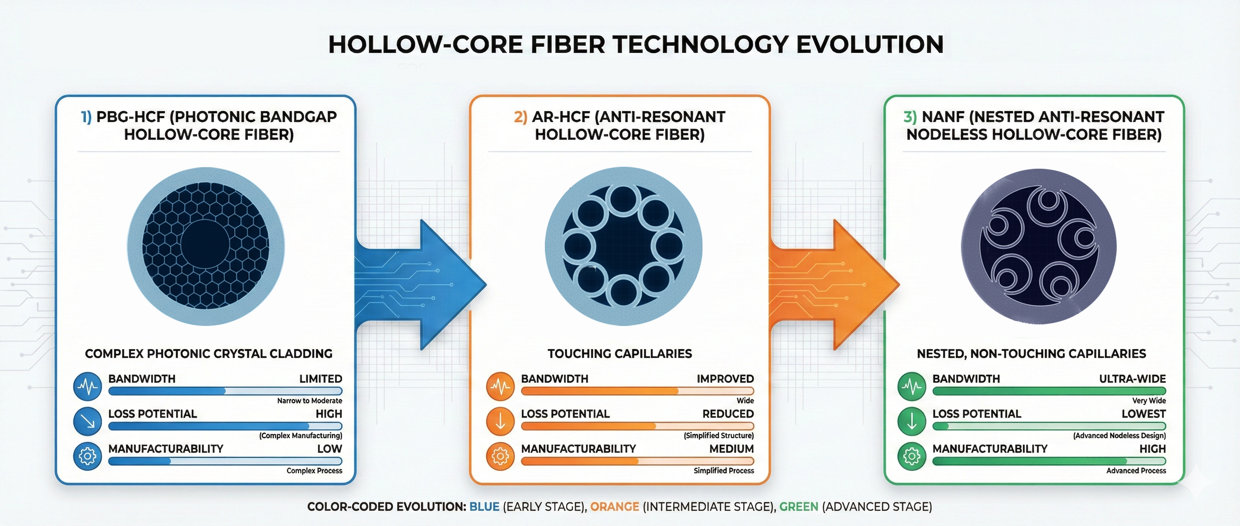
3.1 First Generation: PBG Hollow-Core Fibers (PBG-HCF)
The PBG-HCF technology was the first to achieve meaningful optical signal transmission in air-core fibers. It used photonic bandgap (PBG) fiber cladding to prevent leaky modes.
PBG-HCF factors limiting its performance include:
Narrow-band transmission
Low fabrication tolerance
Limited scaling potential (low limit attenuation)
As a result, PBG-HCFs were largely limited to experiments and specific sensing applications.
3.2 Transition: Anti-Resonant Hollow-Core Fiber (AR-HCF)
21st-century AR-HCF effectively replaced complex PBG-HCF by thin-walled capillary for fiber cladding.
The advantages of AR-HCF are:
Wide-band signal transmission
High fabrication tolerance
Low limit attenuation
The early AR-HCFs still had inter-capillary nodes (point contact) limiting fiber performance by dominant scattering.
3.3 NANF: Nested, Nodeless, Physical Limit Performance
Nested Anti-Resonant Nodeless Hollow-Core Fiber (NANF) is the direct evolution of hollow-core fiber technology.
By combining:
Nested anti-resonant structure for superior fiber performance
Nodeless topology: inter-capillary contact eliminated (no dominant scattering)
Thin capillary wall design for lossless wide-band transmission control
NANF achieves a unique combination of ultra-low loss performance and potential cost-effective fabrication.
■ Research Origin and Theoretical Basis For NANF
The NANF research concept was first published by Francesco Poletti et al. in 2014 in a now-famous Optics Express paper.
The study covered the theoretical basis of nested nodeless anti-resonant hollow-core fiber:
Inter-capillary node contact is a major scattering locus (loss center) in the physical design
Nested anti-resonant structure achieves superior optical confinement
Wide-band transmission and low attenuation can be achieved in a hollow-core fiber.
This paper became the reference point for the broad NANF research that now spans over a decade of luck and labor.
■ Physical Design Concepts Of NANF Fiber
5.1 Hollow Air Core
The air-core performance comes from the minimal interaction of light with solid glass. This translates into:
High-speed (light-speed) optical signal transmission
Minimal signal degradation (nonlinear effects)
Low absorption
5.2 Nested Anti-Resonant Capillaries
Many layers of nested capillaries (glass, air) attenuate leaky optical modes out of the diamond core resonance.
5.3 Nodeless Fiber Geometry
No contact between capillaries to eliminate scattering centers and facilitate optical confinement.
5.4 Thin-Wall Resonance Control
Capillary wall design for distributed low-loss optical bidirectional transmission.
■ How NANF Guides Light: Anti-Resonant Mechanism
NANF operates on the Anti-Resonant Reflecting Optical Waveguide (ARROW) principle rather than total internal reflection.
At anti-resonant wavelengths, thin silica walls surrounding the air core act as effective reflectors, preventing light from coupling into the cladding and forcing it to remain confined within the hollow core.
6.1 Anti-Resonant Condition and Wall-Thickness Control
From a simplified analytical perspective, the resonant wavelengths of a thin-walled capillary can be approximated by:
where:
t is the capillary wall thickness
m is the resonance order (integer)
nglass is the refractive index of silica
nair ≈ 1 is the refractive index of air
At these resonant wavelengths, light strongly couples into the glass structure and experiences high loss.
Conversely, operating between resonances places the fiber in an anti-resonant condition, where reflection at the glass–air boundary is maximized and transmission loss is minimized.
This relationship explains why geometric precision—especially wall thickness control—is central to NANF design, enabling engineers to position low-loss transmission windows across O, S, C, and L bands.
■ What Are The Loss Mechanisms In NANF Fiber
In NANF Fiber, attenuation is not caused by material losses but by random medium geometrical and operational characteristics, including:
Confinement loss (subsumed into leaky optical mode attenuation)
Capillary interfaces scattering (air-glass)
Bending-induced mode coupling (high-wavelengths)
■ What Are The Key Performance Benefits Of NANF Fiber
8.1 Ultra-Low Latency
The air-core propagation velocity is significantly higher than conventional solid glass. Optical links based on NANF achieve 30–40% latency improvement over Standard Single-Mode Fiber.
8.3 Wide-band Low-dispersion Transmission
The nested anti-resonant mechanism of the light guide supports ultra-wide-band and low-dispersion transmission.
8.3 Environmental sensitivity
The air-core channel is less susceptible to:
EMI interference
Radiation-induced loss
Thermal nonlinearity
■ NANF vs Conventional Single-Mode Fiber
Parameter | NANF Fiber | Conventional SMF |
Propagation Medium | Air | Silica |
Latency | ~30–40% lower | Benchmark |
Nonlinearity Effects | ↓ 2–3 orders | Significant |
Bandwidth | Ultra-wide | Limited |
Power Handling | Very high | Moderate |
Technology Maturity | Emerging | Fully mature |
■ What Are The Application Scenarios That Create Value Using NANF
10.1 High-Frequency Trading (HFT)
The HFT financial trading networks operate by trading algorithms in the core centers for finance and derivatives.
Many known trading centers are within microsecond optical propagation paths:
Chicago–New York microseconds
London–Frankfurt microseconds
For such critical timing, few microseconds of latency is considered a substantial market advantage.
Reducing the physical layer latency by 30–40% is one of the ways to gain a competitive advantage over rivals.

10.2 AI Scale-Out GPU Clusters
AI training requires large scale-out clusters of GPU chips where:
Latency is a critical element of clustering
Power cost (compute) for optical interconnect modules is significant
Nonlinear effects limit the bandwidth performance
Implications for LPO (Linear Drive Pluggable Optics)
An additional and increasingly important implication of NANF’s ultra-low nonlinearity effects is its compatibility with LPO (Linear Drive Pluggable Optics) architectures.
In conventional solid-core fiber links, significant optical nonlinearity effects require complex DSP (Digital Signal Processing) at the transceiver level to compensate for signal distortion, which directly increases power consumption, latency, and module cost.
By contrast, because NANF exhibits an effective nonlinear coefficient γ\gammaγ that is 2–3 orders of magnitude lower than that of standard single-mode fiber, nonlinear impairments become far less dominant in short- to medium-reach data center links.
This opens the possibility that, in certain AI scale-out scenarios:
DSP complexity can be significantly reduced or partially eliminated
Linear-drive optical modules (LPO) become more practical
Overall optical module power consumption can be reduced
System-level latency and cost are further optimized
In large-scale GPU clusters, where thousands of optical links operate continuously, this combination of NANF + LPO has the potential to deliver substantial energy-efficiency and total cost of ownership (TCO) advantages.

10.3 More General Applications Beyond Optical Communication
These are radiation-intensive application scenarios:
High-power laser fibers
Quantum communication hubs
Aerospace
■ The Global Ecosystem: What Are The Recent Achievements In NANF Fiber Technology
NANF and hollow fiber technology are developed across the globe and are subject to international industry competition:
YOFC (China): hollow core fiber attenuation at 0.04–0.065 dB/km
FiberHome (China): 0.063 dB/km at 1550 nm, triple band transmission
Lumenisity (UK): acquired by Microsoft, focus on data center interconnects
University of Southampton / ORC: leader in the hollow fiber research
■ What Are The Engineering Challenges In NANF Fiber Deployment
12.1 Splicing and Connectors
Splicing NANF is challenging compared to solid array fibers. High heat level of the arc process can collapse or deform capillaries:
Specialist low-heat splicing procedures (fusion splicing)
Cyclic arc training with low power discharge
Pressure-assisted stabilization after splicing
Mechanical/splicing connectors
■ What Is The Future For Optical Networks With NANF
NANF is not a universal replacement for conventional fibers. Instead, it will be employed in costly time-critical market value applications.
■ Conclusion
Nested Anti-Resonant Nodeless Hollow-Core Fiber (NANF) is a new topological design of fiber optics.
By changing the optical core from solid monolithic glass to air, NANF provides:
Ultra-low latency (speed)
Significant performance reduction in nonlinear effects
Wider band and power transmission
Cost-saving options for next-gen optical broadcast designs
Contact us for more information

James is a technical manager and associate at Zion Communication.
Specializes in Optical Fiber communications, FTTH Solutions,
Fiber optic cables, ADSS cable, and ODN networks.
james@zion-communication.com
+86 13777460328