Batch Test Certificate vs Type Test Report: What Is the Difference?
Author: Site Editor Publish Time: 22-04-2026 Origin: Site
Batch Test Certificate vs Type Test Report: What Is the Difference?
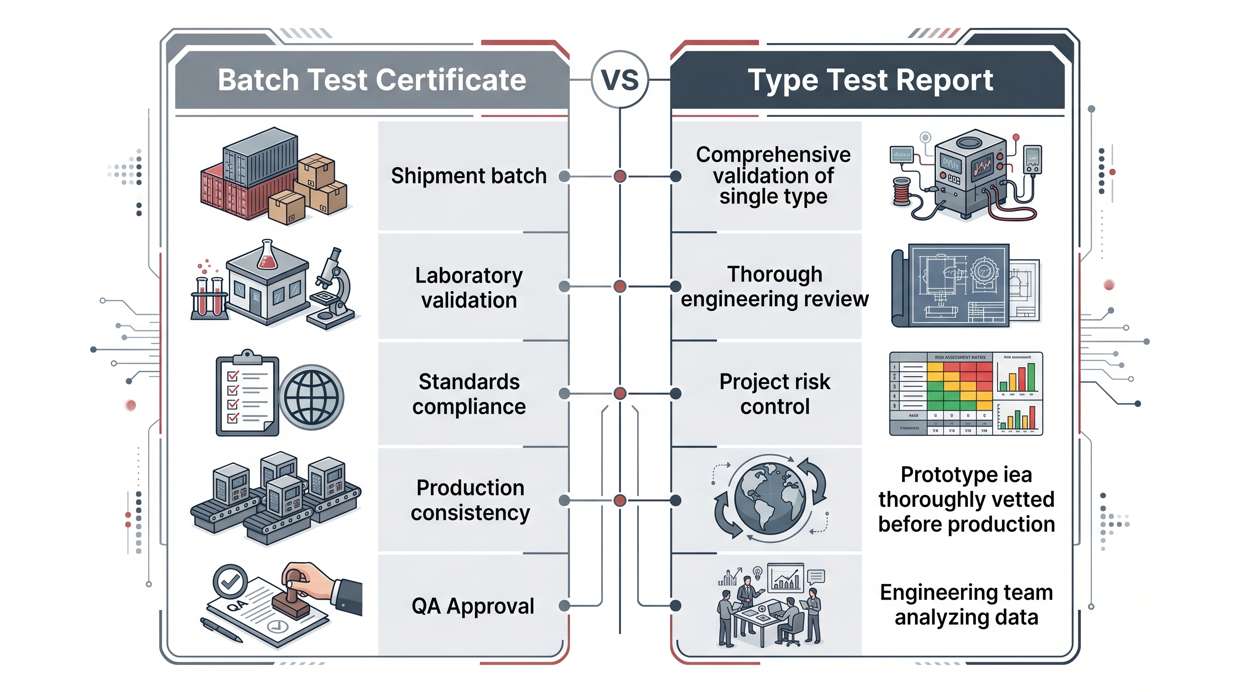
A Batch Test Certificate proves that a specific production batch meets the order specification before shipment, while a Type Test Report proves that a product design has been validated against relevant standards. For engineers and buyers, the difference is not academic—it directly affects supplier qualification, shipment approval, and long-term project risk.
Batch Test Certificate (BTC) is used to verify the quality of an actual shipment batch.
Type Test Report (TTR) is used to verify that the cable design complies with standards and qualification requirements.
In serious projects, BTC controls delivery risk and TTR controls design risk; most buyers should not rely on only one.
■Direct Answer
A Batch Test Certificate proves that a specific manufactured batch has passed routine production tests and matches the agreed specification before shipment. A Type Test Report proves that a product design or model has passed a broader set of qualification tests against relevant standards under controlled conditions. In practical procurement terms, BTC is about shipment compliance, while TTR is about design qualification.
For most cable buyers, the correct approach is simple: use the Type Test Report to assess whether the product family is technically qualified, and use the Batch Test Certificate to assess whether the actual delivered goods are consistent with what was ordered.
■What Is a Batch Test Certificate?
A Batch Test Certificate is a production-level document linked to a specific manufacturing lot, shipment, or drum group. It records the results of routine tests performed on the actual goods being delivered. In cable supply, this is one of the most important documents for shipment release and incoming inspection review.
| BTC Element | Typical Content |
|---|---|
| Batch identification | Batch No., lot No., drum No., order reference |
| Routine test items | Conductor resistance, attenuation, dimensions, marking checks |
| Shipment traceability | Date, production line, inspection signoff |
| Purpose | Show that the actual shipped goods match the agreed specification |
■What Is a Type Test Report?
A Type Test Report is a design-level qualification document. It is usually associated with a cable model, construction, or product family, and demonstrates that the design has been tested against a recognized standard or defined technical requirement. Compared with a BTC, the scope is broader and more focused on compliance, durability, and performance limits.
| TTR Element | Typical Content |
|---|---|
| Design qualification scope | Cable structure, materials, rated performance |
| Standard reference | IEC, ISO, customer technical standard, project spec |
| Advanced tests | Environmental, fire, aging, performance and durability tests |
| Purpose | Show that the product design is technically qualified for the intended requirement |
■BTC vs TTR Comparison Table
| Dimension | Batch Test Certificate | Type Test Report |
|---|---|---|
| Main purpose | Shipment-level compliance check | Design-level qualification check |
| Scope | Specific lot or batch | Cable model or product family |
| Testing stage | During or after production | Before approval or mass adoption |
| Typical issuer | Factory QA / QC | Lab, accredited institution, or manufacturer with formal test basis |
| Primary buyer concern | Is this shipment consistent? | Is this design compliant and suitable? |
| Risk controlled | Production deviation risk | Design / compliance risk |
■How They Work Together in Real Projects
In serious cable procurement, these two documents serve different checkpoints. The Type Test Report is usually reviewed first, because buyers need confidence that the product family meets the required technical standard. Once the product is approved, the Batch Test Certificate becomes important for shipment release, because it helps confirm that the delivered goods are consistent with the approved design and purchase specification.
| Project Stage | Main Document Focus | Why It Matters |
|---|---|---|
| Supplier evaluation | TTR | Confirms technical basis and compliance |
| Tender / submittal | TTR | Supports approval and specification matching |
| Pre-shipment review | BTC | Checks the actual goods before dispatch |
| Incoming inspection / acceptance | BTC + TTR | Combines design qualification with batch traceability |

■Common Mistakes and Risks
Risk: The approved design may be correct, but the shipped goods may still vary in conductor size, attenuation, jacket marking, or batch consistency.
Risk: Routine batch checks do not replace full qualification testing for fire, aging, environmental, or long-duration performance.
Risk: A valid document can still be irrelevant if it references a different structure, standard, model, or application class.
■Decision Rules / Engineer’s Shortcut
| Situation | What to Ask For | Why |
|---|---|---|
| New supplier qualification | Type Test Report | You need proof of technical credibility |
| Project approval or consultant submission | Type Test Report | You need standard-based qualification evidence |
| Before shipment release | Batch Test Certificate | You need evidence linked to actual delivered goods |
| Custom or OEM cable order | BTC + relevant TTR basis | You need both compliance logic and production traceability |
| Critical infrastructure or long-life system | BTC + TTR | You need to reduce both design and delivery risk |
■Applications in Cable Projects
In LAN cabling, fiber optic cabling, power cable supply, OEM assemblies, and project-based structured cabling, document discipline matters. A Type Test Report may support claims related to design structure, electrical or optical performance, flame class, or environmental suitability. A Batch Test Certificate then supports the practical question of whether the delivered reels, drums, or assemblies match what the buyer approved.
This is especially important where installation cost is high, where access is limited after deployment, or where a mismatch can delay commissioning. In these situations, relying on only one document is often not enough. Buyers need to know both that the design is sound and that the shipment is consistent.
■FAQ
No. A BTC is linked to a specific production lot and routine checks. It does not replace full design qualification.
No. A TTR may prove that a design passed formal testing, but it does not prove that a specific delivered batch is consistent.
That depends on the stage. TTR matters more during approval and specification review. BTC matters more during shipment and acceptance review.
Check whether the report is tied to the actual batch, whether the test items match the order specification, and whether the traceability information is complete.
Check whether the tested construction, standard, model, and application conditions match the product and project requirement you are evaluating.
■Conclusion
A Batch Test Certificate and a Type Test Report are both important, but they solve different problems. The first helps you confirm what is being delivered now. The second helps you confirm what was technically qualified in principle. Serious buyers, engineers, and project managers should not confuse the two.
The most practical rule is simple: use TTR to approve the product family, and use BTC to approve the shipment. That approach reduces compliance misunderstandings, lowers acceptance risk, and improves document discipline across the full project lifecycle.
Need support for cable qualification or shipment documents?
ZION Communication supports technical document coordination for cable selection, project approval, and delivery review, including product specifications, certificate references, and production documentation support for different application environments.