FPLP Fire Alarm Cable: What It Is and When to Use It
Author: Site Editor Publish Time: 22-04-2026 Origin: Site
FPLP Fire Alarm Cable: What It Is and When to Use It
FPLP is the plenum-rated version of power-limited fire alarm cable, selected mainly by installation environment.
Use FPLP when the cable route passes through plenum or other environmental air-handling spaces.
Do not treat FPLP as a universal cable rating for outdoor, wet, underground, or chemically harsh environments.
■ Direct answer: when should you choose FPLP?
FPLP fire alarm cable is the plenum-rated version of power-limited fire alarm cable. In practical project terms, you choose it when a fire alarm circuit will be installed in a plenum or other environmental air-handling space, such as certain ceiling or floor cavities used for return air. The selection driver is not “higher-end system design,” but pathway risk: smoke generation, flame spread, inspection compliance, and rework exposure. For procurement teams and engineers, the real question is not whether FPLP is better in general, but whether the building pathway makes plenum performance necessary.
■ What FPLP fire alarm cable is
FPLP stands for power-limited fire alarm plenum cable. It is designed for fire alarm system circuits installed in environmental air spaces where smoke and flame behavior matter more than in ordinary indoor pathways. That means the cable type is selected mainly by where it will be installed, not by whether the fire alarm panel is addressable, conventional, shielded, or unshielded.
From a buying perspective, FPLP solves a specific compliance problem: it allows the fire alarm circuit to run through plenum spaces without forcing a late-stage redesign of pathway method, raceway strategy, or ceiling routing. That is why FPLP is often treated as a risk-control choice on projects where ceiling pathways are complex or not fully finalized during early procurement.
| Item | Meaning for engineers and buyers |
|---|---|
| FPLP | Plenum-rated power-limited fire alarm cable |
| Main selection trigger | The installation pathway is a plenum or environmental air-handling space |
| Main project value | Lower smoke-risk mismatch, cleaner inspection path, lower rerouting exposure |
| Common misunderstanding | It is not automatically the right choice for outdoor, wet, direct-burial, or all “premium” projects |
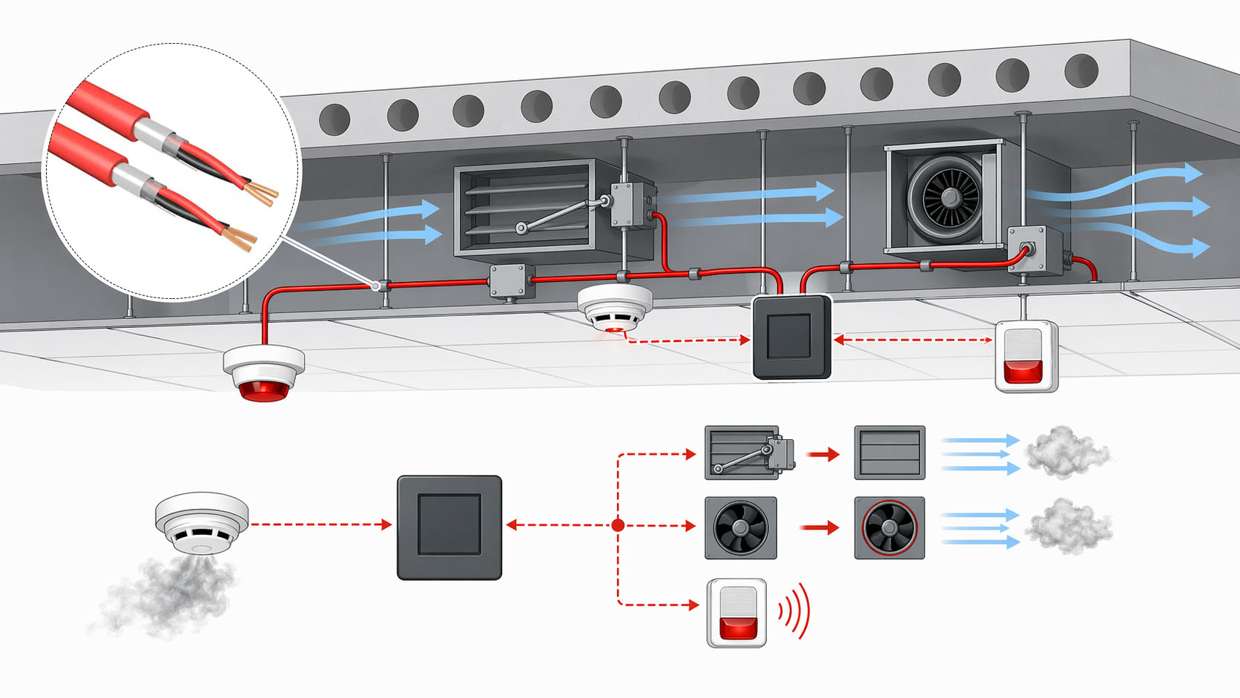
■ What counts as a plenum space
A common mistake in cable selection is assuming that every above-ceiling area is automatically a plenum. In practice, what matters is whether that space is used to move environmental air. If the ceiling or raised-floor cavity functions as part of the building’s HVAC return-air path, smoke behavior becomes more critical and plenum cable selection becomes the safer and more code-conscious choice.
This distinction matters because it affects cost. Over-specifying every fire alarm run as FPLP raises material cost. Under-specifying a true plenum run can create failed inspections, cable replacement, schedule delay, and project-management friction. So the first step is always to verify pathway function, not just building type.
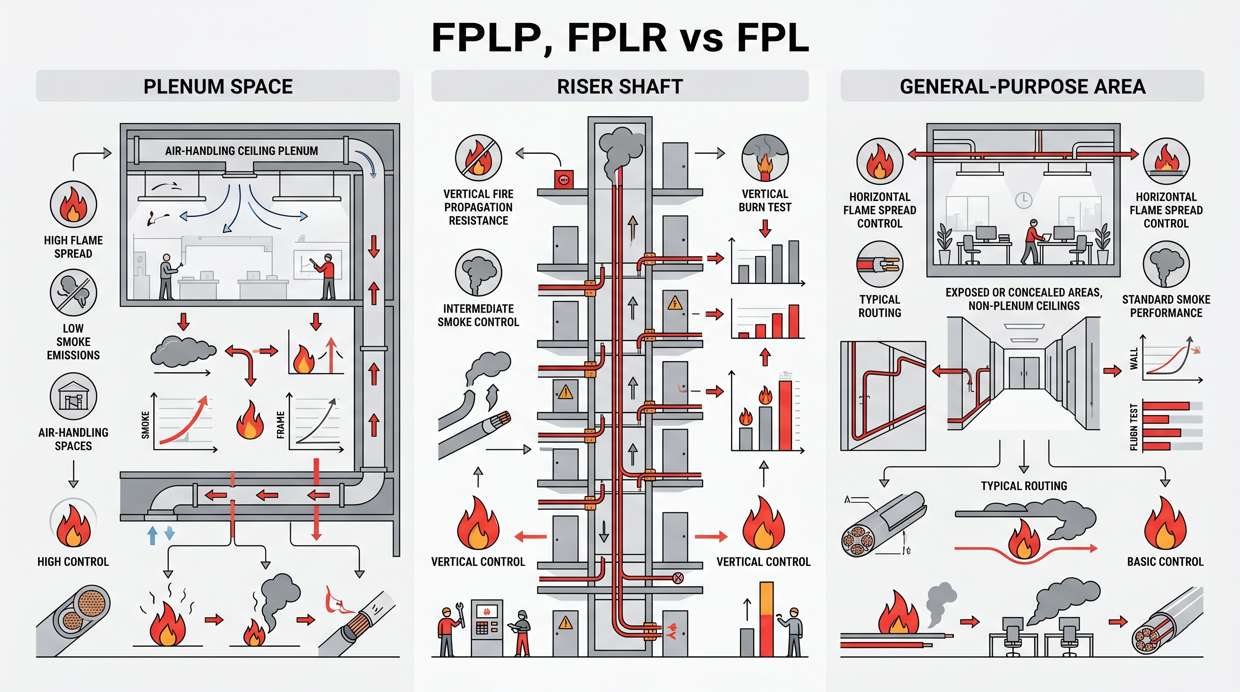
■ FPLP vs FPLR vs FPL
The simplest way to compare these fire alarm cable types is by installation environment. FPLP is the plenum-rated option, FPLR is the riser-rated option, and FPL is the general-purpose option for standard indoor spaces where plenum or riser conditions do not apply. This is why the correct question is not “Which cable is best?” but “Which cable matches the pathway?”
| Cable Type | Typical Pathway | Main Performance Focus | Project Logic |
|---|---|---|---|
| FPLP | Plenum or environmental air spaces | Low smoke and controlled flame spread | Choose when ceiling/floor air spaces are part of the route |
| FPLR | Vertical riser shafts between floors | Vertical flame propagation control | Choose when the run is between floors but not in plenum air space |
| FPL | General indoor non-plenum, non-riser spaces | Standard general-purpose fire alarm cable performance | Choose when the pathway is simpler and code allows it |
■ When to use FPLP fire alarm cable
FPLP is the right direction when the installation environment makes smoke control and inspection certainty more important than lowest first-cost procurement. That usually happens in commercial interiors, schools, hospitals, public buildings, mixed-use properties, and retrofit projects where return-air spaces are common or where routing may shift during installation.
| Project Condition | Should FPLP be considered? | Why |
|---|---|---|
| Cable exposed in environmental air space | Yes | This is the clearest FPLP use case |
| Pathway may change during installation | Usually yes | Reduces rerouting and reinspection risk |
| Open office, hospital, school, commercial interior with return-air ceiling | Often yes | Smoke behavior in shared air spaces matters more |
| Owner prioritizes lowest compliance risk over lowest cable cost | Often yes | FPLP may reduce expensive downstream mistakes |
■ When FPLP may not be necessary
FPLP is not automatically the most cost-efficient choice for every fire alarm project. If the cable route stays entirely outside plenum spaces and the design only requires riser or general-purpose performance, a lower category may be more economical while still meeting project needs. This matters in cost-sensitive bidding, repetitive indoor layouts, and projects with clearly defined non-plenum routes.
The key point is that FPLP is a pathway-driven solution, not a generic upgrade label. Over-specifying it across an entire project can increase material cost without delivering equal practical benefit if the routes are already well controlled.
■ Selection risks and common mistakes
| Risk Area | What goes wrong | Project impact | Control action |
|---|---|---|---|
| Code mismatch | Wrong cable type for actual pathway | Inspection failure and replacement | Verify pathway function early |
| Procurement waste | FPLP specified everywhere without need | Unnecessary cost increase | Separate pathways by actual use class |
| Environment mismatch | Indoor plenum cable used in unsuitable conditions | Premature failure or noncompliance | Check wet, outdoor, UV, burial, or armor needs separately |
| Late route change | Original cable type no longer matches final pathway | Delay, rework, coordination friction | Use FPLP upfront when route uncertainty is high |
■ Engineer’s shortcut: how to decide fast
| Question | If yes | If no |
|---|---|---|
| Will the cable be exposed in a plenum or air-handling space? | Move toward FPLP | Check whether riser or general-purpose rating is enough |
| Is the route likely to change during installation? | FPLP may reduce rework risk | Optimize cost by matching exact pathway type |
| Is the project cost-sensitive with well-defined non-plenum pathways? | Use the lowest compliant pathway rating | Favor lower compliance risk over small unit-price savings |
| Does the environment also involve wet, outdoor, or special mechanical exposure? | Verify additional environmental listing needs separately | Proceed with normal indoor pathway evaluation |
■ FAQ
■ Conclusion
FPLP fire alarm cable is the right selection when a fire alarm circuit must run through plenum or other environmental air-handling spaces and the project cannot afford smoke-control mismatch, inspection failure, or pathway rework. It should be treated as a pathway-specific engineering decision, not as a generic premium label. For procurement teams, the best approach is to balance unit price against inspection certainty, route flexibility, and lifecycle project cost.
If you are defining a new project or comparing fire alarm cable constructions for a retrofit, start with the pathway, then confirm conductor count, shielding, jacket type, and any extra environmental requirements. That sequence reduces selection error and helps keep the project both compliant and commercially efficient.