CMP vs CMR vs LSZH vs CPR: Fire Ratings Explained for Procurement & Compliance
Author: Michael Publish Time: 19-01-2026 Origin: Site
CMP vs CMR vs LSZH vs CPR (2026): Fire Ratings Explained for Procurement & Compliance
Fire rating is not a “nice-to-have” label—it is a code and liability decision. Selecting the wrong rating can trigger failed inspections, rework costs, project delays, and legal exposure. This guide clarifies UL (CMP/CMR/CM) vs EU CPR classes, explains what LSZH really means, and provides procurement-ready decision rules for commercial buildings, data centers, and smart infrastructure.
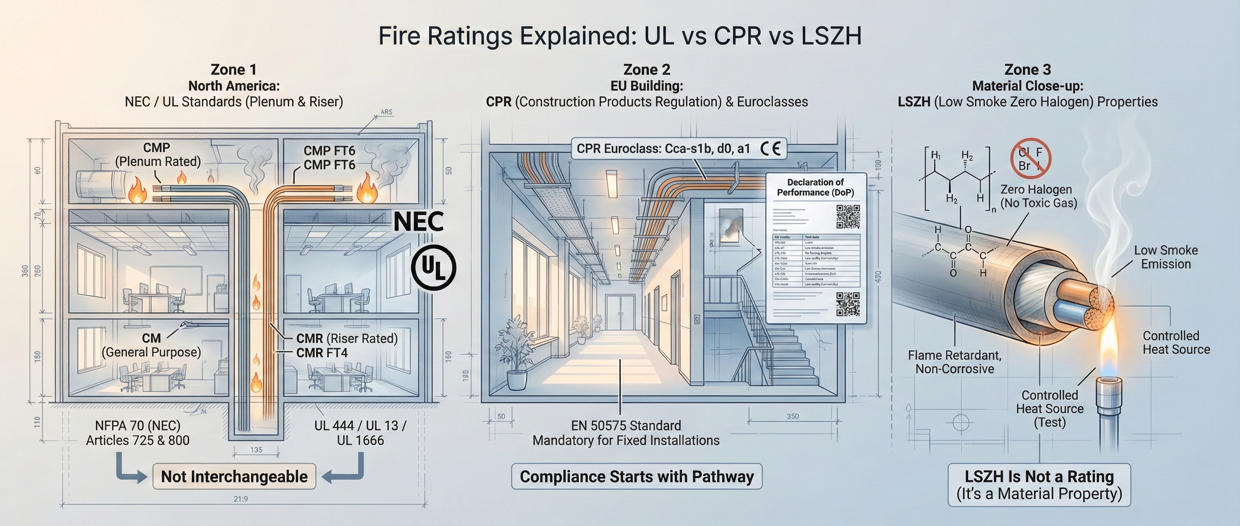
CMP/CMR/CM are UL ratings (North America); CPR classes are EU regulation—they are not interchangeable.
LSZH is a jacket property (smoke/toxicity behavior), not a fire performance class—always confirm the required standard.
Select by pathway + jurisdiction first (plenum/riser/general + UL/CPR), then optimize price and performance.
■ 1) Why Fire Ratings Matter in 2026
Fire rating requirements are driven by installation pathway (plenum, riser, general space) and jurisdiction (UL vs CPR), not by Ethernet category alone. In 2026, higher cable density and PoE-powered endpoints increase the importance of smoke management, toxic gas risk, and inspection readiness.
Many projects fail inspection not because of performance, but because procurement ordered the wrong rating for the pathway (e.g., CM in a riser, CMR in a plenum, or non-CPR cable in EU permanent installation).
Decide in this order: (1) Country/region compliance → (2) Pathway type → (3) Required documentation (DoP, labels, test reports) → then select product options and price.
■ 2) CMP vs CMR vs CM (UL Ratings)
CMP, CMR, and CM are UL-based fire ratings widely used in North America. They describe how cables behave under specific fire test conditions and installation environments.
Where each UL rating is typically required
| UL Rating | Pathway / Space | Procurement Meaning | Typical Risk If Wrong |
|---|---|---|---|
| CMP (Plenum) | Air-handling spaces (return air plenums above ceilings / raised floors used for air) | Highest fire/smoke performance in UL framework | Inspection failure + forced replacement |
| CMR (Riser) | Vertical runs between floors (riser shafts, non-plenum vertical pathways) | Designed to limit flame spread between floors | Failed inspection in riser + rework |
| CM / CMG (General) | General-purpose spaces where allowed by local code | Cost-optimized rating; limited pathway eligibility | Often rejected in commercial projects |
■ 3) LSZH: What It Is (and Isn’t)
LSZH (Low Smoke Zero Halogen) describes the jacket material behavior during burning: lower smoke and reduced halogen acid gas emission. It is widely requested in public buildings, transportation, data centers, and critical infrastructure for life-safety and equipment protection.
Procurement teams often treat LSZH as “automatically fire compliant”. This causes scope gaps: LSZH may still fail CMP/CMR tests or may not satisfy EU CPR class requirements.
LSZH is not a fire rating. It is a material property. Always specify the required UL rating (CMP/CMR/CM) or CPR class (Cca/Dca/etc.) in addition to LSZH if required.
■ 4) CPR (EU): Classes, s/d/a Suffixes
CPR (Construction Products Regulation) applies to cables permanently installed in buildings within the EU. CPR classification describes reaction to fire and includes additional performance indicators for smoke, flaming droplets, and acidity.
CPR class structure (what procurement should verify)
| Element | Examples | Meaning for Procurement | Where It Matters Most |
|---|---|---|---|
| Main class | B2ca / Cca / Dca / Eca | Core compliance tier (project minimum) | All EU permanent installations |
| Smoke (s) | s1a, s1b, s2, s3 | Visibility + evacuation risk control | Public spaces, transport, high occupancy |
| Droplets (d) | d0, d1, d2 | Flaming droplets can spread fire | Vertical shafts, escape routes |
| Acidity (a) | a1, a2, a3 | Corrosion/toxicity indicator (gas acidity) | Data centers, equipment rooms |

■ 5) Side-by-Side Comparison Table
UL and CPR are different regulatory frameworks. LSZH is a material property used globally. Use this table to prevent spec mix-ups in international procurement.
| Item | CMP / CMR / CM (UL) | LSZH | CPR (EU) |
|---|---|---|---|
| Region | USA / Canada (code driven) | Global (project driven) | EU (regulatory requirement) |
| Type | Fire performance rating | Jacket material behavior | Reaction-to-fire classification + documentation |
| Core focus | Flame spread + smoke control (test-dependent) | Low smoke + zero halogen gas emissions | Main class + smoke/droplets/acidity (s/d/a) |
| Typical marking | CMP / CMR / CM on jacket | LSZH/FRNC style markings (varies) | Cca-s1b,d0,a1 (example) |
| Procurement must verify | Pathway eligibility (plenum/riser/general) + local code acceptance | Whether LSZH is required in addition to UL/CPR classification | Class + DoP/labeling + applicable system documentation |
■ 6) Decision Rules / Engineer’s Shortcut
Use this shortcut matrix during tender review and BOM approval. It connects location + pathway to the minimum compliance requirement and reduces the chance of rework.
| Project Location | Pathway Type | Minimum Requirement | Procurement Checklist | Typical Buyer Risk |
|---|---|---|---|---|
| USA / Canada | Plenum (air-handling) | CMP | Confirm plenum space definition + jacket marking | CMR/CM rejected → replacement |
| USA / Canada | Riser (vertical shafts) | CMR | Confirm pathway is not plenum; verify riser shaft requirements | CM often rejected in riser |
| EU | Permanent building installation | CPR class required | Verify class + s/d/a suffix + DoP availability | Non-CPR cable = compliance breach |
| Hospitals / Transport / Public | High occupancy / critical routes | Higher CPR (e.g., Cca/B2ca) and/or LSZH | Align with project safety spec; verify documentation set | Penalty risk + rework delays |
| Global / Mixed-region | Cross-border supply | Confirm UL and/or CPR as needed | Map site-by-site requirements before ordering | Spec mismatch across sites |
■ 7) Cost Structure & Risk of Wrong Selection
Fire-rated cables often cost more than general-purpose products—but the real cost of fire rating is typically dominated by rework risk, schedule impact, and inspection failure. Procurement should evaluate total cost of ownership (TCO), not unit price.
A single failed inspection can trigger cable removal, reinstallation labor, ceiling rework, and new documentation—often costing far more than the original savings from buying a lower rating.
Optimize cost after compliance is locked. If compliance is uncertain, treat the “cheapest option” as the highest-risk option.
■ 8) Common Procurement Mistakes
Top mistakes that cause rework (and how to prevent them)
Assuming LSZH equals compliance: LSZH is not CMP/CMR and not a CPR class. Always specify the required standard and evidence.
Using CMR in a plenum: riser-rated cable may be rejected in air-handling spaces.
Buying CM to reduce cost: CM is frequently rejected in commercial projects depending on pathway and code.
Ignoring CPR documentation: EU projects often require a clear DoP and correct marking—absence can stop acceptance.
Mixing UL and CPR language: “CMP” does not translate to “Cca”, and “Cca” does not imply “CMP”. Map requirements per region.
■ 9) ZION Procurement Perspective
ZION COMMUNICATION recommends a procurement-first compliance workflow: (1) identify jurisdiction, (2) confirm pathway, (3) lock minimum rating, then select cable structure and performance options. This prevents inspection failure and protects schedule.
Fire rating is not where you “save cost”. It is where you avoid risk: rework, delays, liability, and customer disputes.
Document the rating choice in your project file: pathway map, rating rationale, and documentation set. This improves handover clarity and reduces future audit burden.
■ 10) Conclusion
To select the correct fire rating in 2026, follow a simple procurement sequence: jurisdiction (UL vs CPR) → pathway (plenum/riser/general) → documentation (DoP/marking) → LSZH requirement. This approach reduces inspection risk and protects project schedule and budget.
Send your project details and compliance targets: region (UL/CPR), installation pathway (plenum/riser/general), required class (CMP/CMR/CPR), and whether LSZH is required. ZION COMMUNICATION will recommend the correct cable construction and provide the matching documentation set.