CPR Cable Regulation: Fire Safety, EN 50575, and Building Compliance
Author: Luke Publish Time: 22-10-2025 Origin: Site
In buildings, the safety of people is ensured by the constant prevention of fire and its containment. Often overlooked, permanently installed cables play a significant role in the spread of fire. Consequently, the European Union adopted a unified regulatory framework, primarily the Construction Products Regulation (CPR), which fundamentally changed fire safety protocols for cables, the protocol of cables in buildings regarding fire safety has changed.
■ Construction Products Regulation – introduction and the field of action.
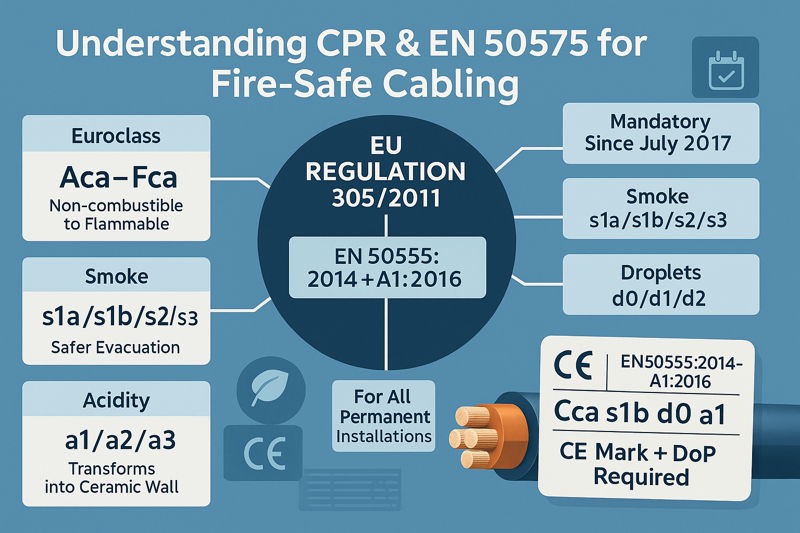
The Construction Products Regulation (CPR), formally EU Regulation No 305/2011, is the legal foundation that guarantees identical performance of all construction products in the area of the European single market. The principal objective is to provide reliable information to professionals, public authorities, as well as consumers about the performance of building products regarding their safety parameters like fire parameters.
Scope and Application for Cables:
The CPR covers all the devices designed for permanent integration into the construction works, such as buildings and civil engineering structures. The scope covers the cable industry, including:
Power cables
Control cables
Communication cables that consist of metallic and fiber optic materials.
The regulation requires that these cables be tested for their “reaction to fire” performance, including the consequences of choosing the cable for the fire spread and the emission of hazardous substances.
■ The Role of EN 50575:2014+A1:2016
While CPR establishes the legal framework, harmonised standards provide the technical methods for compliance. In the cable category, these standards are mainly represented by EN 50575:2014+A1:2016.
The importance of this standard relies on the fact that it specifies:
The Reaction to Fire Requirements where the testing methods, classification, and evaluation criteria are set out for cables with prerequisites for fire requirements.
Establish the Euroclass system (Aca to Fca), creating a common technical language across Europe., which is the common technical language for all Europe.
An additional classification for the cables is introduced by EN 50575, as only predicting the flame spread is not enough but also including:
Smoke Production classification which is based on s1, s2, s3 and takes into account the opacity of the smoke and visibility during the evacuation.
Flaming Droplets classification which is based on d0, d1, d2 and takes into consideration the burning droplets that can travel and ignite other materials.
Acidity/Toxicity of Smoke that is monitored by a1, a2 and a3 and gives information on the corrosive properties of surfaces and toxicity of the gas released.
The EN 50575 cables create the possibility for the designer to choose a cable with a straight forward, public fire performance statement with a pure numerical statement (for example, Cca-s1b, d1, a1), and it is clear to what the selected cable suits or fulfills.
■ CPR’s Function in Fire Cable Safety of Buildings
Adoption of the CPR brings more than one level of safety from fire:
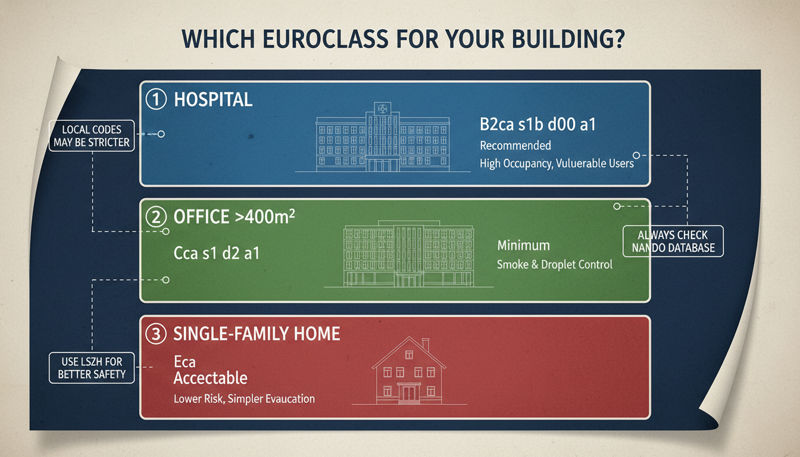
The CPR creates a set of risk-based specifications that are the base for ranging from non-combustible (Aca) to flammable (Fca). The Euroclasses are then used in the national legislation to describe the minimum required cable class in different environments (such as escape routes, high-rise buildings, or public areas) that address the same technical assessment.
The amount of smoke and burning products is lowered. Additional classifications address smoke production, ensuring better visibility during evacuation. Fire alarm response time goes up, and the conditions for emergency responders increase.
There exists a Manufacturer's obligation to adhere to compliance and traceability. The regulation on the manufacturer's part involves:
Initial type testing by a Notified Body (third-party laboratory).
Stringent Factory Production Control (FPC) compliance.
Issuing of a Declaration of Performance (DoP), that includes the product fire classification.
Application of a CE marking, not only for the product but also for its respective documentation.
The whole system of traceability and accountability ensures that only compliant products reach the market.
■ Zion Communication: A Responsible Manufacturer and Certification System
Being adherent to the responsibilities of a manufacturer, Zion sticks to the CPR standards and safety of cables. The presence of these systems at Zion that ensure the compliance to the CPR safe cables is either through a vigorous certification or quality systems such as:
Fully Compliant with CPR, the compliance with EN 50575 Requirements: Zion guarantees that all cables intended for installation are tested as per harmonized standard EN 50575 inclusively for all mandatory and supplementary requirements corresponding to the Euroclass.
Preliminary Certificate by Third Party: The cables are thoroughly product-tested and verified by accredited European Notified Bodies, based on the specific assessment system of Assessment and Verification of Constancy of Performance (AVCP), for instance, System 1+ or System 3, for a class B2ca and Cca.
DoP Transparency: Zion provides a consistent DoP for all CPR compliant cables outlining their fire performance class and characteristics, also stating the name and address of the manufacturer ensuring full legal validity.
Assurance of Quality Manufacturing and The Factory Production Control (FPC): Zion follows a Factory Production Control system certified in order to maintain permanent system of measurements in order to check the declared performance on DoP for each new cable. Surveillance audits from an external body guarantee consistency in quality of our fire safe products.
At Zion, we believe that you are selecting not only a partner who is compliant but also a partner that serves the wider purpose of a safer environment as all our cables are stringently tested, classified, and certified for their fire safety performance.
Contact us for more information

Luke Han is a Product Manager and Director at Zion Communication,
Specializing in fire, security, and alarm solutions. With extensive industry experience,
Dedicated to delivering high-performance, reliable products that are tailored to customer needs.
luke@zion-communication.com
0086 19883212162