FPV Drone Fiber Optic Spool — Stop Signal Loss & Unlock Stable Long-Range Flights
Author: James Publish Time: 04-12-2025 Origin: Site
■ Inner-Winding FPV Fiber Spool Overview
Zion Communication FPV drone optical fiber spool is an industrial-grade optical tether designed explicitly for long-range FPV, industrial inspection drones, tunnel and pipeline robotics, and high-EMI mission profiles.
It features an inner-winding, allowing frictionless payout of the tether, extremely low attenuation, zero fiber crossover, and fast payout capabilities.
The Fiber spool configuration is ideal for applications requiring reliable anti-jam communication at distances of 80 km or less.
■ Key Advantages of Inner Winding
Ultra-low Attenuation & Frictionless Payout
No friction with the wall of the spool
Provides a very low signal loss
Payout is easy in any direction
No Fiber Crossover or Kinking
Inner winding design keeps the fiber organized without crossing or sticking to itself.
Strong Anti-jam Reliability
No threat of radio jamming or electromagnetic interference
Provides consistent HD video/data transmission for long-range missions
Suitable for Faster Payout FPV Missions
Safe operational speed: ≤ 180 km/h
No risk of spooling fiber jamming or snapping
■ Inner-Winding FPV Fiber Spool Technical Specifications
Optical Fiber Characteristics
Parameter | Value |
Typical measured attenuation | 0.21–0.24 dB/km |
Fiber outer diameter | 0.239 mm |
Tensile strength | >70 N |
Payout tension | 2–3 N |
Cable length options | 5 km / 10 km / 15 km / 20 km / 30 km / ... 80 km |
Fiber Spool Dimensions & Weight
Fiber Length | Spool Size (mm) | Weight (g) |
5 km | OD 94 × H 350 | ~1096 g |
10 km | OD 110 × H 365 | ~1445 g |
15 km | OD 120 × H 375 | ~1830 g |
20 km | OD 120 × H 425 | ~2650 g |
30 km | OD 136 × H 505 | — |
■ Inner Winding vs. External Winding Under Comparison
Feature | Inner Winding | External Winding (Traditional) |
Jam Risk | ✔ No jam issues | ✘ High risk of knotting or jamming |
Attenuation | ✔ Ultra-low attenuation | ✘ High fiber attenuation |
Payout Flexibility | ✔ Frictionless payout in any direction | ✘ Fiber needs to be horizontal during payout |
Fiber Integrity | ✔ No risk of fiber snapping | ✘ Fiber is prone to snapping |
Fiber Organization | ✔ No fiber crossover | ✘ Prone to crossover and tangling |
Conclusion
Inner-winding is the safest and most reliable configuration for long-range 5–80 km FPV missions.
■ Application Scenarios
The following scenarios can utilize the system:
Long-range FPV aerial transmission
UAV surveillance
High-EMI RF environments
Tunnel, pipeline, and industrial inspection robotic applications
Wired communications for emergency missions
Tethered UAV in tactical and industrial applications
Utilities and mapping special missions
■ System Connectivity Overview
Airborne Module Wiring (Drone-Side)
 | 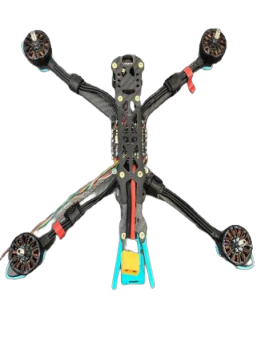 |
Wire Color | Function |
Red | 5V Power |
Black | Ground |
Yellow | RX |
Green | TX |
Ground Module Connection

This module converts electrical video/control signals into optical signals for transmission through the fiber spool.
Ground Station Topology
Optical receiver module
FPV goggles
(Optional) Monitor
RC transmitter/receiver
XT60 power input
Tethered fiber input port
The ground station uses an optical demodulator to translate the optical signals back to video or control data.
■ Flight Safety Guidelines
For safe and easy payout of the fiber tether:
Check that the fiber releases freely from the spool before flight
Do not place fiber outlet near the propellers
Avoid high-speed deceleration and drops
Avoid making a small-angle left/right descending turn
Do not exceed 180 km/h payout speed
Manually pull out 2–3 m of fiber from the spool before flight
Before flying, please connect the FC connector to the ground module interface.
Steadily apply acceleration to the drone during takeoff to avoid generating extra fiber tension
Avoid sharp edges at the payout point where the fiber exits the spool
Following the above rules reduces the risk of fiber tension buildup and fiber breakage.
■ Why Choose Zion Communication Optical Fiber Spools
Proven fiber solutions for FPV, UAV, and industrial applications
High-quality G.657A2 micro-diameter fiber — bend-insensitive, ultra-low loss, ideal for compact drone integration
OEM customization available — fiber length, connector type, strength member, spool size, color, laser marking
Wide range of spool capacities — from 1 km disposable reels to 80 km heavy-duty inner-winding capsules
Reliable performance in professional environments — tested in tunnels, high-EMI zones, emergency response, and defense operations
■ Ideal for:
✔ FPV long-range pilots — jam-free HD video & control beyond 30 km
✔ Industrial UAV integrators — plug-and-play tether systems for inspection, mapping, and payload telemetry
✔ Tactical and surveillance drones — secure, non-RF communication for sensitive missions
✔ Robotics and inspection systems — ROV/AUV, pipeline crawlers, tunnel bots with stable wired links
✔ Communication technology developers — modular optical transceivers, ground stations, and full-system integration support
Contact us for more information

James is a technical manager and associate at Zion Communication.
Specializes in Optical Fiber communications, FTTH Solutions,
Fiber optic cables, ADSS cable, and ODN networks.
james@zion-communication.com
+86 13777460328