Field Termination Plug vs Keystone Jack: Which Is Better for Site Installation?
Author: Site Editor Publish Time: 09-01-2026 Origin: Site
Field Termination Plug vs Keystone Jack: Which Is Better for Site Installation?
A practical guide for choosing between field termination plugs and keystone jacks in structured cabling, IP camera, Wi-Fi AP, data center and on-site network installation projects.
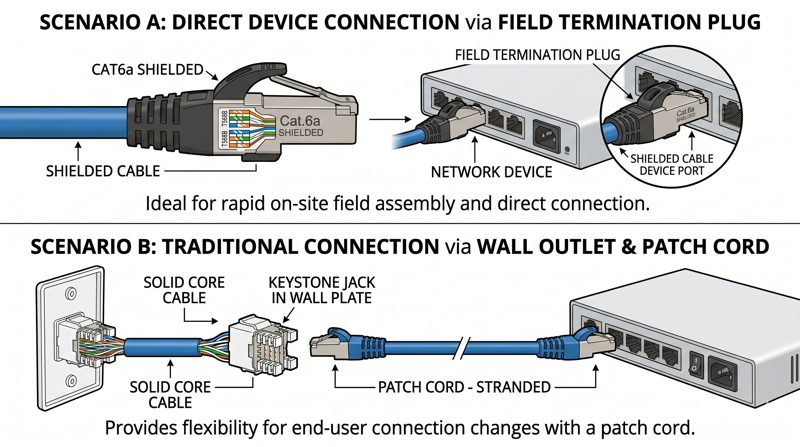
Field termination plug is useful when a horizontal cable needs to connect directly to equipment such as IP cameras, Wi-Fi access points or industrial devices.
Keystone jack is usually better for standard structured cabling because it creates a clean outlet or patch panel termination point.
For project buyers, the right choice depends on installation space, maintenance method, cable type, testing requirement and long-term service access.
■ Quick Answer
A field termination plug is a site-installable RJ45 plug designed to terminate Ethernet cable directly onto a device-side connector. A keystone jack is a modular socket used in wall plates, patch panels and surface boxes to create a structured cabling connection point.
In most standard building cabling projects, keystone jacks are preferred because they support cleaner cable management, easier maintenance and a more conventional permanent link structure. Field termination plugs are preferred when the cable must connect directly to equipment and there is no space or need for a wall outlet or patch cord.
Use keystone jacks for structured cabling outlets and patch panels. Use field termination plugs for direct device connection, limited-space equipment installation or special on-site termination needs.
■ What Is a Field Termination Plug?
A field termination plug is an RJ45 plug that can be terminated directly on site, usually without factory-molded patch cord production. It is often used with solid or stranded Ethernet cable depending on plug design. Many field termination plugs are available for Cat6 or Cat6A applications and may include tool-less or tool-assisted termination structures.
Direct Connection
The cable can be terminated directly into a plug and inserted into equipment without an extra patch cord.
Useful for Devices
Common in IP cameras, wireless access points, LED displays, industrial switches and compact equipment boxes.
Site Flexibility
Installers can cut cable to actual length and terminate the plug on site.
■ What Is a Keystone Jack?
A keystone jack is a modular RJ45 socket used to terminate horizontal Ethernet cable into a wall plate, patch panel, surface mount box or furniture outlet. It is one of the most common components in structured cabling because it separates fixed cabling from movable patch cords.
Structured Outlet
Creates a standard connection point for work areas, patch panels and equipment rooms.
Better Maintenance
Patch cords can be replaced without disturbing the fixed horizontal cable.
Project Standardization
Supports labeling, testing, documentation and long-term structured cabling management.
■ Field Termination Plug vs Keystone Jack
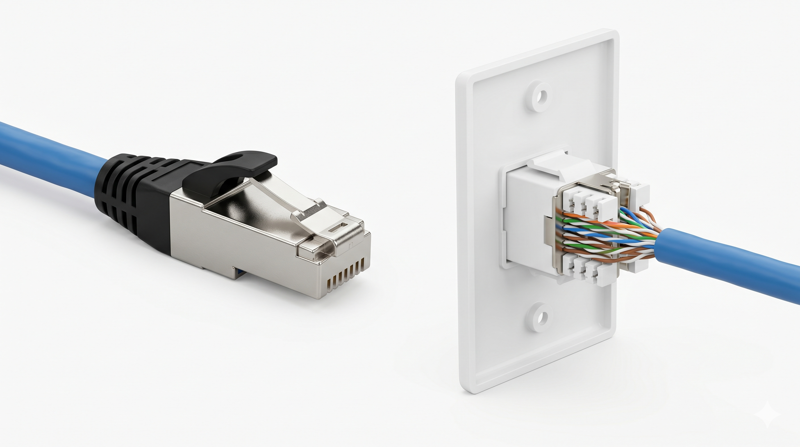
The difference is not simply “plug vs jack.” It is about system design. A field termination plug creates a direct equipment connection. A keystone jack creates a fixed cabling outlet that is normally connected to equipment through a patch cord.
| Item | Field Termination Plug | Keystone Jack | Buyer Decision |
|---|---|---|---|
| Connection style | Direct plug into equipment | Socket connection point plus patch cord | Choose based on whether the equipment needs direct connection or outlet-based cabling. |
| Best use | IP cameras, APs, industrial devices, compact boxes | Wall outlets, patch panels, office cabling, telecom rooms | Use plugs for equipment ends and jacks for structured outlets. |
| Maintenance | Cable termination may need rework if damaged | Patch cord can be replaced easily | Keystone is better when frequent changes are expected. |
| Installation space | Good for limited space near devices | Needs outlet, box, faceplate or patch panel | Field plug is useful where no outlet can be installed. |
| Testing and documentation | Can be less conventional for permanent link layout | Fits standard structured cabling documentation | Keystone is usually easier for project acceptance and labeling. |
■ Best Application Scenarios
The best choice depends on where the cable terminates and how the connection will be maintained after installation.
| Scenario | Better Choice | Reason | Installation Note |
|---|---|---|---|
| Office wall outlet | Keystone jack | Cleaner, standardized and easier to maintain. | Use wall plate or surface mount box. |
| Patch panel termination | Keystone jack or punch-down patch panel | Better labeling, testing and cable management. | Use proper rear cable support and bend radius control. |
| Ceiling Wi-Fi access point | Depends on design | Outlet is better for maintenance; field plug is compact for direct connection. | Check ceiling space and service access. |
| IP camera installation | Field termination plug | Direct device connection is often practical in camera boxes or poles. | Use waterproof housing if exposed outdoors. |
| Industrial equipment cabinet | Field termination plug or industrial connector | Direct equipment connection and ruggedness may be required. | Confirm shielded, M12 or RJ45 requirement. |
| Frequent moves and changes | Keystone jack | Patch cords can be replaced without touching fixed cable. | Use clear labeling and spare ports. |
■ Installation and Testing Considerations
Both products can deliver good performance if they are matched to the cable and installed correctly. Most failures come from wrong conductor type, poor termination practice, excessive untwist, incompatible shielded parts or insufficient strain relief.
| Check Item | Field Termination Plug | Keystone Jack | Risk if Ignored |
|---|---|---|---|
| Cable conductor | Confirm solid or stranded compatibility | Usually used with solid horizontal cable | Poor contact or unstable link. |
| Cable category | Match Cat5e, Cat6 or Cat6A plug rating | Match jack category to cable system | Reduced channel performance. |
| Shielding | Use shielded plug for shielded cable | Use shielded keystone and grounded panel if required | Broken shield continuity. |
| Strain relief | Very important at device side | Important behind wall plate or patch panel | Connector stress or intermittent failure. |
| Test method | May be evaluated as part of channel or specific link design | Fits conventional permanent link testing | Acceptance confusion if test scope is unclear. |
■ What Buyers Should Confirm Before Ordering
For procurement and project planning, the main risk is not the product name. The risk is ordering a plug or jack that does not match the cable, installation environment or acceptance method.
Cable Type
Confirm Cat5e, Cat6, Cat6A, UTP, FTP, STP, solid or stranded cable compatibility.
Installation Space
Check whether the site has space for wall plates, boxes, patch panels or direct device termination.
Tool Requirement
Some products are tool-less, while others need punch-down tools, termination tools or crimping tools.
Environment
For outdoor, industrial or camera installations, check waterproofing, dust protection, shielding and strain relief.
Testing Requirement
Confirm whether the project requires permanent link test, channel test or basic continuity test.
Maintenance Plan
If the connection will be changed often, keystone plus patch cord is usually easier to maintain.
■ Site Installation Risk Levels
Use the following guide to evaluate whether the termination choice is suitable for the installation environment.
Product category matches the cable, shielded parts are compatible, strain relief is provided and test scope is clear.
Site space is limited, cable type is not fully confirmed or maintenance responsibility is unclear.
Wrong plug for conductor type, shielded cable with unshielded parts, no strain relief or unclear test acceptance.
■ Decision Rules / Engineer’s Shortcut
The correct choice depends on whether the cable end is part of a structured cabling outlet or a direct equipment connection.
| Project Need | Recommended Choice | Reason | Buyer Checkpoint |
|---|---|---|---|
| Standard office outlet | Keystone jack | Cleaner structured cabling and easier maintenance. | Confirm category, wall plate and back box. |
| Patch panel system | Keystone jack or patch panel IDC termination | Better labeling and permanent link testing. | Confirm port density and cable manager. |
| IP camera or AP direct cable | Field termination plug | Direct connection saves space and avoids extra patch cord. | Confirm device clearance and waterproof housing. |
| Industrial equipment | Field termination plug or industrial connector | Rugged direct connection may be required. | Confirm shielding, IP rating and strain relief. |
| Frequent service changes | Keystone jack plus patch cord | Patch cord is easier to replace than re-terminating fixed cable. | Use clear labels and accessible outlet positions. |
If the cable ends at a wall, panel or outlet, choose a keystone jack. If the cable must plug directly into a device, choose a field termination plug. For long-term maintenance, keystone plus patch cord is usually safer.
■ FAQ
What is a field termination plug?
It is an RJ45 plug that can be terminated directly onto Ethernet cable at the installation site.
What is a keystone jack?
It is a modular RJ45 socket used in wall plates, patch panels and surface boxes for structured cabling termination.
Which is better for IP camera installation?
A field termination plug is often practical for direct camera connection, especially in compact camera boxes or pole-mounted installations.
Which is better for office cabling?
A keystone jack is usually better because it supports standard outlets, easier labeling and simpler maintenance.
Can field termination plugs be used with Cat6A cable?
Yes, but the plug must be rated for Cat6A and compatible with the cable diameter, conductor type and shielding structure.
What should buyers specify in an RFQ?
Specify cable category, conductor type, shield type, termination method, tool requirement, environmental rating and testing requirement.
Need RJ45 Field Termination Plugs or Keystone Jacks?
ZION Communication can support Cat5e, Cat6, Cat6A field termination plugs, keystone jacks, patch panels, patch cords and customized copper cabling solutions for structured cabling, IP camera, Wi-Fi AP, data center and OEM projects.