How Long Should Fire-Resistant Cable Maintain Circuit Integrity?
Author: Site Editor Publish Time: 15-05-2026 Origin: Site
ZION Fire-Resistant Cable Engineering Guide
How Long Should Fire-Resistant Cable Maintain Circuit Integrity?
From 30 minutes to 120 minutes, the correct fire-resistant cable circuit integrity rating is not simply the longest number on a datasheet. It should match the safety system function, evacuation strategy, local code, test standard, and installed cable system.
Quick answer: In many building projects, 30–60 minutes may be specified for early warning and evacuation-related circuits, while 90–120 minutes is often considered for higher-risk or critical systems. Final selection should follow local codes, consultant specifications, and certified test evidence.
 Circuit integrity is a survival-time decision
 Contents
Engineer’s reading path- Answer First: How Long Is Long Enough?
- What Circuit Integrity Really Means
- 30, 60, 90 and 120 Minutes Explained
- Main Standards That Influence the Rating
- Application Guide by Safety System
- Why Minutes Alone Are Not Enough
- Project Requirement Quick Check
- Cable Structure and Material Factors
- Documentation Checklist
- Common Engineering Mistakes
- ZION Selection Guide
- FAQ
■1. Answer First: How Long Is Long Enough?
In most building safety projects, fire-resistant cable circuit integrity is commonly specified as 30, 60, 90 or 120 minutes. However, the correct duration is not a universal number. It depends on what the circuit must keep doing during a fire.
■2. What Circuit Integrity Really Means
Circuit integrity means that a cable can continue to transmit power, signals, data, or control commands under defined fire test conditions. In emergency systems, the key question is not only whether the cable resists burning, but whether the connected circuit remains functional during the required survival period.
| Performance Term | Main Question | Engineering Meaning | Can It Replace Circuit Integrity? |
|---|---|---|---|
| Flame retardant | Does the cable limit flame spread? | Helps reduce fire propagation along cable routes. | No |
| LSZH | Does the cable reduce smoke and halogen gas? | Improves evacuation visibility and reduces corrosive gas risk. | No |
| Fire-resistant cable | Can the cable keep the circuit operating during fire? | Supports emergency system operation for a defined time window. | Yes, if tested |
| Fire-rated cable system | Can the installed system survive? | Considers cable, supports, fixings, joints, routing, and accessories together. | Best practice |
■3. 30, 60, 90 and 120 Minutes Explained
The “minute” rating should be treated as a survival target under a defined test method, not a guarantee that every installed circuit will survive the same duration in every real fire. The same number may also mean different things under different standards.
30 Minutes
Often used for basic emergency circuits where evacuation time is shorter and the building risk is lower.
60 Minutes
Commonly considered for commercial buildings, emergency lighting, fire alarm circuits, and public circulation areas.
90 Minutes
May be required where evacuation, occupancy, or local approval requirements demand a higher safety margin.
120 Minutes
Often specified for critical firefighting systems, rescue support, high-rise buildings, underground spaces, and critical facilities.

■4. Main Standards That Influence the Rating
A cable should not be approved only because the datasheet says “fire resistant.” Engineers should check the exact standard, test condition, rating, cable construction, and certificate scope.
| Standard / Reference | Main Focus | Typical Project Use | Selection Note |
|---|---|---|---|
| IEC 60331 | Circuit integrity under fire conditions. | International fire-resistant cable reference for emergency circuits. | Check part number, voltage range, cable size, fire condition, and test setup. |
| BS 6387 | Test method for cables required to maintain circuit integrity under fire conditions. | Often used where fire, water, and mechanical shock performance is discussed, such as BS 6387 CWZ cable requirements. | Do not treat BS 6387 as a simple 30/60/90/120-minute system. Confirm the actual category and certificate scope. |
| EN 50200 | Fire resistance of unprotected small cables used in emergency circuits. | Fire alarm, emergency lighting, communication, and emergency control circuits. | PH30, PH60, PH90 and PH120 are mainly associated with EN 50200-style classifications. |
| BS 8519 | Selection and installation of fire-resistant power and control cable systems. | Life safety, firefighting, and other critical applications. | More useful for system-level classification and installation practice, often involving 30/60/120-minute system logic rather than PH labels. |
■5. Application Guide by Safety System
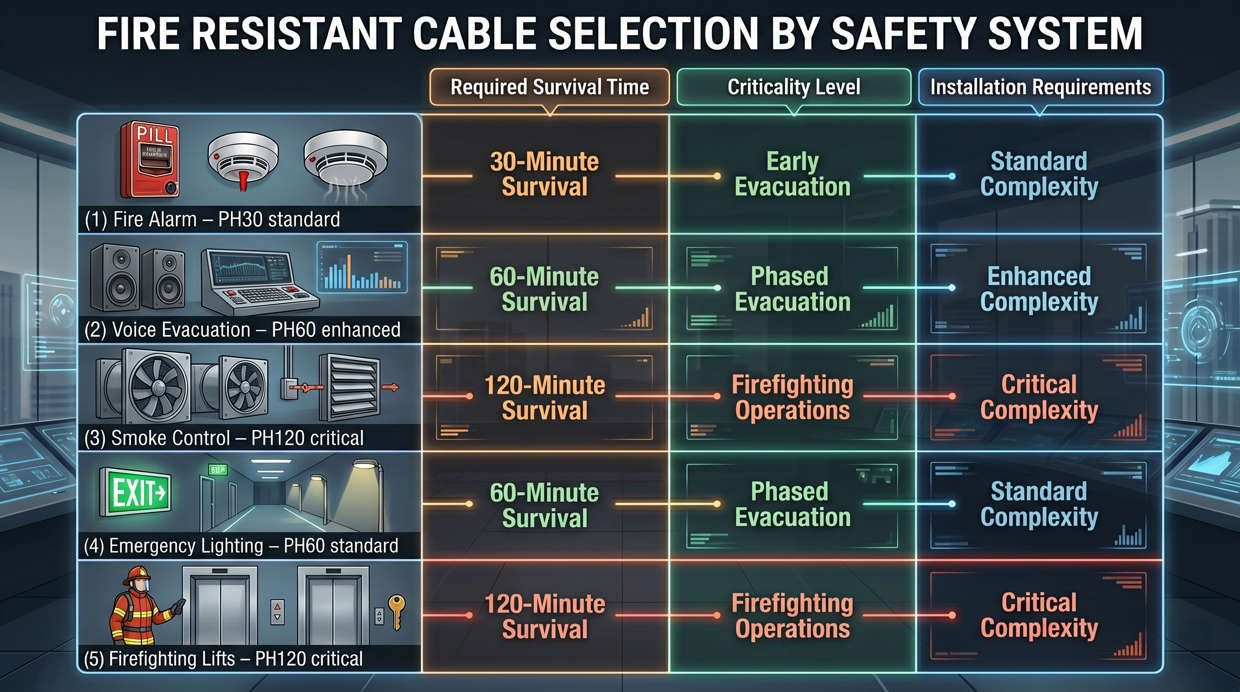
The following table provides a practical starting point for engineers and procurement teams. Final selection must follow local code, project consultant requirements, authority approval, and product test evidence.
| Application | Common Direction | Selection Logic | Risk if Underspecified |
|---|---|---|---|
| Fire alarm system | 30–60 minutes | Maintains alarm initiation, loop communication, and control signal transmission. | Signal loss |
| Emergency lighting | 30–60 minutes | Keeps escape routes visible during evacuation. | Poor visibility |
| Voice evacuation / PAGA | 60 minutes or higher | Supports evacuation instructions in larger or more complex buildings. | Lost guidance |
| Smoke extraction control | 60–120 minutes, project-defined | Supports smoke management during evacuation and firefighting. | Smoke spread |
| Fire pump / sprinkler control | 120 minutes often specified for critical firefighting systems | Supports active firefighting and water delivery control. | Equipment failure |
| Fire elevator / rescue elevator | 120 minutes often specified or required by project design | Supports firefighter access and rescue operation in high-rise buildings. | Rescue impact |
| Data center critical links | 60–120 minutes or project-defined | Depends on business continuity, emergency power, and fire zone strategy. For high-density network continuity, see ZION / Hello Signal data center cabling and MPO/MTP solutions: Data Center Connectivity Solutions. | Downtime risk |
| Airport, metro, hospital, tunnel | 90–120 minutes often considered or specified | High occupancy, complex evacuation, and high consequence of failure. | High consequence |
■6. Why Minutes Alone Are Not Enough
A cable that passes a 120-minute laboratory test does not automatically mean the whole installed circuit will keep working for 120 minutes in a real building fire. Fire-resistant cabling must be treated as a system engineering decision.
Cable Route
Exposure level changes with risers, escape routes, plant rooms, shafts, tunnels, trays, conduits, and fire compartments.
Support System
Clips, trays, fixings, brackets, and spacing can decide whether the circuit remains supported during fire.
Accessories
Junction boxes, glands, terminals, splices, and enclosures should match the required fire survival strategy.
| Factor | Why It Matters | What to Confirm |
|---|---|---|
| Conductor size | Heat can increase resistance and affect voltage drop. | Load, circuit length, voltage drop margin, and emergency operation time. |
| Shielding | Alarm, control, and communication circuits may face EMI risk. | Shield type, grounding method, and control cabinet environment. |
| Sheath material | Occupied buildings often require low smoke and low halogen emission. | LSZH requirement, flame spread requirement, and CPR/local reaction-to-fire class where applicable. |
| Installation method | Real performance depends on tray, conduit, support, and compartment penetration. | Approved fixing method, spacing, route protection, and fire stopping details. |
■7. Project Requirement Quick Check
Use this lightweight selector as an internal discussion tool before quotation. It does not replace local code, consultant approval, or third-party certification review, but it helps clarify the first engineering direction.
Select the system type and risk level to estimate the initial circuit integrity direction. Confirm final rating against project specifications, local code, test standard, and installation method.
■8. Cable Structure and Material Factors
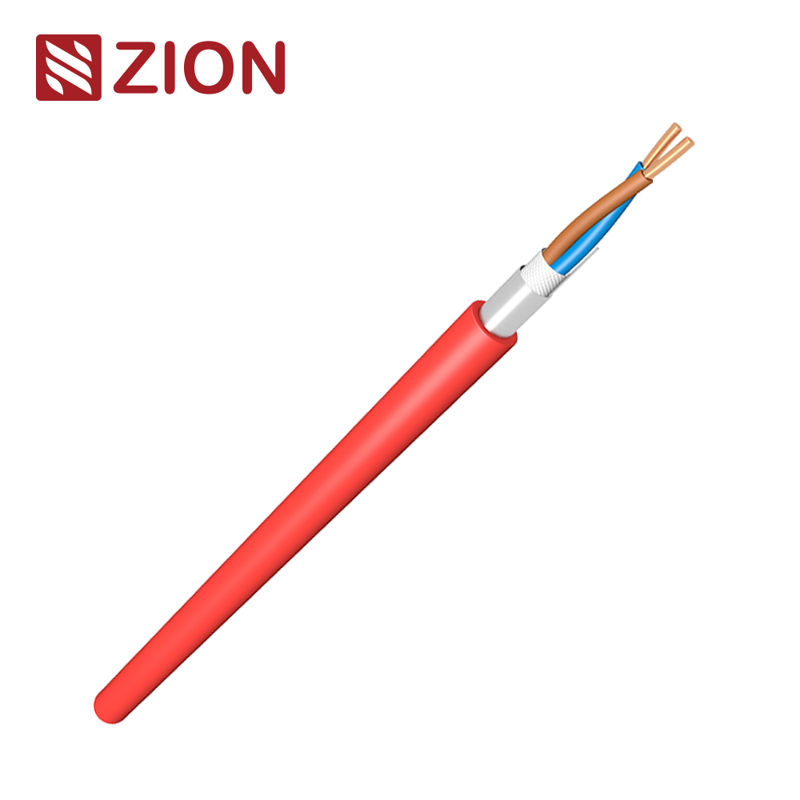
Fire-resistant performance depends on cable construction. The same external red sheath does not mean the same circuit integrity performance. For a PH120 certified fire cable or a BS 6387 CWZ cable, engineers should confirm whether the certificate covers the exact conductor size, core count, voltage rating, and cable structure being supplied.
Typical construction points to confirm
- Copper conductor: conductor size, class, resistance, and voltage drop margin.
- Mica tape or fire-resistant barrier: insulation continuity at elevated temperature.
- Fire-resistant insulation: material system should match the tested cable construction.
- Al-foil or braided shield: useful for alarm, control, RS485, BMS, and EMI-sensitive emergency routes.
- LSZH sheath: important for occupied buildings where smoke and corrosive gas must be reduced.
- Documentation: test report, certification scope, datasheet, marking, and batch traceability.
Recommended labeled structure for technical image or product page visual
For a stronger manufacturing-expert impression, use a labeled cable cutaway image or exploded-view illustration showing the functional layers clearly.
■9. Documentation Checklist Before Approval
Fire-resistant cable selection is often delayed not by the cable itself, but by missing approval documents. Before placing an order, engineers and procurement teams should confirm the documents below.
| Document / Evidence | What to Check | Why It Matters |
|---|---|---|
| Test report or certificate | Standard, test method, rating, issuing body, validity, and certificate scope. | Prevents using a claimed rating without verified evidence. |
| Covered cable size and core count | Whether the tested product family includes the ordered size and construction. | A certificate may not cover every conductor size or core configuration. |
| Rated voltage | 300/500 V, 450/750 V, 600/1000 V, or project-specified voltage class. | Ensures compatibility with emergency power or control circuit design. |
| Fire survival duration | PH30, PH60, PH90, PH120, IEC fire survival time, or BS classification. | Ensures the minute rating is interpreted under the correct standard. |
| LSZH / flame retardant performance | Smoke, halogen, flame spread, CPR or local reaction-to-fire requirements. | Important for public buildings, escape routes, and enclosed spaces. |
| Cable marking and batch traceability | Printed standard, voltage, size, manufacturer, batch number, and production record. | Supports site inspection, maintenance, and future replacement. |
| Installation limitations | Tray, conduit, support spacing, bending radius, terminations, and accessories. | Ensures the installed system matches the intended fire survival strategy. |
■10. Common Engineering Mistakes
1. Treating flame retardant as fire resistant
Flame retardant performance mainly limits flame spread. It does not prove that the circuit remains electrically functional during fire exposure.
2. Assuming LSZH means circuit integrity
LSZH is important for smoke and halogen reduction, but it does not automatically provide circuit survival.
3. Buying the longest rating without context
120 minutes may be necessary for critical systems, but the selection should still match the application, cost target, installation route, and approval path.
4. Ignoring the installed system
Cables, clips, conduits, trays, glands, junction boxes, penetrations, and supports should be reviewed together.
■11. ZION Selection Guide
For ZION customers, the best quotation request is not “send fire cable price.” A better request defines the system, required survival time, standard, cable structure, and installation condition.
- Confirm the system function: fire alarm, emergency lighting, smoke control, PAGA, BMS emergency interface, fire pump, elevator, or data center circuit.
- Confirm the required survival time: 30, 60, 90, 120 minutes, or project-specific duration.
- Confirm the applicable standard: IEC, EN, BS, UL, GB, or owner/consultant specification.
- Confirm the cable construction: conductor size, core count, insulation, mica tape, LSZH sheath, shielding, or armor.
- Confirm the installation route: tray, conduit, riser, tunnel, shaft, plant room, public area, or fire compartment crossing.
- Confirm documentation: datasheet, test report, third-party certificate, cable marking, and batch traceability.
| Project Requirement | Information to Send ZION | Why It Helps |
|---|---|---|
| Fire alarm loop | Core count, conductor size, PH rating, LSZH requirement, shielding need. | Prevents mismatch between signal cable and emergency circuit requirement. |
| Smoke control or fire pump control | Required duration, standard, route exposure, cabinet interface, voltage and current. | Supports critical equipment operation and system survivability design. |
| Public building or infrastructure | Local code, consultant specification, CPR/reaction-to-fire needs, installation method. | Improves approval confidence and reduces procurement replacement risk. |
■12. FAQ
How long should fire-resistant cable maintain circuit integrity?
Common ratings are 30, 60, 90, and 120 minutes. The correct duration depends on the circuit function, building risk, evacuation strategy, local code, applicable standard, and installation method.
What is the difference between PH30, PH60, PH90 and PH120 cable?
PH30, PH60, PH90 and PH120 generally indicate different fire survival durations associated with EN 50200-style emergency circuit testing. The number alone is not enough; engineers should check the certificate scope, cable size, construction, voltage rating, and test condition.
Is 30 minutes enough for fire alarm cable?
It may be sufficient for some smaller or lower-risk systems, but larger buildings, public areas, phased evacuation strategies, or stricter project specifications may require 60 minutes or higher.
When should 120-minute fire-resistant cable be considered?
120 minutes is often considered or specified for firefighting systems, smoke extraction, firefighter lifts, hospitals, tunnels, airports, data centers, high-rise buildings, and other critical applications.
Does LSZH cable mean fire-resistant cable?
No. LSZH mainly describes low smoke and zero halogen behavior. It does not automatically prove circuit integrity during fire.
Can different 60-minute ratings be compared directly?
Not always. Different standards may use different fire temperature, shock, water spray, cable diameter, voltage range, and test arrangement. Always compare the exact test standard and certificate scope.
Need help selecting the right circuit integrity rating?
ZION can support fire alarm cable, fire-resistant control cable, LSZH cable, shielded emergency cable, PH120 certified fire cable options, BS 6387 CWZ cable discussions, and customized project cable structures for building safety, data center, infrastructure, and industrial applications.