From Design to Certification: How Zion Builds LPCB-Approved Fire Cables
Author: Site Editor Publish Time: 22-10-2025 Origin: Site
■ Introduction
Now, given the critical safety environments, a cable installed in a building is required to do more than deliver power or data — it must also ensure the optimal protection of human lives and property in the event of a fire. In these critical scenarios, LPCB-approved cables are the gold standard. The Loss Prevention Certification Board (LPCB) is a world-leading, reliable certification authority, and it certifies that specific products comply with rigorous performance criteria., which include fire resistance, low smoke emission, and integrity. At Zion Communication, the whole process from designing the product to getting final certification involves a thorough leaving no room for error. non-compliance, unreliability, or acceptability issues.
■ Analyzing LPCB certification and its significance in the context of a fire project.
What is LPCB Certification?
LPCB (Loss Prevention Certification Board) is an internationally recognized body in the UK that examines and certifies fire protection systems, including fire-resistant cables. LPCB certification is proof that a product has been tested for fire, water, and mechanical use — and that it can be used in extreme conditions.
Why It Matters
LPCB certification is of great significance to contractors, consultants, and project owners for the following reasons:
Safety Assurance — During a fire, guaranteeing the functionality of power and signal transmission.
Legal Compliance — Compliance to BS 6387 (CWZ), EN 50200, and BS 8434, the minimum required standard.
Credibility of Testing — Test results issued by BRE Global laboratories in the UK.
Worldwide Approval — Used in Europe, the Middle East, and Asia countries for such assets with high-risk zones.
■ Zion’s Engineering and Production Standards
Design Philosophy
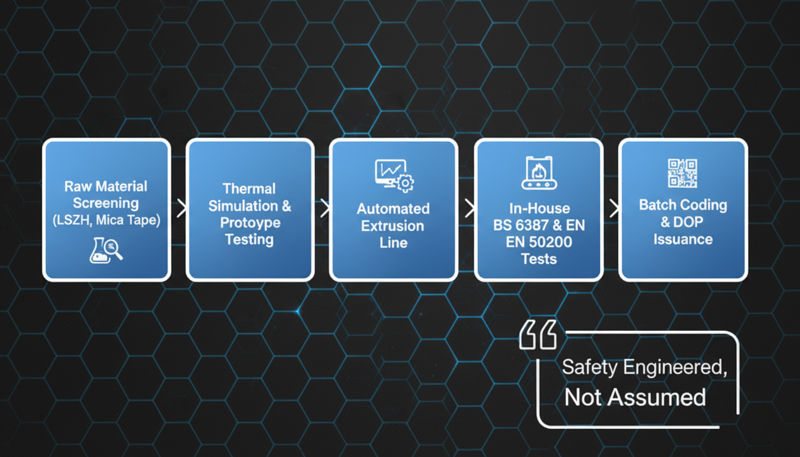
Zion Communication’s design process integrates fire science, material engineering, and real-world application testing. Each cable design begins with:
Thermal Simulation Analysis to predict conductor performance under fire exposure.
Material Screening to ensure compliance with LSZH (Low Smoke Zero Halogen) requirements.
Prototype Fire Endurance Testing is conducted in controlled laboratory conditions before mass production.
Quality-Assured Manufacturing
Every production line at Zion’s facility is equipped with automated extrusion systems, precision wire drawing machines, and laser marking units for complete traceability.
Key internal testing includes:
Fire Resistance Test (950 °C for 3 hours) per BS 6387 Cat C
Water and Impact Resistance Tests (Cat W and Z)
Insulation Integrity Measurement during and after flame exposure
Smoke Density and Toxicity Testing (IEC 61034 & IEC 60754)
Electrical Performance Verification (continuity, capacitance, and voltage withstand)
These in-house procedures guarantee that only cables that meet Zion’s internal QC standards proceed to external LPCB testing — ensuring first-pass approval.

■ Product Construction Example
A typical Zion LPCB-approved fire cable consists of:
Layer | Material | Function |
Conductor | Stranded or solid copper | Ensures stable conductivity during high temperatures |
Insulation | Ceramifiable Silicone Rubber | Maintains circuit integrity up to 950 °C |
Shield (optional) | Aluminum/polyester foil or tinned copper braid | Reduces electromagnetic interference |
Filler & Separator | Fire-resistant mica or glass yarn | Prevents internal combustion spread |
Outer Sheath | LSZH compound (red/orange color) | Limits smoke and corrosive gas emissions |
Each component is carefully selected to achieve fire resistance, mechanical flexibility, and low toxicity, making the cables suitable for life-safety systems.
■ Global Applications of Zion’s LPCB Fire Cables
Data Centers
Zion’s CWZ-rated fire cables power emergency lighting, fire alarms, and control systems in international data centers where zero downtime and minimal smoke emission are critical for protecting both servers and personnel.
Metro and Tunnel Projects
In the case of metro and tunnel projects, such cables assure that communication and ventilation systems are able to operate continuously despite high-temperature exposure, vibration, and mechanical stresses, which they are subjected to.
Hospitals and Healthcare Facilities
Fire cables are of paramount importance to key systems including nurse-call, evacuation alarms, and medical data networks. LSZH insulation from Zion minimizes the Release of toxic fumes emitted to ensure safe evacuation for all the patients.
High-Rise Buildings and Smart Infrastructure
Zion's cables are used with their BMS (Building Management System) to enhance fire safety, signal holding, and aesthetic appeal, making them well-suited to modern architecture.

■ Zion’s Commitment to Compliance and Reliability
Zion Communication ensures:
LPCB-Approved Manufacturing Process
Complete Traceability with batch coding and test certificates
Continuous Audit Support by BRE Global inspectors
Comprehensive Technical Documentation (DoP, CPR, and LPCB certificates)
With a focus on continuous improvement, Zion’s R&D teams regularly upgrade formulations to align with EN 50575 (CPR) and other regional fire-performance directives.
■ Conclusion
Fire safety is not a matter of chance — it is engineered through design discipline, material excellence, and third-party verification.
Zion Communication’s LPCB-approved fire cables exemplify this philosophy, providing peace of mind to engineers, builders, and end-users worldwide.
From design to certification, every meter of cable represents Zion’s unwavering commitment to quality, safety, and trust.
Contact us for more information

Luke Han is a Product Manager and Director at Zion Communication,
Specializing in fire, security, and alarm solutions. With extensive industry experience,
Dedicated to delivering high-performance, reliable products that are tailored to customer needs.
luke@zion-communication.com
0086 19883212162