G.657.A2 vs G.657.B3: Which Fiber Is Better for Ultra-Tight Bends?
Author: Site Editor Publish Time: 01-04-2026 Origin: Site
G.657.A2 vs G.657.B3: Which Fiber for Ultra-Tight Bends?
Choose G.657.A2 as the default option when you need stronger bend performance with steadier G.652.D-aligned deployment logic.
Choose G.657.B3 only when the real installation problem is extremely tight terminal-side routing and very small bend space.
Do not treat B3 as a universal upgrade; it is a tighter-bend specialist, not the broadest low-risk choice.
■ 1) Quick Answer
If you need one practical recommendation, choose G.657.A2 for most indoor, in-home, and mixed-use single-mode deployments. It is the safer engineering default because it combines strong bend resistance with a broader Category A positioning that aligns more cleanly with G.652.D-based project logic. Choose G.657.B3 only when the installation has real ultra-tight routing pressure, such as compact terminal housings, very small loops, or end sections where a 5 mm class design radius materially reduces installation risk.
| Question | Fast Answer | Engineering Reading |
|---|---|---|
| Default indoor fiber choice? | A2 | Better balance of bend performance and broader compatibility logic |
| Ultra-tight device-side or wall-box routing? | B3 | Use when 5 mm class bend capability solves a real space constraint |
| Need lower spec-review risk across projects? | A2 | Safer mainstream choice for broader deployment consistency |

■ 2) What It Is / Definition
G.657.A2 and G.657.B3 are both bend-insensitive single-mode fiber categories, but they are not designed for the same decision priority. A2 is built to deliver stronger bend performance while remaining within the broader Category A logic that is commonly favored when projects want stable interoperability expectations. B3 is built to push bend performance further for ultra-tight routing conditions, especially in short-reach terminal-side environments.
That means the selection question is not simply “which fiber bends more,” but rather “which fiber fits the project’s bend threshold, compatibility boundary, and deployment risk profile better.”
■ 3) What Makes A2 Different from B3
The real difference is design priority, not just tighter bending
A2 is the more balanced engineering option. It is usually preferred when procurement, design, and maintenance teams want one bend-insensitive single-mode type that can fit a broader range of indoor uses. B3 is more specialized. Its value appears when the fiber path becomes extremely tight and the installation margin around terminals, outlets, trays, or equipment is the main problem.
In practice, A2 is easier to use as a default stock and standard project option, while B3 is better treated as a problem-solving choice for the tightest spaces.
■ 4) Minimum Bend Radius Comparison
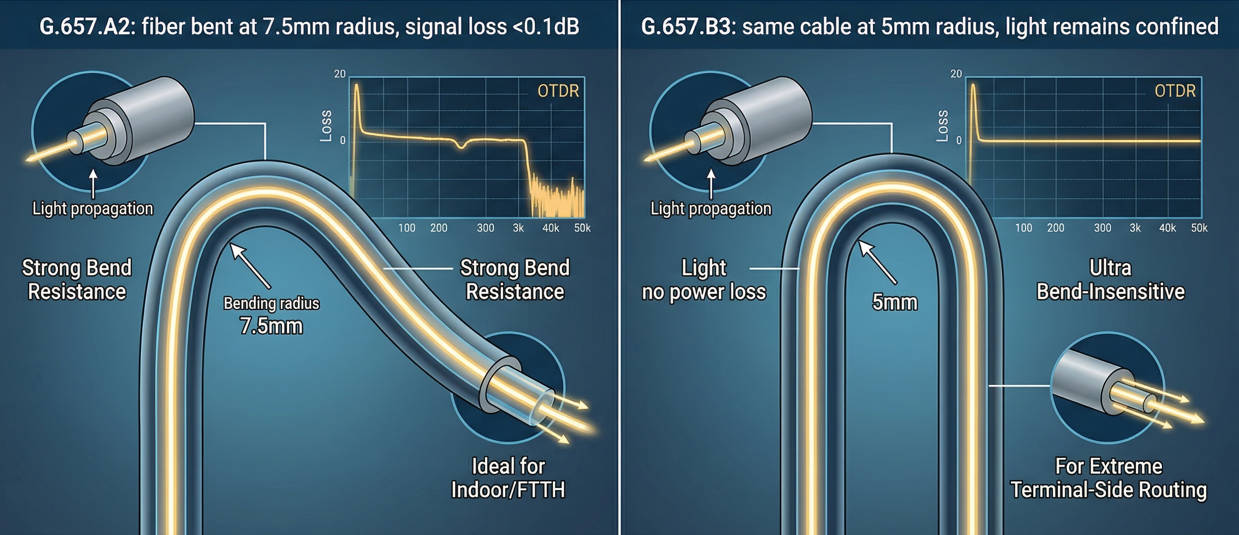
This is the most visible technical difference. A2 is positioned around a 7.5 mm minimum design radius, while B3 is positioned around a 5 mm minimum design radius. The practical meaning is simple: B3 gives more safety margin where the routing geometry is extremely tight, but that does not automatically make it the best full-link choice for every project.
| Item | G.657.A2 | G.657.B3 | What It Means |
|---|---|---|---|
| Category | A | B | Different design priorities |
| Minimum design radius | 7.5 mm | 5 mm | B3 is stronger in ultra-tight routing |
| Default project role | Mainstream bend-insensitive deployment | Tight-space specialist | Use B3 where geometry is the main challenge |
| Over-spec risk | Lower | Higher | B3 can be unnecessary if tight bends are not real |
■ 5) Transmission Compatibility Considerations
This is the most important decision point for engineers and procurement teams. A2 is generally the safer option when projects want stronger confidence around G.652.D-oriented thinking, because Category A is the better fit for broader compatibility expectations. B3 may perform better in tighter bends, but it should be viewed as the narrower, more specialized option.
In other words, A2 is easier to justify when the project wants one practical indoor fiber with lower review friction. B3 is easier to justify when the installer can prove that bend geometry, not general compatibility, is the key deployment issue.
| Compatibility factor | A2 | B3 | Selection effect |
|---|---|---|---|
| Broad project acceptance | Stronger | More limited | A2 is safer as a default spec |
| Use as standard stock item | Easier | More selective | A2 reduces stocking complexity |
| Value in ultra-tight bends | Good | Higher | B3 earns its place only in tighter routing |
| Review / approval burden | Lower | Higher | B3 should be chosen with a clear use-case reason |
■ 6) Decision Rules / Engineer’s Shortcut
The simplest way to decide is to start from the routing geometry and work backward into compatibility and stocking strategy. If the project can be handled safely with A2, there is usually no need to move upward into the more specialized B3 class.
| Project condition | Choose A2 | Choose B3 | Why |
|---|---|---|---|
| General indoor or in-home routing | Yes | Usually no | A2 already covers most bend-sensitive installs |
| Customer wants one broader default fiber type | Yes | No | A2 is easier to standardize |
| Very small wall box, outlet, or terminal loop | Maybe | Yes | B3 adds value in ultra-tight spaces |
| Need lower review friction for mixed projects | Yes | Usually no | A2 is the lower-risk mainstream pick |
| Short-reach terminal-side space is the real constraint | Possible | Strong fit | This is where B3 is justified |
■ 7) When to Choose It
When to choose G.657.A2
Choose A2 when you need one practical default for FTTH indoor routing, in-home wiring, apartment or office indoor runs, and projects where compatibility confidence matters more than chasing the smallest possible bend number. It is also the better choice when procurement wants lower stocking complexity and broader cross-project reuse.
When to choose G.657.B3
Choose B3 when the installation includes compact terminal areas, tight device-side loops, very small wall-box space, or short-reach end sections where the physical routing path is so constrained that the 5 mm class materially reduces stress and handling risk.
When not to choose B3
Do not default to B3 when the project does not actually face extreme bend constraints, when a broader standardized fiber type is preferred, or when the customer wants the lowest review burden across multiple indoor deployment types.
■ 8) Common Mistakes / Risks
This comparison is often misunderstood because teams focus too much on the bend number and not enough on the full project logic.
| Factor | A2 | B3 | Risk / cost reading |
|---|---|---|---|
| Spec acceptance risk | Lower | Higher | A2 is easier to defend as a default choice |
| Inventory simplification | Better | Weaker | A2 reduces operational complexity |
| Value in tight terminal space | Moderate | High | B3 pays off when the geometry is severe |
| Over-spec probability | Lower | Higher | B3 can add narrow specialization without broad project benefit |
■ 9) Application Scenarios
The application boundary is where this comparison becomes practical. A2 covers most normal indoor and in-home work. B3 becomes the better fit when the final section of routing is physically constrained enough to justify tighter-bend specialization.
| Scenario | Better choice | Why | Notes |
|---|---|---|---|
| FTTH indoor drop routing | A2 | Balanced choice for mainstream indoor use | Best default starting point |
| Apartment or office indoor runs | A2 | Easier to standardize and manage | Lower review friction |
| Compact wall box or outlet area | B3 | Better fit for very tight local loops | Use when geometry is genuinely constrained |
| Equipment-side short patching | B3 | More margin for compact device-side spaces | Short-reach focused use |
| Mixed projects with varied customer specs | A2 | More universal engineering logic | Better for broader repeat use |

■ 10) FAQ
■ 11) Final Recommendation
For most engineering teams, the right default answer is G.657.A2. It is the broader, lower-risk option for indoor and in-home fiber deployment because it gives strong bend performance without narrowing the project logic too early. Choose G.657.B3 only when the installation has a proven ultra-tight routing problem and the added bend margin directly solves that problem.
The most effective selection rule is simple: define the bend constraint first, then choose the least specialized fiber that solves it safely. That usually points to A2; only the tightest end-space scenarios should push the decision toward B3.