How to Protect an Outdoor Ethernet Cable
Author: Site Editor Publish Time: 06-08-2020 Origin: Site
Outdoor Ethernet reliability depends on the complete route, not just the cable jacket. A durable installation combines correctly marked cable, weather-rated enclosures and glands, controlled bending and support, appropriate shielding and grounding, surge protection where required, and verified data and PoE performance.
■Start with cable rated for the actual environment
Select cable by its verified markings and datasheet, not by color or a general “outdoor” description. Direct sun exposure calls for a sunlight- or UV-resistant jacket. Wet routes require cable evaluated for wet locations. Direct burial requires a construction specifically identified for underground installation; general outdoor cable is not automatically suitable for direct contact with soil.
| Installation condition | What to verify | Typical protection approach |
| Exposed on a wall or pole | Sunlight resistance, temperature range, water exposure and support spacing | Outdoor-rated jacket, UV-resistant fittings, drip loops and protected entry points |
| Underground in conduit | Wet-location suitability, conduit fill, pulling tension and drainage | Wet-location cable inside a correctly designed underground raceway |
| Direct burial | Direct-burial rating, moisture barrier, soil conditions and mechanical risk | Jelly-filled, water-blocked, double-jacketed or armored construction as the site requires |
| Between buildings | Ground-potential difference, lightning exposure and building-entry protection | Consider fiber to remove the conductive data path; otherwise engineer bonding and surge protection |
Outdoor cable options for different routes
The following ZION constructions illustrate how cable choice changes with category, shielding, pathway and power architecture. Select the exact product only after confirming the route, PoE or separate-power design, grounding plan, conductor material and required cable markings.
Solid bare-copper, unshielded CAT6 with a PE jacket for general outdoor or duct routes where the equipment and EMI assessment do not require shielding. The product page lists PoE and PoE+ support. |
Solid bare-copper CAT6 with foil and braid shielding for electrically demanding outdoor routes. Use it with compatible shielded hardware and a continuous bonding plan; the product page lists PoE and PoE+ support. |
FTP CAT5e + 2C Power + Messenger A combined outdoor CCTV construction with four Cat5e pairs, two separate power conductors and a steel messenger. It is intended for separately powered surveillance architecture, not as the default choice for a standards-based PoE link; verify voltage drop, loading and installation rules. |
Solid bare-copper, unshielded CAT5e with a PE jacket for cost-controlled outdoor or duct routes. It suits many 100/1000 Mb/s devices when the route, environment and PoE load match the product datasheet. |
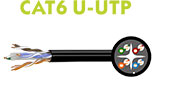
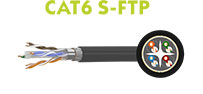
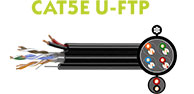
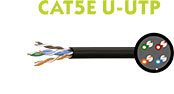
These examples are construction references rather than interchangeable substitutes. Confirm the current datasheet, cable marking, conductor details, shielding, installation method and environmental rating before ordering.
■Protect cable from sunlight, heat, cold and physical damage
Sunlight can embrittle a jacket that has not been evaluated for UV exposure. Choose cable marked for outdoor or sunlight-resistant use and confirm both installation and operating temperature ranges. Polyethylene jackets are common outdoors, but jacket material alone does not prove every environmental rating; the product datasheet and cable marking remain the deciding evidence.

Support the cable with fittings approved for the surface and environment. Do not crush the jacket with overtightened clips, exceed the specified pulling tension, violate minimum bend radius or leave the cable carrying the weight of an enclosure. Protect exposed sections from impact, abrasion, landscaping tools, vehicles, animals and sharp edges.

■Weatherproof connectors and enclosure entries
Use an enclosure, connector and cable gland with an ingress-protection rating suitable for the location. Route the cable downward before it enters the box to form a drip loop, keep the sealing surface clean, use the correct gland size, and tighten the fitting to the manufacturer's instructions. Position openings so water is not directed toward the seal.

A bead of generic sealant is not a substitute for a properly rated enclosure and gland. Unplanned sealant can trap water, interfere with a gasket or make maintenance difficult. If supplemental sealing is permitted, use a material compatible with the enclosure, cable jacket and connector, and preserve any designed drainage or pressure-equalization path.
■Control surge, lightning and grounding risk
No ordinary Ethernet cable can be selected by a single universal “6 kV cable” rule to make an outdoor link lightning-safe. Protection must be designed as a system around the equipment manufacturer's requirements, the site's grounding and bonding network, cable exposure, local lightning conditions and the applicable electrical code.
Follow the camera, access point or outdoor device instructions for shielded cable and grounding.
When shielding is required, maintain a compatible shield path through connectors, couplers, patch panels and the power sourcing equipment.
Bond and ground the PSE, enclosure and surge protective devices according to their instructions and site design.
Install PoE-compatible Ethernet surge protectors at the required building-entry and equipment locations; keep bonding conductors short and correctly routed.
Keep communications cabling separated from power conductors, motors and other strong electromagnetic sources according to the applicable rules.
Use fiber when electrical isolation is the safer architecture For links between buildings, across exposed grounds or in locations with severe lightning and ground-potential risk, fiber removes the conductive data path. The remote device still needs a properly designed local power or PoE source. |
■Protect Ethernet cable in conduit and underground routes
Underground conduit provides mechanical protection and a replaceable pathway, but moisture and condensation can still enter. Treat an underground raceway as a wet environment and use cable evaluated for that exposure. Size the conduit and bends for the cable diameter and pulling limits, seal entries with listed fittings, and provide drainage or water-management details where the design requires them.

For direct burial, select a cable explicitly designed for direct contact with soil. Water-blocking gel, tapes or powders help limit moisture migration, while armor or other mechanical layers may be needed for rocky soil, crushing, rodents or accidental digging. Burial depth, warning tape, route marking, separation and mechanical protection must follow the local authority and site design rather than a universal depth.


ZION's direct-burial outdoor Ethernet cable range includes moisture-blocked, armored and duct-oriented constructions. Match the final product to soil, water exposure, mechanical risk, shielding, PoE load and required compliance documents.
■Keep the channel within Ethernet and PoE limits
Plan a standards-based balanced copper Ethernet channel for a maximum of 100 m between active devices. This is a transmission-channel limit, not a special 91 m underground energy limit. If the route is longer, redesign it with an intermediate active device, a validated extender or a fiber link rather than joining ordinary cable segments.
For PoE, verify the powered device's maximum demand, the PSE's per-port and total budget, conductor resistance, temperature, bundle size and connection quality. Specify standards-compliant solid copper conductors; copper-clad aluminum has higher resistance and is not a substitute for compliant category cable.
■Outdoor Ethernet installation checklist
Document the route: exposed, aerial, wet conduit, direct burial, between buildings or industrial area.
Confirm sunlight, wet-location, burial, temperature, chemical and mechanical requirements.
Verify cable category, solid-copper conductors, shielding construction and PoE suitability.
Select compatible outdoor enclosures, glands, connectors and surge protectors.
Plan grounding, bonding, building-entry protection and separation from power.
Maintain pull tension, bend radius, support spacing, drip loops and service access.
Keep the copper channel within 100 m or change the network architecture.
Test and document wiremap, length and category performance; add PoE resistance checks when the test platform supports them.
For general exposed routes, review ZION's LAN and outdoor Ethernet cable catalog. Product selection should be based on the exact jacket, construction, cable marking and datasheet rather than the category name alone.
■Frequently asked questions
Can indoor Ethernet cable be used outdoors inside conduit?
Do not assume so. Outdoor and underground conduit can contain moisture, and ordinary indoor cable may lack the required wet-location, sunlight or temperature evaluation. Use cable identified for the actual environment.
Is outdoor Ethernet cable waterproof?
“Outdoor” is not a complete specification. Confirm whether the exact cable is evaluated for sunlight, wet locations, water blocking, direct burial or temporary exposure. The required construction depends on the route.
Does shielded Ethernet cable prevent lightning damage?
Shielding can support surge and electromagnetic protection only as part of a continuous, correctly bonded system. It does not make a cable immune to lightning. Follow the equipment instructions and use appropriately installed surge protective devices where required.
How far can outdoor copper Ethernet cable run?
A standards-based balanced copper Ethernet channel is planned for up to 100 m between active devices. Outdoor exposure does not extend that limit. Use active equipment or fiber for longer routes.
What project information is needed before selecting outdoor cable?
Provide the route length, installation method, sunlight and moisture exposure, temperature range, soil and mechanical conditions, EMI environment, data rate, PoE type and load, shielding and grounding plan, required category, jurisdiction and documentation requirements.



 Fiber Optic Tools
Products 6 families
Solutions 6 markets
Resources Tools & docs
Certificate
Certification and compliance references for project review, qualification and purchasing documentation.

 Fiber Optic CableAccess and backbone
 Ethernet CableCat5e to Cat8
 Coaxial CableRF and video signal
 Fire, Security & AlarmSafety systems
 Voice, Audio & VideoSignal cabling
 Power & Control CableEnergy and control
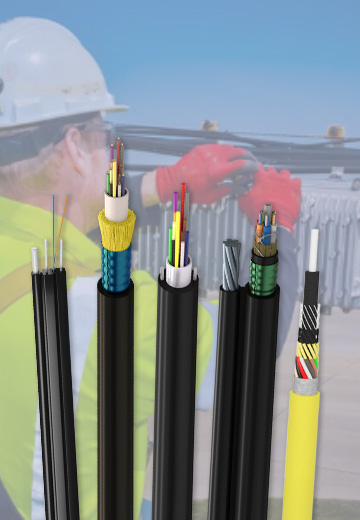
Fiber optic cable systems
Outdoor, indoor, FTTH and distribution cable lines for access networks, backbone routes and campus deployments.
 Telecom & ISP NetworksFTTH, PON, ODN
 Data Center InfrastructureServer room cabling
 Building Low-Voltage SystemsBMS, AV, weak current
 Security & Fire ProtectionAlarm, CCTV, access
 Industrial Automation CablePLC, RS485, fieldbus
 Energy & Power InfrastructureSolar, battery, power
Telecom & ISP Networks
For FTTH / PON access, outdoor fiber deployment, aerial routes, duct routes, direct burial routes, rural broadband and ODN planning.
Tools
Use calculators and planning tools for conduit capacity, PoE voltage drop and fiber optic link loss budget work.