PoE++ Cable Bundle Heat: AWG, Conduit Fill and Cable Selection
Author: Site Editor Publish Time: 28-04-2026 Origin: Site
PoE++ Cable Bundle Heat: AWG, Conduit Fill and Cable Selection
A practical engineering guide for selecting Ethernet cables in high-power PoE++ installations, focusing on conductor size, bundle heat, conduit fill, cable category and project safety margin.
PoE++ increases heat risk because higher current flows through the copper conductors.
23AWG or 24AWG solid copper Cat6A is usually safer for high-power PoE++ and dense cable bundles.
Conduit fill, bundle size and ambient temperature must be checked before cable selection, not after installation.
■ Quick Answer
For PoE++ projects, the safest cable choice is usually a solid copper Cat6A cable with 23AWG or 24AWG conductors, especially when cables are installed in bundles, conduits, ceiling spaces or warm environments. Smaller conductors, tight conduit fill and large cable bundles can increase temperature rise and reduce power-delivery margin.
PoE++ cable selection should not be based only on category name. A Cat6 or Cat6A cable may look suitable on paper, but real performance depends on conductor material, AWG size, cable construction, bundle size, pathway ventilation, ambient temperature and installation length.
If the project includes PoE++ devices, dense cable bundles or long cable runs, avoid thin conductors and CCA cables. Choose solid copper, larger AWG conductors and a cable pathway with enough space for heat dissipation.
■ Why PoE++ Cable Bundles Get Hot
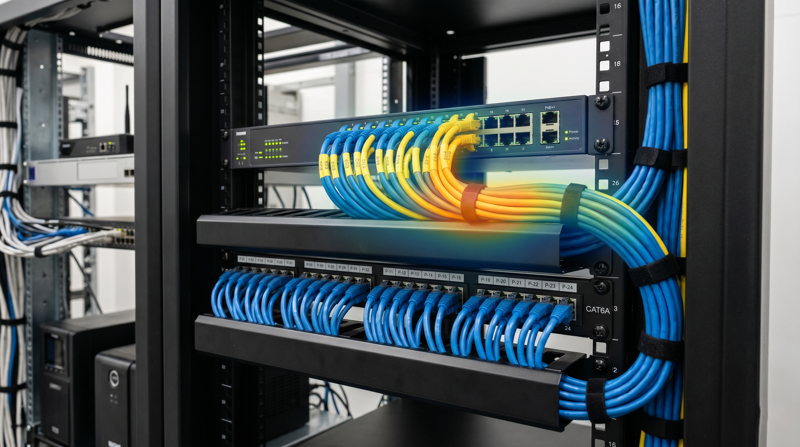
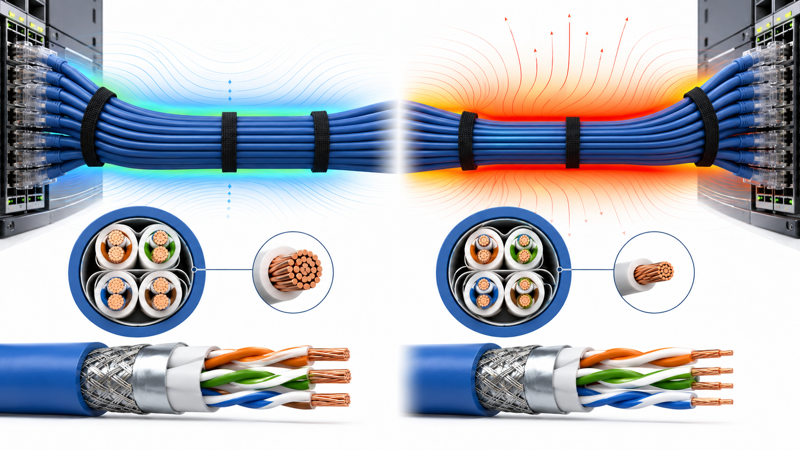
PoE++ delivers both data and power through twisted-pair Ethernet cabling. When current flows through copper conductors, electrical resistance creates heat. One cable may not show a serious temperature rise, but many powered cables bundled together can trap heat inside the bundle.
Heat risk becomes higher when the bundle is large, the pathway is poorly ventilated, the conduit is crowded, the ambient temperature is high, or the conductor size is too small for the power load.
Higher Current
PoE++ devices draw more power than standard PoE devices, increasing thermal stress on cable conductors.
Large Cable Bundles
When many powered cables are bundled together, inner cables have less airflow and may run hotter.
Crowded Pathways
Tight conduit fill, cable trays and ceiling spaces can reduce heat dissipation.
■ AWG and Conductor Size
AWG describes conductor size. A lower AWG number means a thicker conductor. For PoE++ cabling, thicker solid copper conductors generally provide lower resistance, lower voltage drop and better heat performance.
| Conductor Size | PoE++ Suitability | Typical Use | Buyer Note |
|---|---|---|---|
| 23AWG | Excellent | Cat6A permanent links, 10G, PoE++ backbone to devices | Strong option for high-power and longer links. |
| 24AWG | Very good | Cat6/Cat6A links, PoE+ and PoE++ projects | Common and reliable for structured cabling. |
| 26AWG | Limited | Short patch cords, moderate power load | Check length, bundle size and device power carefully. |
| 28AWG | Not preferred for PoE++ bundles | Short high-density patching only | Avoid using as a universal PoE++ cable choice. |
Cable category and AWG are different decisions. Cat6A tells you performance class; AWG tells you conductor size. For high-power PoE++, both matter.
■ Conduit Fill and Bundle Density
Conduit fill affects both installation difficulty and heat dissipation. When too many Ethernet cables are pulled into one conduit, pulling tension increases, bend stress increases and heat has less space to escape.
| Pathway Condition | Heat Risk | Recommended Action | Engineering Logic |
|---|---|---|---|
| Loose cable tray with airflow | Lower | Use proper cable support and spacing. | Airflow helps dissipate heat. |
| Moderate conduit fill | Medium | Check cable diameter and fill ratio. | Cable spacing becomes more important. |
| Tight conduit fill | High | Reduce cable count or use larger conduit. | Heat and installation stress both increase. |
| Large powered bundle | High | Split bundles or improve ventilation. | Inner cables can become hotter than outer cables. |
■ Cable Selection Rules for PoE++
For PoE++ installations, the cable should be selected as part of the whole power and pathway system. Do not select cable only by price or color.
| Selection Factor | Preferred Choice | Why It Matters | Avoid |
|---|---|---|---|
| Conductor Material | Solid bare copper | Better conductivity and lower heat rise. | CCA for PoE++ power delivery. |
| Conductor Size | 23AWG or 24AWG | Lower resistance and better power margin. | Very thin conductors in large bundles. |
| Cable Category | Cat6A for 10G and high-performance links | Better alien crosstalk and bandwidth margin. | Underspecified cable for future upgrades. |
| Jacket Rating | CMR, CMP, LSZH or project-required rating | Must match building code and installation area. | Wrong flame rating for plenum or riser spaces. |
| Shielding | UTP or shielded based on EMI environment | Shielding can improve EMI resistance when grounded correctly. | Shielded cable without a grounding plan. |
■ Heat Risk Levels
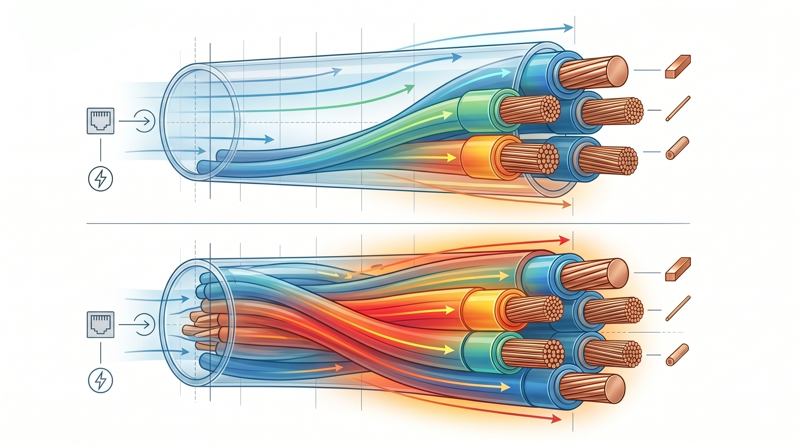
The following risk guide helps buyers and installers quickly understand when cable bundle heat becomes a design concern.
Solid copper Cat6A, larger conductor size, moderate bundle, good ventilation and controlled ambient temperature.
Moderate conduit fill, mixed PoE loads, longer runs or limited airflow. Check bundle size and pathway design.
CCA cable, thin conductors, tight conduit fill, large powered bundles or high ambient temperature.
■ Application Scenarios
PoE++ cabling is becoming more important as more devices require both higher data performance and higher power delivery through one Ethernet cable.
Wi-Fi 6 / Wi-Fi 7 Access Points
High-performance access points may require higher PoE power and stable cabling in ceilings or conduits.
IP Cameras and Security Systems
PTZ cameras, heaters and outdoor security devices can increase power demand and cable stress.
Smart Buildings and IoT Devices
Lighting, sensors, access control and building automation systems can create many powered cable bundles.
■ Decision Rules / Engineer’s Shortcut
The correct cable is the one that matches the device power, link length, bundle size and installation pathway. Use the table below as a practical decision shortcut.
| Project Condition | Recommended Cable Choice | Reason | Checkpoint |
|---|---|---|---|
| PoE++ access points | Solid copper Cat6A, 23/24AWG | Better power and data margin. | Check ceiling pathway and temperature. |
| Large powered cable bundle | Larger conductor, split bundles if possible | Reduces temperature rise. | Check bundle count and airflow. |
| Tight conduit route | Reduce fill or use larger conduit | Improves pulling and heat dissipation. | Calculate cable OD and conduit fill. |
| Budget-sensitive low-power links | Standard Cat6 solid copper | Acceptable for lower power and moderate density. | Do not use CCA for powered links. |
| Future-ready smart building | Cat6A solid copper | More margin for 10G, PoE++ and device upgrades. | Plan pathway capacity early. |
For PoE++ plus dense cable bundles, start with Cat6A solid copper 23AWG or 24AWG, then verify conduit fill, bundle size, ambient temperature and device power budget.
■ OEM Ordering Notes
For OEM buyers and project contractors, cable selection should be locked before mass production. Confirm the cable specification based on installation environment, not only based on product category.
Electrical Specification
Confirm Cat6 or Cat6A, solid copper conductor, AWG size, resistance and PoE application level.
Installation Environment
Confirm conduit size, cable tray, ceiling space, outdoor route, ambient temperature and bundle density.
Compliance and Packaging
Confirm jacket rating, labeling, carton mark, OEM brand, test report and project delivery schedule.
For PoE++ projects, the safest RFQ includes cable category, AWG size, conductor material, jacket rating, cable OD, pathway condition, bundle size and target device power.
■ FAQ
What cable is best for PoE++?
Solid copper Cat6A with 23AWG or 24AWG conductors is usually a safer choice for PoE++ projects, especially in longer links or dense bundles.
Does PoE++ require Cat6A?
Not always, but Cat6A provides better performance margin for 10G, higher-density cabling and future-ready installations.
Why is CCA cable risky for PoE++?
CCA has higher resistance than solid copper, which can increase voltage drop and heat risk in powered Ethernet links.
Does conduit fill affect PoE heat?
Yes. Crowded conduits and large bundles reduce heat dissipation and may increase cable temperature rise.
Can 28AWG patch cords be used for PoE++?
They may be used only in carefully controlled short links, but they are not preferred for dense PoE++ bundles or long powered links.
What should buyers confirm before ordering?
Confirm AWG size, conductor material, cable category, jacket rating, cable OD, pathway, bundle size, PoE level and test requirement.
Need Ethernet Cable for PoE++ Projects?
ZION Communication can support solid copper Cat6 and Cat6A Ethernet cables for PoE, PoE+ and PoE++ applications, including project-based cable selection, jacket rating, OEM packaging and structured cabling requirements.