Standard Loss vs Low Loss MPO Connectors: What’s the Difference and Which Should You Buy?
Author: Site Editor Publish Time: 20-03-2026 Origin: Site
Standard Loss vs Low Loss MPO Connectors
A practical engineering guide to insertion loss, link-budget impact, testing thresholds, and purchase decisions for MPO-based optical channels.
Standard loss MPO is usually acceptable for short, simple channels with adequate optical margin.
Low loss MPO becomes the safer choice when the channel includes multiple mated pairs, higher speeds, or stricter certification limits.
Buy against guaranteed maximum insertion loss and defined test criteria, not against a generic “low loss” label.
In MPO systems, the connector choice is not only a hardware detail. It directly affects insertion loss, available link margin, pass/fail risk during certification, and how much flexibility remains for future upgrades. For buyers comparing standard loss and low loss MPO assemblies, the real question is not which option sounds better on paper, but which one matches the channel architecture and the cost of failure.
This page is written as an engineering decision reference for projects involving MPO trunks, patch cords, cassettes, and parallel optics deployment. It focuses on thresholds, tradeoffs, and purchase controls rather than general marketing language.
■ 1) What It Is / Definition
Insertion loss is the optical power lost when light passes through a connector interface. In MPO systems, the number that matters most for selection is the connector or mated-pair loss used in the channel budget. Even a small difference per interface becomes important when a link includes trunks, cassettes, adapters, and patching points.
In practical terms, the market usually distinguishes two grades:
| Connector Grade | Typical Market Position | Common Max IL Target | Main Buying Logic |
|---|---|---|---|
| Standard Loss MPO | General-purpose structured cabling | Commonly ≤ 0.75 dB | Lower upfront cost for simpler links |
| Low Loss MPO | Performance-oriented or tighter-budget links | Commonly ≤ 0.35 dB | More margin, lower risk, better upgrade headroom |
■ 2) Types / Categories
The distinction between standard loss and low loss usually comes from the connector assembly quality, ferrule geometry control, fiber alignment accuracy, polishing consistency, and endface condition. The external product appearance may be similar, but the performance tolerance is different.
Standard Loss MPO
This option is commonly used in conventional enterprise or structured cabling projects where the channel is short, the number of mated pairs is limited, and the optical budget is not highly constrained.
Low Loss MPO
This option is intended for higher-performance channels where each decibel matters more. It is often specified for higher-speed data center links, multi-connector architectures, or projects where commissioning failure is expensive.
| Factor | Standard Loss MPO | Low Loss MPO |
|---|---|---|
| Typical application level | General projects | Tighter or higher-speed projects |
| Manufacturing tolerance | Standard | Tighter |
| Link margin contribution | More limited | More comfortable |
| Project risk profile | Higher if the budget is tight | Lower in demanding channels |
| Cost | Lower | Higher |
■ 3) How It Works in Link Budgets
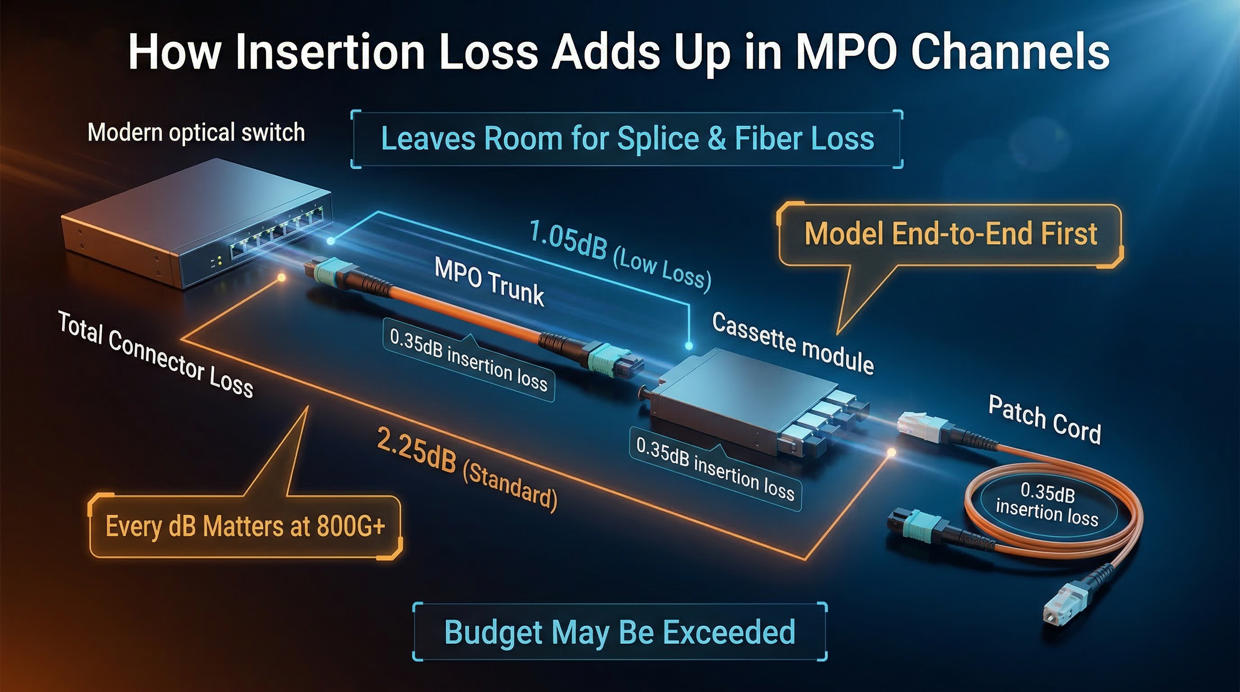
The cumulative nature of connector loss is the reason the distinction matters. A single MPO interface may not look critical in isolation, but a real deployment often includes several interfaces. Each one consumes part of the available link budget before fiber attenuation, splice loss, and system margin are added.
| Example Channel | Mated Pairs | Per-Pair IL Assumption | Total Connector Loss | Engineering Result |
|---|---|---|---|---|
| Standard loss channel | 4 | 0.75 dB | 3.0 dB | May consume a large part of the budget |
| Low loss channel | 4 | 0.35 dB | 1.4 dB | Leaves more margin for design and testing |
This difference becomes more important in channels with cassettes, cross-connect points, or migration plans toward 40G, 100G, 200G, and 400G parallel optics. The more interfaces in the path, the less tolerance there is for connector loss inflation.
■ 4) Common Mistakes / Risks
The most common buying and deployment errors are not technical mysteries. They are usually control failures in specification, acceptance criteria, or channel planning.
| Common Mistake | Why It Happens | Project Risk | Control Measure |
|---|---|---|---|
| Buying on label only | “Low loss” is treated as self-explanatory | Unclear acceptance level | Specify guaranteed max IL in PO or spec |
| Using typical values as guarantees | Datasheets emphasize best-case numbers | Budget is overstated | Separate typical IL from maximum IL |
| Ignoring total channel architecture | Components are evaluated one by one | Unexpected cumulative loss | Model end-to-end loss before purchase |
| Overbuying low loss for every link | No threshold-based selection rule | Unnecessary cost increase | Use application-specific decision rules |
| Weak field testing discipline | Cleaning, polarity, or reference issues | False failures or hidden defects | Agree test method and documentation in advance |
■ 5) Decision Rules / Engineer’s Shortcut
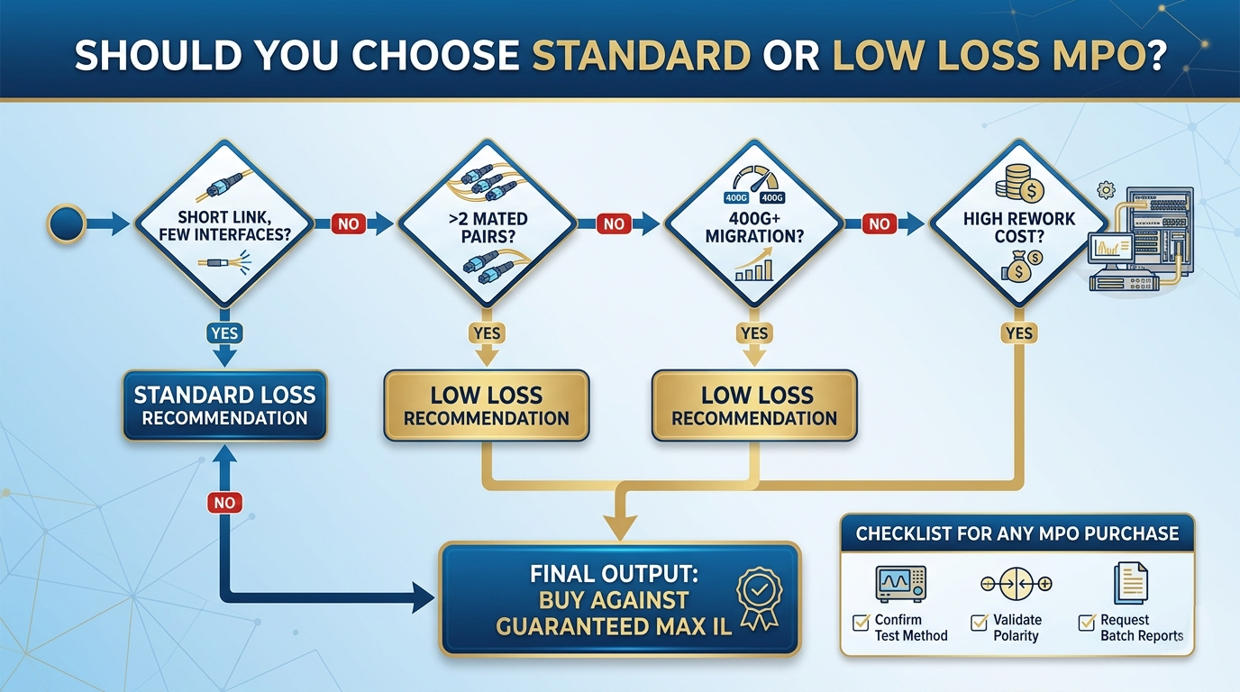
For fast decision-making, the connector grade should follow the channel difficulty, not habit. The table below is a practical shortcut for engineering teams and buyers who need a quick recommendation path.
| Channel Condition | Use Standard Loss MPO | Use Low Loss MPO | Decision Logic |
|---|---|---|---|
| Short link, few interfaces, generous margin | Yes | Optional | Cost control is reasonable |
| Multiple MPO mated pairs in one channel | Possible but risky | Recommended | Cumulative loss becomes significant |
| Higher-speed parallel optic link | Usually not preferred | Recommended | Lower margin means lower tolerance to connector loss |
| Commissioning failure would be expensive | Not ideal | Recommended | Rework cost may exceed component savings |
| Future migration expected | Acceptable for current use only | Preferred | Preserves budget for upgrades |
| Very cost-sensitive project with simple layout | Recommended | Only if justified by budget model | Do not over-specify without engineering reason |
■ 6) Application Scenarios
Different project types do not require the same loss grade. A selection that is reasonable in a simple enterprise backbone may be too weak for a denser, higher-speed or more modular architecture.
| Application Scenario | Preferred Grade | Reason | Procurement Note |
|---|---|---|---|
| Short enterprise backbone | Standard loss | Simple layout, moderate performance pressure | Confirm max IL and polarity only |
| Data center trunk with cassettes | Low loss | Multiple interfaces increase cumulative loss | Ask for assembly-level test data |
| 40G/100G parallel optic link | Low loss | Link budget is tighter | Model the full channel before ordering |
| Staged upgrade project | Low loss | Preserves room for future architecture changes | Consider long-term cost, not only initial PO |
| Simple lab or internal short patching | Standard loss | Often enough when the path is controlled | Avoid premium grade without budget justification |
■ 7) Testing and Acceptance
Performance should be verified at the same level it is purchased. If the project is bought on a maximum insertion loss threshold, then acceptance should reference that threshold using a defined method and documented result format.
Recommended acceptance controls
Separate typical insertion loss from guaranteed maximum insertion loss.
Confirm whether the value applies to connector, mated pair, or full assembly.
Request factory test reports for critical batches or assemblies.
Define field test method, polarity verification, and cleaning discipline before delivery.
Test the complete installed channel, not just individual loose components.
■ 8) Procurement Notes
From a commercial perspective, the decision is not simply “cheaper vs better.” The real comparison is component cost against failure cost, retest cost, design margin, and future upgrade constraints.
| Procurement Factor | Standard Loss MPO | Low Loss MPO | Commercial Implication |
|---|---|---|---|
| Unit price | Lower | Higher | Savings are visible at PO stage |
| Certification margin | Less forgiving | More forgiving | May reduce commissioning friction |
| Rework exposure | Higher in tight channels | Lower | Important where site access is expensive |
| Upgrade readiness | Moderate | Better | Useful for staged network growth |
| Best buying use case | Budget-controlled simple link | Performance-controlled channel | Match selection to link risk, not preference |
Recommended procurement checks before placing an order:
Specify required maximum insertion loss in the technical specification or purchase order.
Confirm polarity method, fiber count, connector gender, and assembly structure.
Ask whether test values are typical or guaranteed maximums.
Request batch traceability or reports for critical projects.
Align field acceptance logic with supplier declarations before shipment.
■ 9) FAQ
Is low loss MPO always required for data center links?
No. It depends on the full channel design. For short links with limited connection points and adequate optical margin, standard loss MPO may be sufficient. Low loss becomes more important as the number of interfaces, transmission speed, or commissioning risk increases.
Can standard loss and low loss MPO components be mixed in one system?
They can be physically used within the same broader system if the connector format and polarity architecture match, but the total link budget must be recalculated at channel level. Mixing grades without budget verification can create hidden margin problems.
Should buyers evaluate typical insertion loss or maximum insertion loss?
For procurement and acceptance, maximum insertion loss is the more important control value. Typical values can help compare product quality, but they should not replace guaranteed pass/fail thresholds in project specifications.
Does low loss MPO reduce project cost in the long run?
In many performance-sensitive projects, yes. Although unit price is higher, low loss can reduce the likelihood of retesting, redesign, and site rework. The value is strongest where failure cost is higher than the connector price difference.
What should be confirmed with the supplier before ordering?
Confirm guaranteed maximum insertion loss, test method, assembly configuration, polarity, connector gender, fiber count, and whether batch reports or inspection records can be provided for the shipment.
■ 10) Conclusion
Standard loss and low loss MPO connectors serve different engineering priorities. Standard loss is a rational option for simple and cost-sensitive channels. Low loss is a stronger fit where the design includes multiple interfaces, tighter optical budgets, higher-speed optics, or limited tolerance for commissioning failure.
The most reliable selection method is straightforward: define the channel architecture first, calculate the loss budget second, and buy against guaranteed performance values third. That process reduces the chance of both under-specification and unnecessary overbuying.
For engineering teams and procurement managers, the practical advice is to treat insertion loss as a channel control issue, not only a connector feature. Once that mindset is clear, the standard loss versus low loss decision becomes much easier and more defensible.
Need help selecting standard loss or low loss MPO assemblies for your channel design? Send your fiber count, connector type, polarity method, target application, and insertion loss requirement. ZION can support matching datasheets, assembly options, and project quotation references.