What Does 10/100/1000 Base-T Mean? | Ethernet Speed Guide
Author: Michael Publish Time: 04-01-2026 Origin: Site
What Does 10/100/1000 Base-T Mean?
A Practical Ethernet Speed Guide for Modern Networks (1G → 800G)
This ZION COMMUNICATION guide explains 10BASE-T, 100BASE-TX, 1000BASE-T (Gigabit), Multi-Gig (2.5G/5G), 10GBASE-T, and what happens beyond 25G/50G/100G where fiber becomes the dominant medium in real networks.
■ 1) What Does “Base-T” Mean in Ethernet?
Base-T is an Ethernet naming convention that defines how data is transmitted over twisted-pair copper. It’s a shorthand used by network engineers, IT managers, and procurement teams to quickly map speed to cabling requirements.
Base = baseband transmission
T = twisted-pair copper cable
10 / 100 / 1000 = maximum data rate in Mbps
■ 2) Evolution of Base-T Ethernet Speeds
Here are the most common copper Ethernet standards and what they typically require:
| Ethernet Standard | Max Speed | Typical Cable | Max Distance |
|---|---|---|---|
| 10BASE-T | 10 Mbps | Cat3+ | 100 m |
| 100BASE-TX | 100 Mbps | Cat5 | 100 m |
| 1000BASE-T | 1 Gbps | Cat5e / Cat6 | 100 m |
| 2.5GBASE-T | 2.5 Gbps | Cat5e / Cat6 | 100 m |
| 5GBASE-T | 5 Gbps | Cat6 | 100 m |
| 10GBASE-T | 10 Gbps | Cat6A (recommended) | 100 m |

■ 3) Why 1000BASE-T Became the Enterprise Baseline
1000BASE-T (Gigabit Ethernet) became the global baseline because it delivers reliable 1G performance over standard structured cabling. It also uses all four twisted pairs, supports full-duplex communication, and remains backward compatible with 10/100 Mbps equipment.

■ 4) Multi-Gig Ethernet (2.5G & 5G Base-T)
Multi-Gig Ethernet (2.5G/5G) was introduced to support modern access-layer demand—especially Wi-Fi 6/6E, higher uplink capacity, and PoE+ / PoE++ devices—without forcing immediate fiber upgrades.
| Speed | Typical Use | Recommended Cable |
|---|---|---|
| 2.5GBASE-T | Wi-Fi 6 AP uplinks | Cat5e / Cat6 |
| 5GBASE-T | High-density PoE & AV | Cat6 (preferred) |
■ 5) 10GBASE-T: The Practical Upper Limit for Copper
10GBASE-T is widely used in enterprise backbones and data-center horizontal links, but it demands higher performance cabling.
| Cable | Typical 10G Support | Recommendation |
|---|---|---|
| Cat6 | ≤55 m (typical) | Short runs only |
| Cat6A | 100 m (standard) | Best for new installs |
■ 6) 25G to 800G: What Changes Beyond Base-T?
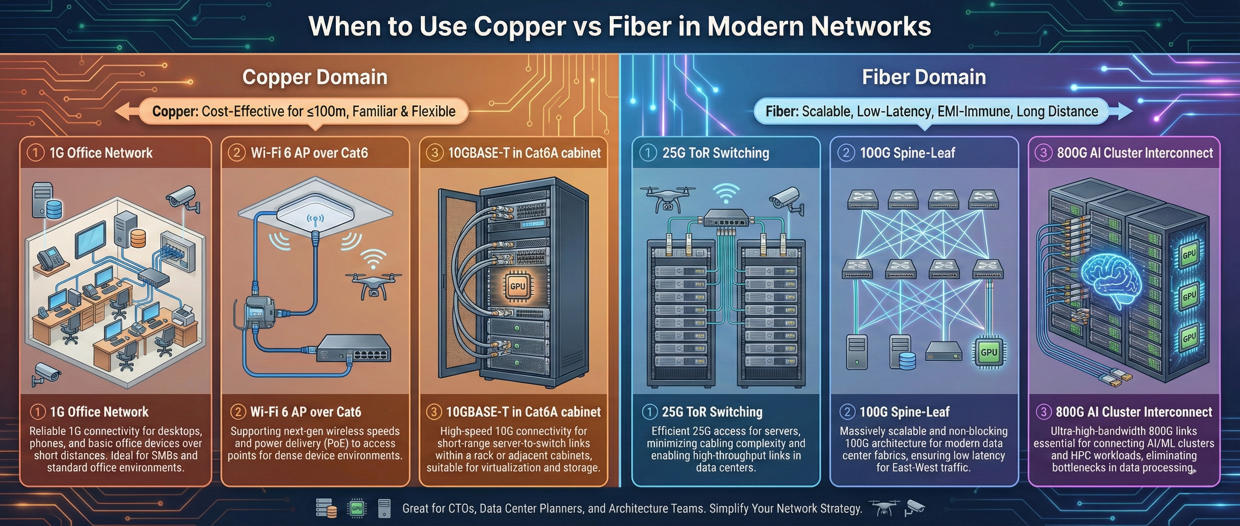
Here’s the critical point: 50G / 100G / 400G / 800G Ethernet speeds are real industry standards—but they are not classic Base-T over structured twisted-pair copper. In real-world deployments, these speeds are primarily delivered via optical fiber or DAC/AOC interconnects.
| Ethernet Speed | Typical Medium | Typical Use |
|---|---|---|
| 25G | Fiber / DAC | ToR switching |
| 40G | Fiber | Aggregation |
| 50G | Fiber / DAC | AI / cloud leaf |
| 100G | Fiber | Core / spine |
| 200G | Fiber | AI clusters |
| 400G | Fiber | Hyperscale DC |
| 800G | Fiber | Next-gen AI fabric |
■ 7) 25GBASE-T / 40GBASE-T Over Cat8: Real but Limited
Cat8 can support 25G/40G over copper, but distance is limited to short data-center interconnects (typically ≤30 meters). For most enterprise networks, Cat6A remains the best long-run copper choice, while fiber is preferred for higher speeds.
| Standard | Cable | Max Distance | Typical Use |
|---|---|---|---|
| 25GBASE-T | Cat8 | ≤30 m | Row / rack adjacency |
| 40GBASE-T | Cat8 | ≤30 m | Rare deployments |
■ 8) Why High-Speed Ethernet Moves to Fiber
As frequency increases, copper faces exponential insertion loss and crosstalk challenges. Optical fiber delivers massive bandwidth headroom, EMI immunity, and longer reach—making it the default path for 25G and beyond.
| Factor | Copper (Base-T) | Optical Fiber |
|---|---|---|
| Bandwidth headroom | Limited | Excellent |
| EMI immunity | Medium (depends on shielding) | High |
| Distance scalability | Limited | Long |
| Power per bit (at scale) | Higher | Lower |
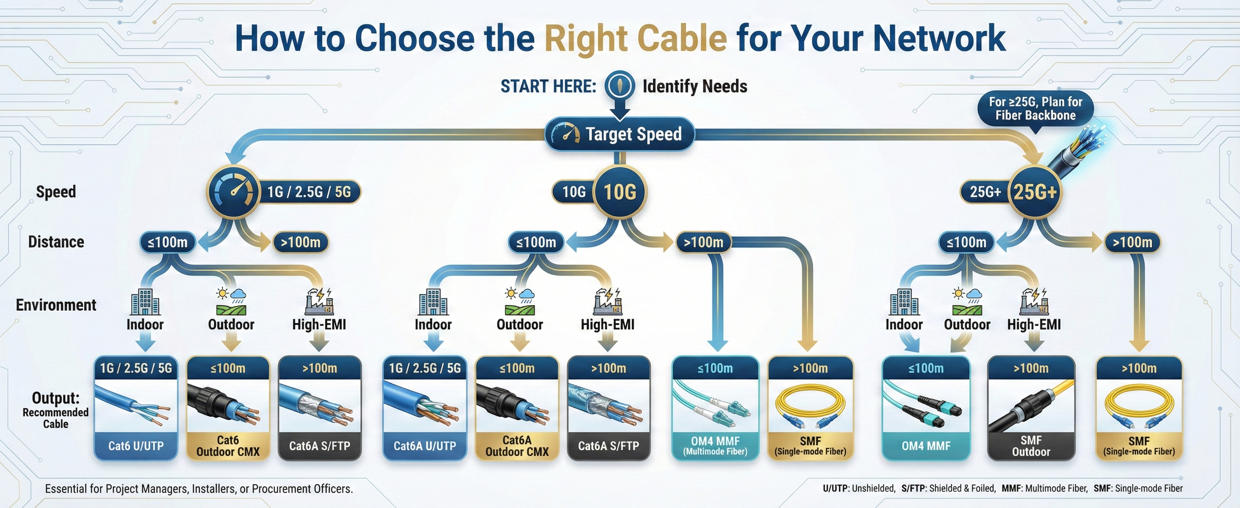
■ 9) Practical Cable Selection Guide (Engineer + Procurement View)
| Target Speed | Recommended Medium | Best Fit Scenarios |
|---|---|---|
| 1G | Cat5e / Cat6 | Office, commercial structured cabling |
| 2.5G–5G | Cat6 (FTP preferred) | Wi-Fi 6 APs, PoE++, AV systems |
| 10G | Cat6A S/FTP | Enterprise future-proof, high EMI, DC horizontal |
| ≥25G | Fiber (SM/MM) / DAC / AOC | Data centers, AI clusters, core networks |
■ 10) Auto-Negotiation & Speed Downgrade
Most Ethernet ports support auto-negotiation: devices choose the highest common speed and will downgrade if cabling or termination cannot meet requirements. If a gigabit link drops to 100 Mbps, the root cause is often installation quality.
■ 11) Common Deployment Mistakes (Avoid These)
Wrong connector for cable OD (e.g., Cat6 plug on Cat6A cable)
Shield not properly grounded in STP/FTP systems
Bend radius violations at patch panels
Indoor cable used outdoors (UV/moisture damage)
■ 12) FAQ
Q: Can Cat5e support 1000BASE-T (Gigabit Ethernet)?
A: Yes. High-quality Cat5e supports 1G up to 100 m in structured cabling.
Q: Is Cat6 enough for 10G?
A: Typically only for short runs (often ≤55 m). For full 100 m compliance, use Cat6A.
Q: Do I need Cat8 for future-proofing?
A: In most enterprise buildings, Cat6A is the best practical choice. Cat8 is mainly for short data-center interconnects (≤30 m).

michael@zion-communication.com
+86 13757188184