Why 50G/100G Ethernet Is No Longer Copper-Based
Author: Michael Publish Time: 04-01-2026 Origin: Site
Why 50G / 100G Ethernet Is No Longer Copper-Based
The engineering reality behind modern high-speed networks
— with an ESG “Energy per Bit” perspective.
Network EngineersData Center ArchitectsIT ManagersProject ProcurementESG / Green DC
50G / 100G Ethernet is fiber-native, not an extension of Base-T copper.
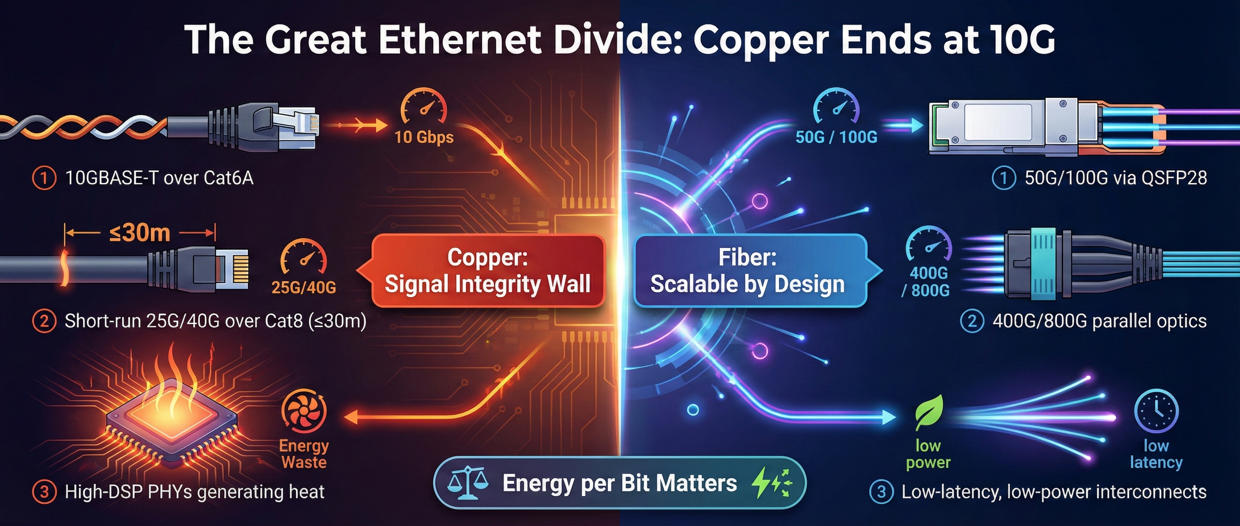
Cat8 supports 25G/40G only at short distances (≤30 m).
Measured by Energy per Bit, optical links are often the greener choice beyond 10G.
■ 1) Executive Summary
50G and 100G Ethernet are not faster versions of 10GBASE-T. They mark a fundamental transition in Ethernet architecture—from twisted-pair copper cabling to fiber-centric connectivity.
Copper Ethernet reaches a practical limit at 10GBASE-T.
25G/40G BASE-T exist as short-distance transitional options (typically ≤30 m).
50G / 100G / 400G / 800G are implemented primarily via optical fiber and high-speed interconnects.
For modern IT, Energy per Bit (W/Gbps) increasingly defines what is “future-proof” and “green”.
■ 2) A Common Misunderstanding: Speed ≠ Better Copper
A frequent assumption is that Ethernet speed evolves the same way copper categories do: “Cat6 → Cat6A → Cat8 → (maybe Cat9) → 100G”. This is misleading.
■ 3) The Physical Limits of Copper Beyond 10G
3.1 Frequency Wall
As Ethernet speed increases, operating frequency rises sharply. At GHz-level frequencies, copper impairment grows exponentially, not linearly.
| Ethernet Speed | Approx. Frequency Level |
|---|---|
| 1GBASE-T | ~100 MHz |
| 10GBASE-T | ~500–600 MHz |
| 25GBASE-T | >1.6 GHz |
| 40GBASE-T | >2.0 GHz |
3.2 Insertion Loss & Crosstalk Escalation
Insertion loss rises rapidly at high frequencies
Near-end / far-end crosstalk becomes harder to suppress
Alien crosstalk (between adjacent cables) turns into a system-level problem
Even with heavy shielding and thicker conductors, Cat8 is typically limited to ≤30 meters for 25G/40G applications in controlled environments.
3.3 Power & Heat: The Hidden Constraint
High-speed copper needs complex DSP (echo cancellation, crosstalk mitigation, high-frequency analog front-ends). This makes ≥10G copper interfaces power-hungry, increasing port heat density and cooling requirements—especially at data-center scale.

■ 4) Standards Direction: Base-T Copper vs Optical Ethernet
Ethernet evolution is driven by IEEE 802.3 standards. The roadmap clearly separates into two tracks: a limited copper Base-T track and a mainstream optical track for higher speeds.
| Standard | Cable | Max Distance |
|---|---|---|
| 10GBASE-T | Cat6A | 100 m |
| 25GBASE-T | Cat8 | ≤30 m |
| 40GBASE-T | Cat8 | ≤30 m |
| Speed | Typical Implementation | Typical Use |
|---|---|---|
| 25G | Single-lane optics / DAC | ToR switching |
| 50G | Single / parallel optics | AI & cloud leaf |
| 100G | 4 × 25G lanes | Spine / core |
| 400G | 8 × 50G lanes | Hyperscale DC |
| 800G | 8 × 100G lanes | AI fabric |
■ 5) Why Cat8 Is Not a 100G Copper Future
Cat8 is often misunderstood as “enterprise future-proof copper”. In reality, it is designed for short-reach data-center interconnects with strict length limits (≤30 m). It is not intended to replace structured cabling across buildings or campuses.
■ 6) How 50G / 100G Ethernet Is Actually Delivered
High-speed Ethernet is delivered using parallel lanes (multiple channels operating together). This is why data centers use QSFP modules and parallel fiber assemblies.
| Aggregate Speed | Lane Structure (Typical) |
|---|---|
| 50G | 1 × 50G |
| 100G | 4 × 25G |
| 400G | 8 × 50G |
| 800G | 8 × 100G |
■ 7) Green Data Center View: Energy per Bit (ESG Perspective)
Under ESG reporting, carbon neutrality goals, and rising electricity costs, modern network design is evaluated not only by bandwidth and latency, but also by Energy per Bit (W/Gbps)—how much power is required to transmit each unit of data.
7.1 Why 10GBASE-T Is Energy-Inefficient at Scale
High-speed copper requires complex DSP, echo cancellation, and crosstalk mitigation
PHY complexity increases power draw and heat density per port
More heat increases cooling demand—often the hidden cost in data centers
7.2 Why Optical Ethernet Can Be “Greener”
Optical transmission avoids many high-frequency copper correction penalties
Higher aggregate bandwidth reduces the number of required ports and links
Less port count → fewer PHYs → lower heat → improved cooling efficiency

■ 8) Practical Decision Rules for Professionals
Is the channel longer than 30 meters? → Choose fiber.
Is a 5–10 year lifecycle required? → Avoid relying on high-frequency copper as the core path.
Are power efficiency and density critical? → Fiber typically offers better Energy per Bit.

■ 9) Conclusion
Copper Ethernet has not failed—it has simply reached its optimal domain. For most structured cabling projects, Cat6A remains the best long-term choice up to 10G. For next-generation networks, 50G and above are fiber-native by design.

michael@zion-communication.com
+86 13757188184