Batch Test Certificate vs Type Test Report: Key Differences for Cable Buyers
Author: Site Editor Publish Time: 17-04-2026 Origin: Site
Batch Test Certificate vs Type Test Report: What Is the Difference?
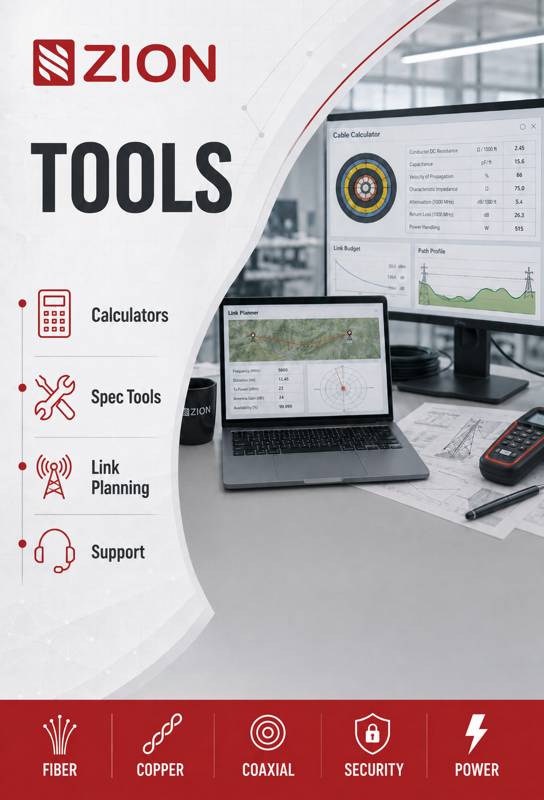
A Batch Test Certificate and a Type Test Report are both important quality documents, but they solve different problems. One helps buyers verify the specific lot being shipped. The other helps engineers verify that the product design or model has already been technically validated. For procurement teams, project managers, and system integrators, understanding this difference is essential to reduce approval risk, shipment disputes, traceability gaps, and specification mismatch.
Batch Test Certificate = evidence for the actual batch, lot, reel, or shipment.
Type Test Report = evidence for the product design, model, or construction.
For serious projects, one should not replace the other.
■ Direct Answer
A Batch Test Certificate is mainly used to confirm that the specific batch being supplied has passed the relevant factory checks, release tests, or lot-based inspection requirements. A Type Test Report is mainly used to confirm that the product design or model has already been tested against the applicable technical standard, construction requirement, or performance criteria. In practical terms, the first document is linked to shipment traceability and acceptance, while the second is linked to design qualification and technical approval.
For engineers and buyers, the decision rule is simple: if the question is “Can we approve this product design?”, review the Type Test Report. If the question is “Can we accept this actual delivery?”, review the Batch Test Certificate. On higher-risk projects, both should be requested and reviewed together.
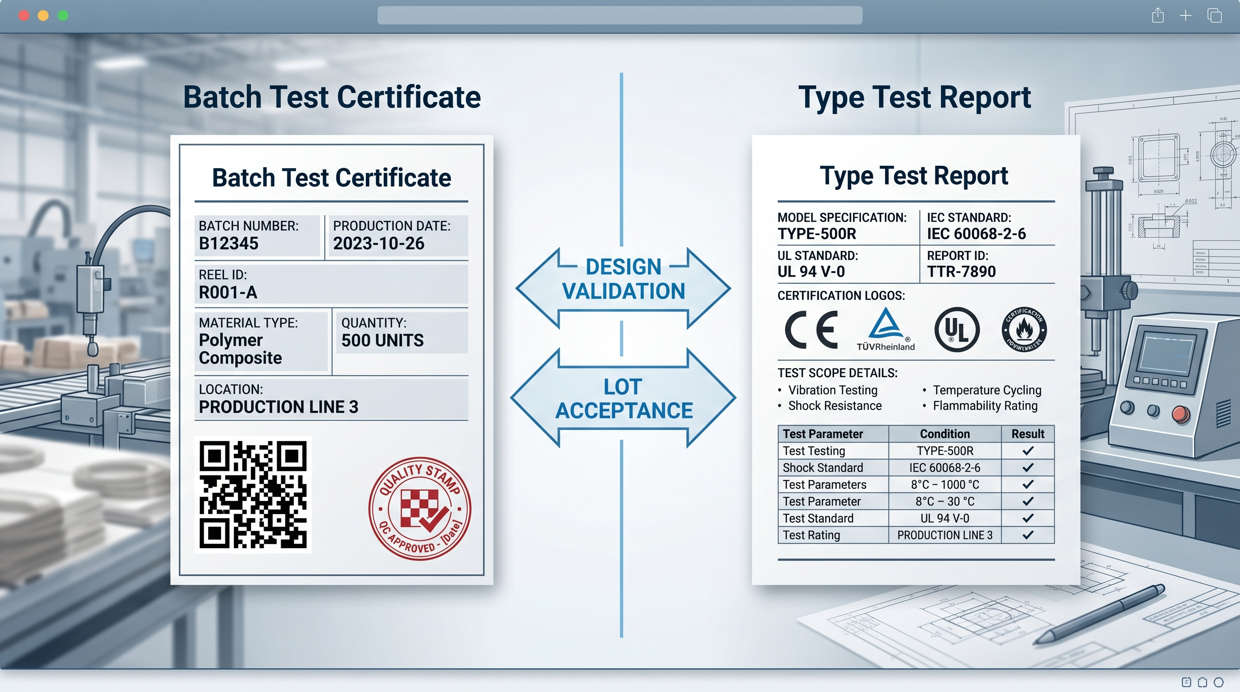
| Point | Batch Test Certificate | Type Test Report |
|---|---|---|
| Primary purpose | Shipment, lot, or reel acceptance | Design, model, or construction validation |
| Focus | Actual supplied goods | Representative product sample |
| Project stage | Pre-shipment, receiving, project handover | Prequalification, submittal review, approval stage |
| Typical identifiers | Batch no., lot no., reel no., production date | Model, construction, standard, report no. |
| Core buyer question | Did this batch pass? | Has this product type been validated? |
A Type Test Report supports engineering confidence. A Batch Test Certificate supports delivery confidence. Projects fail when one of these is missing at the wrong stage.
Using the wrong document for the wrong decision can lead to acceptance disputes, weak traceability, specification mismatch, and approval delays in regulated or high-value projects.
■ What Is a Batch Test Certificate?
A Batch Test Certificate is a lot-specific quality document. It is used to link the goods being delivered to actual production records and test results. In cable and connectivity supply, this document is typically reviewed before shipment release, during incoming inspection, or during project documentation handover. Its value comes from traceability. If the document cannot be matched to the actual reels, drums, cartons, or batch numbers, it becomes much less useful in a warranty claim or site acceptance review.
For procurement teams, a Batch Test Certificate helps answer whether the delivered product matches the approved item and whether the specific lot has passed the agreed checks. For quality teams, it provides a paper trail. For project teams, it supports handover and accountability.
| What to check on a Batch Test Certificate | Why it matters in real projects |
|---|---|
| Product description and item reference | Confirms the certificate matches the ordered product |
| Batch / lot / reel / drum number | Creates direct traceability to the shipment |
| Production date or release date | Supports receiving inspection and dispute review |
| Test items and results | Shows what was actually checked for that lot |
| QA sign-off or release authorization | Improves accountability and document credibility |
| Order, PO, or shipment reference | Connects the certificate to the commercial transaction |
■ What Is a Type Test Report?
A Type Test Report is a design-validation document. It is usually based on testing performed on a representative sample of a product model, construction, or product family. Its purpose is to show that the product design has been assessed against the relevant technical standard, specification, or performance criteria before broad commercial supply or technical approval.
For engineers and consultants, this is the document that supports design approval. For procurement teams, it helps confirm that the offered cable is not only commercially available, but also technically backed by meaningful test evidence. However, a Type Test Report does not automatically prove that every later shipment has passed lot-specific checks. That is why it should not be treated as a replacement for shipment release documentation.
| What to check on a Type Test Report | Why it matters in engineering review |
|---|---|
| Product model and construction details | Shows what was actually tested |
| Applicable standards and test scope | Defines the technical basis for approval |
| Report number and issuing body | Supports document control and verification |
| Sample description and rating details | Helps confirm design equivalence with the offered item |
| Test results and pass criteria | Shows actual performance evidence rather than brochure claims |
| Date and revision status | Helps identify whether later design changes may affect validity |
■ Key Differences for Engineering and Procurement
The confusion usually happens because both documents mention testing and standards. But from a project-control standpoint, they sit at two different decision points. One reduces design risk. The other reduces delivery risk. Treating them as interchangeable weakens both procurement discipline and technical review quality.
| Decision factor | Batch Test Certificate | Type Test Report | Risk if missing |
|---|---|---|---|
| Traceability | Strong | Usually limited | Shipment acceptance disputes |
| Design approval | Limited | Strong | Wrong model may be approved |
| Incoming inspection support | High | Indirect only | Weak site documentation |
| Approval-stage credibility | Moderate | High | Consultant or owner rejection |
| Best use | Release and acceptance control | Qualification and design review | Higher technical and commercial risk |

■ When to Request Each Document
The correct document depends on the project stage. During product approval or consultant review, the Type Test Report usually matters more. During pre-shipment review or goods receipt, the Batch Test Certificate becomes the more practical document. For large-volume procurement, critical infrastructure, or specification-sensitive projects, requesting both is the safer choice.
| Project stage | Document to prioritize | Reason |
|---|---|---|
| Vendor prequalification | Type Test Report | Shows the design has technical validation behind it |
| Submittal or consultant approval | Type Test Report | Helps compare model suitability and compliance basis |
| Pre-shipment documentation review | Batch Test Certificate | Confirms the actual lot being shipped is identifiable and released |
| Incoming warehouse inspection | Batch Test Certificate | Supports receiving checks and traceability control |
| Warranty, claim, or project dispute | Both | One supports design basis, the other supports shipment history |
| Critical or regulated project | Both | Reduces technical approval risk and delivery risk together |
If you need to approve the product design, ask for the Type Test Report. If you need to approve the delivered batch, ask for the Batch Test Certificate. If your project has high compliance, handover, or traceability pressure, request both early instead of waiting until shipment release.
■ Common Buyer Mistakes
The most common mistake is treating a Type Test Report as if it automatically proves the current shipment is acceptable. It does not. The second mistake is accepting a Batch Test Certificate without confirming whether the underlying product design has any real technical validation behind it. The third mistake is failing to compare the document details with the actual offered construction, rating, material set, or shipment labels.
These errors usually create avoidable problems: approval delays, mismatch between approved documents and delivered goods, weaker traceability, and more difficult claim handling after delivery.
| Mistake | What happens | Better approach |
|---|---|---|
| Using Type Test Report as shipment release proof | Weak acceptance control for actual delivered goods | Request Batch Test Certificate for the supplied lot |
| Using Batch Test Certificate as design validation proof | Possible approval of an insufficiently validated design | Request Type Test Report during technical review |
| Ignoring model or construction mismatch | Approved document may not cover the offered item | Compare structure, rating, and materials carefully |
| Ignoring lot identifiers on shipment documents | Traceability becomes weak during claims or handover | Match reel, drum, lot, and PO details before acceptance |
■ FAQ
Can a Batch Test Certificate replace a Type Test Report?
No. A Batch Test Certificate is mainly used for lot-specific release, traceability, and acceptance. It does not prove that the overall product design or model has been technically validated against the required standard.
Can a Type Test Report replace a Batch Test Certificate?
No. A Type Test Report supports design approval, but it does not automatically prove that the specific batch being delivered passed the lot-specific checks required for acceptance and traceability.
Which document matters more for project approval?
At the approval stage, the Type Test Report usually matters more because it helps engineers, consultants, and owners verify the product design basis. At the delivery stage, the Batch Test Certificate becomes more important.
What should buyers compare before accepting either document?
Buyers should compare the model, construction, rating, test scope, batch information, shipment identifiers, and project requirements. A document is only useful when it clearly matches the actual product and the actual decision being made.
■ Conclusion
The simplest decision rule is this: Batch Test Certificate = lot-specific release evidence; Type Test Report = design-specific validation evidence. One protects the acceptance process. The other protects the approval process. When procurement teams, engineers, and project managers use these documents correctly, they reduce both delivery risk and technical selection risk.
For B2B cable procurement, the safest practice is not to debate which document is “more important” in general. The right question is which decision you are making right now. If you are approving the product, ask for the Type Test Report. If you are approving the shipment, ask for the Batch Test Certificate. If the project is high-risk, ask for both.
If you are evaluating cable documentation for a project, quotation, or supplier approval workflow, contact ZION for technical support, product information, and relevant documentation coordination.



 Fiber Optic Tools
Products 6 families
Solutions 6 markets
Resources Tools & docs
Certificate
Certification and compliance references for project review, qualification and purchasing documentation.
 Fiber Optic CableAccess and backbone
 Ethernet CableCat5e to Cat8
 Coaxial CableRF and video signal
 Fire, Security & AlarmSafety systems
 Voice, Audio & VideoSignal cabling
 Power & Control CableEnergy and control
Fiber optic cable systems
Outdoor, indoor, FTTH and distribution cable lines for access networks, backbone routes and campus deployments.
 Telecom & ISP NetworksFTTH, PON, ODN
  Data Center InfrastructureServer room cabling
  Building Low-Voltage SystemsBMS, AV, weak current
  Security & Fire ProtectionAlarm, CCTV, access
  Industrial Automation CablePLC, RS485, fieldbus
  Energy & Power InfrastructureSolar, battery, power
 Telecom & ISP Networks
For FTTH / PON access, outdoor fiber deployment, aerial routes, duct routes, direct burial routes, rural broadband and ODN planning.
Tools
Use calculators and planning tools for conduit capacity, PoE voltage drop and fiber optic link loss budget work.